seamus dubhghaill

Promoting Irish Culture and History from Little Rock, Arkansas, USA


Leave a comment

Birth of Liam O’Flynn, Uilleann Piper & Traditional Musician

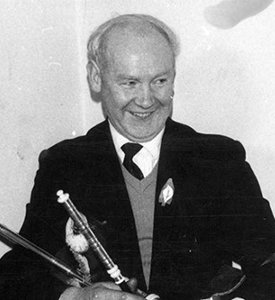
Liam O’Flynn, Irish uilleann piper and Irish traditional musician, is born on September 15, 1945, in Kill, County Kildare. In addition to a solo career and as a member of Planxty, he records with Christy Moore, Dónal Lunny, Andy Irvine, Kate Bush, Mark Knopfler, The Everly Brothers, Emmylou Harris, Mike Oldfield, Mary Black, Enya and Sinéad O’Connor.

O’Flynn is acknowledged as Ireland’s foremost exponent of the uilleann pipes and brings the music of the instrument to a worldwide audience. In 2007, he is named TG4 Musician of the Year at the Gradam Ceoil TG4, considered to be the foremost recognition given to traditional Irish musicians.

O’Flynn is born to musical parents. His father, Liam, is a teacher and fiddle player. His mother, Maisie (née Scanlan), who comes from a family of musicians from County Clare, plays and teaches piano. From an early age, he shows musical talent, and is encouraged to pursue his interest in the uilleann pipes by the piper Tom Armstrong. At the age of 11, he begins taking classes with Leo Rowsome. He is also influenced by Willie Clancy and Séamus Ennis. In the 1960s, he begins to receive recognition of his talent, winning prizes at the Oireachtas na Gaeilge and the Fleadh Cheoil. During his early years, he is sometimes billed as Liam Óg Ó Flynn.

In 1972, O’Flynn co-founds the Irish traditional music group Planxty, alongside Christy Moore, Andy Irvine and Dónal Lunny and remains a member throughout the band’s various incarnations. While Seán Ó Riada and The Chieftains had reinvigorated Irish traditional instrumental music in an ensemble format during the 1960s, Planxty builds on that foundation and takes it one step further. They bring a punch and vitality to acoustic music that draws heavily on O’Flynn’s piping virtuosity.

As O’Flynn grows in his skill as a musician and as he begins to meet pipers like Willie Clancy and Séamus Ennis, he becomes acutely aware of his position in the tradition of piping. His subsequent close friendship with Ennis, which starts as a master/pupil relationship, teaches him that there is much more to being a piper than playing tunes. He notes, “Seamus Ennis gave me much more than a bag of notes.”

“When I’m playing, I’m certainly lost within it. The only way to describe it, is that it’s like looking inwards. I think when a performer engages with the audience, and vice versa, it’s like a spell is cast and a terrific passage of feelings moves from the musician to the audience and back again.”

Following the break-up of Planxty in 1983, O’Flynn finds work as a session musician with such prominent artists as The Everly Brothers, Enya, Kate Bush, Nigel Kennedy, Rita Connolly, and Mark Knopfler. He also works on film scores, including Kidnapped (1979) and A River Runs Through It (1992). He is adventurous enough to work with avant-garde composer John Cage, but his most natural alliance is with neo-romantic composer Shaun Davey.

The Bothy Band are natural successors to the original Planxty, and one of its members, Matt Molloy, who subsequently joins The Chieftains, plays with The Chieftains’ fiddler Seán Keane on O’Flynn’s album, The Piper’s Call, which is performed in the 1999 BBC Proms season at the Royal Albert Hall. He also works on projects with Seamus Heaney, mixing poetry with music.

O’Flynn’s name is mentioned in Christy Moore’s song “Lisdoonvarna.”

O’Flynn dies in a Dublin hospital on March 14, 2018, following a long illness. His cremated remains rest at Newlands Cross Cemetery and Crematorium in Dublin.

The Liam O’Flynn Award is awarded each year by the Arts Council and the National Concert Hall to recognise individual creativity in Traditional Irish music. Awardees include Úna Monaghan, Barry Kerr, Jack Talty, Louise Mulcahy and Strange Boy (aka Jordan Kelly).

2 Comments

Death of Uilleann Piper Willie Clancy

willie-clancy

Willie Clancy, uilleann piper and folklorist, dies in Galway, County Galway on January 24, 1973.

Clancy is born into a musical family in the outskirts of Milltown Malbay, County Clare on December 24, 1918. His parents, Gilbert Clancy and Ellen Killeen, both sing and play concertina, and his father also plays the flute. Clancy’s father has been heavily influenced by local blind piper Garret Barry and passes much of Barry’s music on to Willie.

Clancy starts playing the tin whistle at age five, and later takes up the flute. He first sees a set of pipes in 1936 when he sees Johnny Doran playing locally. He obtains his first set of pipes two years later. His influences include Leo Rowsome, Séamus Ennis, John Potts and Andy Conroy. Clancy wins the Oireachtas competition in 1947. Unable to earn a living from music he emigrates to London where he works as a carpenter.

Returning to Milltown Malbay in 1957 he records some influential 78 rpm recordings for the Gael Linn label, among them the classic reel selection “The Old Bush/The Ravelled Hank of Yarn.” The next decades he stayed in Milltown Malbay. He marries Dóirín Healy in 1962.

Willie Clancy dies suddenly at the early age of 55 on January 24, 1973, leaving a great void. Cór Cúl Aodha sings at his funeral mass, just as Clancy had played at Seán Ó Riada’s funeral only a year earlier. Others who take part include Seán Ach Donnchadha, John Kelly and Séamus Ennis. His funeral cortege to Ballard Cemetery is led by pipers from the Tulla Pipe Band.

The Willie Clancy Summer School is established in his honour in 1973, by Clancy’s friends Junior Crehan, Martin Talty, Seán Reid, Paddy Malone, Paddy McMahon, Frankie McMahon, Jimmy Ward, JC Talty, Harry Hughes, Michael O Friel, Séamus Mac Mathúna and Muiris Ó Rócháin. He is also the subject of a major television documentary “Cérbh É? Willie Clancy” on TG4, first broadcast in November 2009. In this programme, one of a series in which major figures in contemporary traditional music, profile and pay homage to a master of their craft from a bygone age, Peter Browne traces the life and legacy of Clancy.

(Photo courtesy of Mick O’Connor, flute player and friend of Willie Clancy)


Leave a comment

Birth of Uilleann Piper Willie Clancy

willie-clancy

Willie Clancy, an Irish uilleann piper, is born into a musical family at Islandbawn near Milltown Malbay, County Clare, on December 24, 1918.

Clancy’s parents, Gilbert Clancy and Ellen Killeen, both sing and play concertina, and his father also plays the flute. Clancy’s father has been heavily influenced by local blind piper Garret Barry and passes much of Barry’s music on to his son.

Clancy starts playing the whistle at age five, and later takes up the flute. He first lays eyes on a set of pipes in 1936 when he sees Johnny Doran playing locally. He obtains his first set of pipes two years later. His influences include Leo Rowsome, Séamus Ennis, John Potts, and Andy Conroy. Clancy wins the Oireachtas competition in 1947. Unable to earn a living from music he emigrates to London where he works as a carpenter.

Returning to Milltown Malbay shortly after the death of his father in 1957, Clancy records some influential 78 rpm recordings for the Gael Linn label, among them the classic reel selection “The Old Bush/The Ravelled Hank of Yarn.” He develops a highly distinctive and individual style of piping. From 1957 until 1972 the Summer music sessions in the West Clare town become widely renowned, with Clancy as one of the main attractions. Pipe-making, reed-making, and all things connected with the instrument are explored and advanced by the Clancy influence. He gives many performances on both radio and television as well as live sessions in his local area.

He lives out the remainder of his life in Milltown Malbay. Clancy marries Dóirín Healy in 1962. He dies suddenly in a hospital in Galway on January 24, 1973, and is widely mourned among friends and musicians alike. He is buried in Ballard Cemetary just outside Miltown Malbay.

Later that year the Willie Clancy Summer School is established in his honour by his friends Junior Crehan, Martin Talty, Sean Reid, Paddy Malone, Paddy McMahon, Frankie McMahon, Jimmy Ward, JC Talty, Harry Hughes, Michael O Friel, Séamus Mac Mathúna, and Muiris Ó Rócháin. He is also the subject of a major television documentary “Cérbh É? Willie Clancy” on TG4, first broadcast in November 2009. In this programme, one of a series in which major figures in contemporary traditional music, profile and pay homage to a master of their craft from a bygone age, Peter Browne traces the life and legacy of Clancy.

A statue of Clancy is unveiled on November 9, 2013 on the Main Street in Miltown Malbay.