
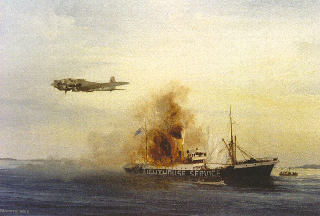
 The Irish lightship tender SS Isolda, which is resupplying lighthouses off the coast of County Wexford, is bombed and sunk by a German Focke-Wulf Fw 200 Condor on December 19, 1940 despite Irish neutrality. Six sailors are killed.
The lightships provide a vitally important service to maritime traffic for over two centuries. People live aboard these ships that anchor stationary at sea, providing a beacon in the dark for vessels that navigate the more treacherous parts of the Irish coast. These ships are faithfully assisted by ships that resupply them and facilitate crew changes. The SS Isolda is one such ship.
Danger in the waters around Ireland greatly increase during World War II. The Battle for the Atlantic is raging and Ireland’s location near important shipping lanes places Irish vessels right in the middle of a conflict zone. As a result, many casualties are incurred on Irish ships despite their position of neutrality.
The SS Isolda is a lightship tender owned by the Commissioners of Irish Lights. The lightship service is considered neutral and the ship has “Lighthouse Service” painted in large letters on both sides of the hull.
On December 19, 1940 she sails out from Rosslare Harbour heading to re-supply nearby lightships with relief crews and Christmas provisions. After placing the first crew at the lightship Barrels she then heads towards her next stop, the lightship Coningbeg. She does not make it very far as three miles out she is attacked from the air.
A German Condor flies over and drops the first bomb on the ship. The plane circles around and drops a second bomb, sealing the ships fate. Realising the SS Isolda is doomed, Captain Albert Bestic gives orders to abandon ship. Back on shore observers at the army lookout post at Carnsore Point look on helplessly at the carnage. The next day the German High Command admits that it is a German aircraft that had bombed the SS Isolda.
Survivors are picked up by boat and brought into Kilmore Quay, County Wexford. Six of the crew die and seven are wounded. Captain Bestic is among the survivors. This is not his first brush with death as he survived the sinking of the ill-fated RMS Lusitania 25 years earlier when it was torpedoed by a German U-boat.
(From: “Remembering the SS Isolda and her crew | Lost December 19th 1940” by Ann Robinson, December 19, 2017, http://coastmonkey.ie/ss-isolda-1940 | Pictured: The Ship – SS Isolda being bombed – Painting By Kenneth King)

 seamus dubhghaill