
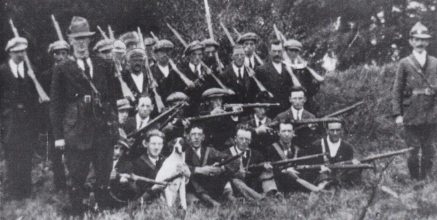
The Dromkeen ambush takes place on February 3, 1921, during the Irish War of Independence, at Dromkeen, County Limerick, when the Irish Republican Army (IRA) ambushes a Royal Irish Constabulary (RIC) patrol, killing eleven policemen.
In late January, Richard O’Connell, commander of the Mid Limerick Brigade flying column, along with Captains Sean Lynch and Morgan Portley, begin planning an ambush of an RIC convoy from the Pallas RIC headquarters. Observing their activities for several months, local Volunteer John Purcell, of Caherconlish, finds that the first Thursday of each month they send a convoy to Fedamore with the payroll for RIC constables there, about eleven miles away. They also seem to use the same route each time. Such predictability is often a fatal flaw in a guerrilla war. The ambush is set for February 3.
The ambush is carried out by the flying columns of the East Limerick and Mid Limerick Brigades of the IRA, some forty riflemen, under the command of Donnocha O’Hannigan, commander of East Limerick Brigade flying column, and Richard O’Connell, commander of the Mid Limerick Brigade flying column.
The ambush location is well selected. The lorries are to come from the west. There is a severe right-hand turn at Dromkeen House, where the road turns east for several hundred yards in a straight line, to an intersection that splits to the north and south. O’Hannigan puts D. Guerin, Sean Stapleton, and Maurice Meade, all of East Limerick Brigade, at the corner to be the lookouts for the convoy. There are low stonewalls along both sides of most of the road. About halfway down its length there is a cemetery and an old, ruined church on the south side.
O’Hannigan spreads his men along both sides of the road, behind the walls and in several homes along the road and sets up barricades on the forks on the eastern end of the ambush, set back so the driver will not see them until they get to the intersection. He takes up a command position in an old, ruined cottage at the intersection. In addition to O’Hannigan, John MacCarthy, David Clancy and a few other East Limerick Volunteers are in the ruined cottage.
At approximately 2:30 p.m. the lookouts near Dromkeen House let them know the lorries are approaching. The plan is to let the lead lorry reach the barricade before they open fire, expecting them to be widely spaced. They are closer together than expected, however, and the men lining the road and near Dromkeen House open fire first at the second lorry when it is near the ruins of the old church to prevent it being getting beyond them. Michael Hennessy, of the Kilfinane Company of the East Limerick Brigade, in a spot near one of the walls, later says he killed the driver of the second lorry, Constable Sidney Millin, on his first shot. Millin may have had his foot on the brake at that moment, as the lorry almost immediately stops in the middle of the road.
The sound of the firing causes the lead lorry to speed up. Turning to the left and seeing one barricade, the driver tries to turn to the right, but is going too fast. He runs into the wall and then slams into a donkey cart with a bog of flour in it, sending a cloud of flour into the air and coming to a halt.
The cloud of flour, along with the fact that they are the only RIC members in civilian clothes, apparently saves the lives of two RIC men, Constable Cox and District Inspector Sanson, who was in charge of the convoy, who are thrown clear of the cab. By the time the cloud of flour clears, two men in civilian clothes are seen running through the field. Given that Crown Forces have been known to have civilian hostages in their lorries, O’Hannigan had his men hold their fire for fear of killing a hostage, and the two escape. Many of the Volunteers later speak of Sanson with scorn for abandoning his men.
All the Volunteer participants say the firing only lasts about ten minutes, with the RIC and Black and Tans able to mount very little resistance before all eleven left in the two lorries are either dead or wounded. Of the three remaining in the first lorry, one is apparently killed very quickly by rifle fire and several grenades. The other two manage to get out and take cover but are quickly hit.
Two constables managed to get underneath the second lorry. They put up a short resistance before both are hit and killed by Volunteers Johnny Vaughan and Seán Carroll, who move into positions along the road. The only Volunteer casualty is Liam Hayes, who is later a general in the Free State Army. He has part of his left thumb and part of a finger shot off, probably by friendly fire. As the firing ends, the Volunteers come out from cover to collect the arms from the dead and wounded.
It has been claimed that three of the RIC dead were executed after they had surrendered. Particular suspicion for this alleged killing of prisoners has fallen on Maurice Meade, a former British soldier who was captured by the Germans in World War I and had joined Roger Casement‘s Irish Brigade. In reprisal, British forces burn ten homes and farms in the area.
In February 2009, up to 2,000 people turn out for the unveiling of a memorial to the ambush.
(From: “The Dromkeen Ambush: Down Into the Mire in County Limerick” by Joee Gannon, The Wild Geese, http://www.thewildgeese.irish, November 2017 | Pictured: The East Limerick Flying Column)

 seamus dubhghaill