seamus dubhghaill

Promoting Irish Culture and History from Little Rock, Arkansas, USA


Leave a comment

Birth of Mal Donaghy, Former Northern Ireland Footballer

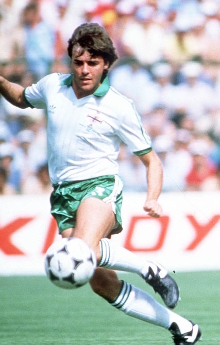
Malachy Martin Donaghy, former Northern Ireland international footballer who also plays for Luton Town F.C. and Manchester United F.C., is born in Belfast, Northern Ireland, on September 13, 1957. He is the manager of the Northern Ireland national under-19 football team from 2000-2008.

Originally from west Belfast, Donaghy begins his football career as a goalkeeper with little-known Down and Connor League side team St. Agnes before moving on to play as an outfield player for works team Post Office Social Club. After barely six months, he is on the move again, this time joining Amateur League side Cromac Albion, where his blossoming talent is spotted by then Larne F.C. boss Brian Halliday.

Donaghy’s rapid rise in the game continues when, after just 20 matches with the Inver Park club, he is transferred to Luton Town F.C. in June 1978 for a fee of £20,000.

Donaghy spends ten years at Luton Town F.C., overseeing the most successful era of their history to date. He collects a Second Division title winner’s medal in 1982, enabling him to experience First Division football for the first time. He helps Luton Town F.C. retain their First Division status and is a key part of the team that finishes a club record high of seventh in the 1986–87 season. In 1987–88, he helps Luton Town F.C. win their first major trophy as they achieve a shocking 3–2 win over Arsenal F.C. in the 1988 Football League Cup Final.

In October 1988, Donaghy departs from Kenilworth Road in a £650,000 move to his boyhood heroes Manchester United F.C. It is at the time a big risk for Alex Ferguson to pay out a large sum of money for a 31-year-old, but Donaghy repays the United manager’s faith in him with some consistent performances in not only his favoured central defensive position but also as a full-back.

Immediately after joining United, Donaghy is the club’s first choice left-back for the 1988–89 season, missing only the League Cup game for which he is cup-tied. However, his opportunities are limited in the 1989–90 season, and he is unable to make even the substitutes bench for the 1990 FA Cup final triumph over Crystal Palace F.C. However, he does make the substitutes bench for the 1991 European Cup Winners’ Cup final triumph.

United are First Division runners-up in 1991–92 and win their first-ever League Cup, but Donaghy’s first-team chances continue to be restricted, and he is also left out of the side that beats Nottingham Forest F.C. in the League Cup final.

Donaghy’s next move is in August 1992 when, just a month short of his 35th birthday, Chelsea F.C. manager Ian Porterfield pays £100,000 for his services. He helps Chelsea finish 11th in the inaugural Premier League season and helps them reach the 1994 FA Cup final, although he does not make the squad for the team that loses 4–0 to double-winners Manchester United F.C. At the end of the season, he announces his retirement from club football.

Donaghy makes his final appearance for Northern Ireland against the Mexico national football team in Miami in June 1994, three months before his 37th birthday.

Shortly after his playing career ends, Donaghy returns to the province with his family and after a brief spell as manager at Newry City F.C., he has stints as a coach with Cliftonville F.C. and as a Youth Development Officer back on his home pitch with Donegal Celtic F.C. In 2000, he is appointed manager for the Northern Ireland national under-19 team. He serves in this capacity until 2008.

The first of Donaghy’s 91 international caps comes in May 1980 at Windsor Park in the 1–0 British Home Championship victory over Scotland. He further enhances his reputation during the 1982 and 1986 World Cup finals. In the former tournament, he plays in four of Northern Ireland’s five games. He is sent off after 60 minutes of the famous 1–0 win over Spain in Valencia, for the offence of shoving Spain’s José Antonio Camacho, but returns for Northern Ireland’s final match, a 4–1 defeat by France in Madrid.

Leave a comment

Pat Jennings Becomes First to Make 1,000 Senior Appearances

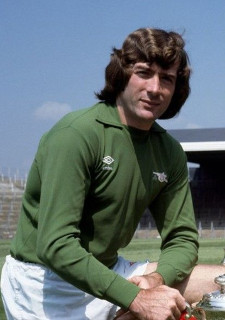
On February 26, 1983, Northern Irish footballer Pat Jennings becomes the first player in English football to make 1,000 senior appearances, celebrating this milestone with a clean sheet in a goalless league draw for Arsenal at West Bromwich Albion.

Jennings is born in Newry, County Down, Northern Ireland on June 12, 1945. After playing for Shamrock Rovers‘ under-18 side at the age of 11, he concentrates on Gaelic football until he is sixteen years old, when he makes his soccer comeback with his hometown side Newry Town. After impressing with the team, he moves to English Third Division side Watford in May 1963. He again impresses in his first season in England, playing every league game for his club. He makes his international debut with the Northern Ireland national football team at the age of eighteen while playing for Watford. This game, on April 15, 1964, is a British Home Championship match against Wales, with Northern Ireland winning the game 3–2. George Best makes his international debut in the same game. Jennings is signed by Tottenham Hotspur for £27,000 in June 1964.

Jennings spends thirteen years at White Hart Lane, where he plays in 472 league games for Spurs, and 591 in all competitions. He wins the FA Cup in 1967, the League Cup in 1971 and 1973, and the UEFA Cup in 1972. In the 1967 Charity Shield he scores once from his own area, kicking the ball from his hands and sending a large punt down the field that bounces over Manchester United goalkeeper Alex Stepney and into the net. In 1973 the Football Writers’ Association names him as its footballer of the year. Three years later he wins Professional Footballers’ Association‘s version of the award, the first goalkeeper to receive this accolade, and to this date remains only one of two, along with Peter Shilton.

In August 1977, he is transferred to Tottenham’s arch-rivals, Arsenal, with Tottenham thinking he is nearing the end of his career. However, he sees off rivals for the goalkeeper’s jersey to play for Arsenal for another eight years. While at Highbury, he helps Arsenal to four Cup finals in three successive years, the FA Cup final in 1978, 1979, and 1980, as well as the European Cup Winners’ Cup final that year. However, Arsenal only manages to win the second of these finals, a 3–2 victory against Manchester United. In total, he makes 327 appearances for Arsenal, 237 of them in the League, between 1977 and his eventual retirement from first-team club football in 1985.

Despite his retirement from club football in 1985, Jennings returns to Tottenham Hotspur, playing mostly in their reserve side to maintain his match sharpness for Northern Ireland’s 1986 FIFA World Cup campaign. He plays his final international game at the 1986 World Cup, on his 41st birthday, making him at the time the World Cup’s oldest-ever participant. The match is Northern Ireland’s final group game, a 3–0 defeat against Brazil. In total, he participates in the qualifying stages of six World Cups between 1966 and 1986.

Jennings final appearance for Tottenham is in the Football League Super Cup against Liverpool in January 1986. He is also briefly on Everton‘s books, having been signed as goalkeeping cover for the 1986 FA Cup Final against Liverpool, Neville Southall having been injured playing for Wales.

Jennings works as a goalkeeping coach at Tottenham since 1993. In 2003 he is inducted into the English Football Hall of Fame in recognition of the skills he demonstrated in the English league. He and his family have lived for many years in Broxbourne, Hertfordshire, where his son attended The Broxbourne School along with the sons of fellow Spurs players Chris Hughton, Osvaldo Ardiles and Ray Clemence. He is still associated with the Spurs and hosts Corporate Hospitality fans in the Pat Jennings Lounges at White Hart Lane and Windsor Park, Belfast.


Leave a comment

Birth of Pat Jennings, Northern Ireland Footballer

pat-jennings

Patrick Anthony Jennings, Northern Irish footballer, is born in Newry, County Down, Northern Ireland on June 12, 1945. He plays 119 games for Northern Ireland as a goalkeeper, a figure which at the time is a world record and is still a Northern Ireland record, in an international career which lasts for over 22 years.

After playing for the Shamrock Rovers F.C. under-18 squad at the age of 11, Jennings concentrates on Gaelic football until he is sixteen years old, when he makes his soccer comeback with his hometown Newry City F.C. After impressing with the team, he moves to English Third Division Watford F.C. in May 1963. He again impresses in his first season in England, playing every league game for his club, and making two international appearances that season. He is signed by Tottenham Hotspur F.C. for £27,000 in June 1964.

Jennings spends thirteen years at White Hart Lane, where he plays in 472 league games for the Spurs, and 591 in all competitions. He wins the FA Cup in 1967, the League Cup in 1971 and 1973, and the UEFA Cup in 1972. In 1973 the Football Writers’ Association name him as its footballer of the year. Three years later he wins the Professional Footballers’ Association‘s (PFA) version of the award, the first goalkeeper to receive this accolade.

In August 1977, Jennings is transferred to Tottenham’s arch-rivals, Arsenal F.C., with Tottenham thinking he is nearing the end of his career. However, Jennings plays for Arsenal for another eight years where he helps Arsenal to the FA Cup final in 1978, 1979, and 1980, as well as the UEFA Cup Winners’ Cup final that year. However, Arsenal only manages to win the second of these finals, a 3–2 victory against Manchester United F.C. In total, Jennings makes 327 appearances for Arsenal between 1977 and his eventual retirement from first-team club football in 1985. On February 26, 1983, he becomes the first player in English football to make 1,000 senior appearances, celebrating this milestone with a clean sheet in a goalless league draw for Arsenal at West Bromwich Albion F.C.

After his retirement, Jennings returns to Tottenham Hotspur, playing mostly in their reserve side to maintain his match sharpness for Northern Ireland’s 1986 FIFA World Cup campaign. His final appearance for Tottenham is in the Football League Super Cup against Liverpool F.C. in January 1986. He also plays briefly for Everton F.C., having been signed as goalkeeping cover for the 1986 FA Cup Final against Liverpool.

Despite retiring from club football in 1985, Jennings plays his final international game at the 1986 FIFA World Cup, on his 41st birthday, making him at the time the World Cup’s oldest ever participant. The match is Northern Ireland’s final group game, a 3–0 defeat against Brazil. In total, he participates in the qualifying stages of six World Cups between 1966 and 1986.

Following his retirement Jennings works as a goalkeeping coach. In 2003 he is inducted into the English Football Hall of Fame in recognition of the skills he demonstrated in the English league. His son, also named Pat, is also a goalkeeper. He has played for League of Ireland clubs University College Dublin A.F.C., Derry City F.C., Shamrock Rovers and NIFL Premiership club Glenavon F.C.

Jennings and his family have lived for many years in Broxbourne, Hertfordshire, where his son attended The Broxbourne School along with the sons of fellow Spurs players Chris Hughton, Osvaldo Ardiles and Ray Clemence. He is still associated with the Spurs and hosts Corporate Hospitality fans in the Pat Jennings Lounges at White Hart Lane and Windsor Park, Belfast.