seamus dubhghaill

Promoting Irish Culture and History from Little Rock, Arkansas, USA


Leave a comment

Birth of Frank Duff, Lay Catholic & Author

Francis Michael Duff, Irish authorlay Catholic and founder of the Legion of Mary, known for bringing attention to the role of the Catholic laity during the Second Vatican Council of the Roman Catholic Church, is born at 97 Phibsboro Road, Dublin, on June 7, 1889.

Duff is the eldest of seven children of John Duff, a civil servant with the local government board, and his wife, Susan Letitia (née Freehill), a civil servant with the post office. The wealthy family lives in the city at St. Patrick’s Road, Drumcondra. He attends Blackrock College.

In 1908, Duff enters the Civil Service and is assigned to the Irish Land Commission. In 1913, he joins the Society of Saint Vincent de Paul and is exposed to the real poverty of Dublin. Many who live in tenement squalor are forced to attend soup kitchens for sustenance, and abject poverty, alcoholism, street gangs, and organized prostitution are rife in parts of Dublin. He joins and soon rises through the ranks to become President of the Saint Patrick’s Conference at Saint Nicholas of Myra Parish. Having concern for people he sees as materially and spiritually deprived, he has the idea to picket Protestant soup kitchens as he considers they are giving aid in the form of food and free accommodation at hostels, in return for not attending Catholic services. He sets up rival Catholic soup kitchens and, with his friend, Sergeant Major Joe Gabbett, who has already been working at discouraging Catholics from patronizing Protestant soup kitchens. They succeed in closing down two of them over the years.

In 1916, Duff publishes his first pamphlet, Can we be Saints?, where he expresses the conviction that all are called to be saints without exception, and that through Christian faith, all have the means necessary.

In 1918, a friend gifts Duff a copy of the book True Devotion to Mary by the seventeenth-century French cleric Louis de Montfort, which influences his views on Mary. He is additionally influenced by the writings of John Henry Newman.

Duff briefly acts as private secretary to Michael Collins, then-Chairman of the Provisional Government and commander-in-chief of the National Army. In 1924, he is transferred to the Department of Finance.

On September 7, 1921, along with Fr. Michael Toher and fifteen predominantly young women, he is present at the first meeting of the association which he would forge as the Legion of Mary. He models the Legion on the Roman legions, naming the local unit the “praesidium,” and he immerses himself in the apostolic work which dominates the rest of his life.

In 1922, Duff establishes the Sancta Maria hostel in Dublin as a refuge for prostitutes, and is the driving force behind the closure of “Monto,” Dublin’s notorious red-light district. In 1927, he establishes the Morning Star hostel for homeless men in Dublin, and in 1930 the Regina Coeli hostel for homeless women, which provides special units for unmarried mothers and their children at a time when neither church nor state favour helping unmarried women to keep their children.

While Duff enjoys the support of W. T. Cosgrave, Ireland’s head of government, and in May 1931 is granted an audience with Pope Pius XI, his efforts are opposed internally in the Dublin diocese. In the 1930s and 1940s, he creates the Mercier Society, a study group designed to bring together Catholics and Protestants, as well as the Pillar of Fire, a group designed to promote dialogue between Irish Catholics with Ireland’s Jewish community.

Duff retires from the Civil Service in 1934 to devote all of his time to the Legion of Mary. For the rest of his life, with the help of many others, he guides the Legion’s worldwide extension.

In 1965, Pope Paul VI invites Duff to attend the Second Vatican Council as a lay observer. When he is introduced to the assembly by Archbishop John Heenan of Liverpool, he receives a standing ovation.

Duff makes the promotion of devotion to the Sacred Heart of Jesus part of the Legion’s apostolate.

Duff dies in Dublin at the age of 91 on November 7, 1980. He Is interred in Glasnevin Cemetery. In July 1996, the cause of Duff’s beatification is introduced by Cardinal Desmond Connell.

Today, the Legion of Mary has an estimated four million active members and 10 million auxiliary members in close to 200 countries in almost every diocese in the Catholic Church.

Leave a comment

Bus Éireann Strike Over Cost-Reduction Measures

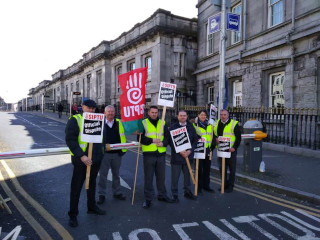
Tens of thousands of people have to make alternative travel arrangements on March 24, 2017 due to a strike at Bus Éireann over the company’s implementation of cost-reduction measures without union agreement. The bus and coach operator warns that the strike will worsen the company’s financial situation, which it describes as perilous.

Iarnród Éireann, the operator of the national railway network, says some Intercity services are affected by the dispute due to picketing. It says there is significant disruption, with some services cancelled and others curtailed. But Iarnród Éireann says special late-night trains for football fans returning from the Republic of Ireland vs. Wales match will operate to Cork, Limerick and Galway.

The Minister for Transport Shane Ross says that he will “categorically” not be intervening during the strike and calls on both sides to get back to the talks. He says an industrial relations dispute is not a matter for the minister and that both parties should go to the Workplace Relations Commission and the Labour Court for talks. He adds that the only reason people are calling on him to intervene is to pay taxpayers’ money and he says he will not be doing that. He says the company needs to reform and that can be done maturely through talks by the two sides.

Dublin Bus services operate as normal. GO-BE, the joint venture company between Bus Éireann and Go-Bus, suspends its services between Cork and Dublin and the Dublin Airport. While it is not meant to be affected by the dispute, it is understood there are issues at its base in Cork and the service is suspended. Aircoach, which has a sizable part of the market for the Cork to Dublin route, contracts ten buses from a private bus operator to meet the additional demand.

The general manager of the Irish Citylink private bus service says the company has increased their departures by 25% on the Dublin to Galway route and other services around the country to meet demands. Irish Citylink usually has 100 daily departures on services that include 14 different towns on the “off motorway route” to Dublin from Galway, but has around 25 additional buses out to meet demands.

The Services, Industrial, Professional and Technical Union (SIPTU) issues a number of steps to its members to assist in ending the strike by Bus Éireann workers. Earlier, a SIPTU official says the blame for the strike must be laid at the door of management and the Minister for Transport Shane Ross.

Divisional Organiser Willie Noone says staff had “no other choice” but to strike in an attempt to protect their livelihoods, but acknowledges that it is unfortunate for commuters. He says that the unions had worked hard to keep staff at work to this point given the anger at company proposals to cut pay.

National Bus and Rail Union General Secretary Dermot O’Leary says disputes such as that at Bus Éireann are solved by discussions sitting around a table behind closed doors and that is where his union would like to be. He acknowledges the strike will exacerbate financial problems at Bus Éireann, but says his members have demanded for many weeks this action be taken in response to what the company has done since January.

Stephen Kent, Chief Commercial Officer with Bus Éireann, apologises to customers for the “highly regrettable” inconvenience caused by the strike. He says the company has run out of time and absolutely needs to implement the cost-cutting measures it has put forward. He adds that the company is doing everything it can to minimise all non-payroll costs and has eliminated all discretionary spending and that the issues at Bus Éireann can only be resolved through discussion with the workforce but they need to deliver work practice changes that will deliver urgently needed savings.

The strike represents a serious escalation of the Bus Éireann row, which could push the company over the edge. It lost €9.4m in 2016 and a further €50,000 a day in January 2017. But each strike day will cost another half a million, which the company insists is unsustainable. Management says that it had to proceed with unilateral implementation of cuts due to the financial crisis, and because unions would not agree to any reductions in take-home pay or unnecessary overtime. However, the unions have accused the company of seeking to introduce so-called yellow-pack terms and conditions in a race to the bottom, to groom the company for privatisation.

The strike affects businesses as well as disrupts the travel plans of 110,000 passengers each day, though not all are stranded. The National Transport Authority reminds passengers that there are alternative private operators on many routes. If Bus Éireann passengers defect to them, they may never return, further damaging revenue at the State-owned company. No further talks are planned as of this date.