
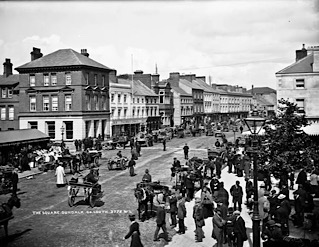
On September 15, 1922, in the context of the Irish Civil War, the Anti-Treaty Irish Republican Army (IRA) launches coordinated attacks on Free State troops in Dundalk, County Louth. These actions are part of a broader campaign by anti-Treaty forces to resist the newly established Irish Free State government, which has accepted the Anglo-Irish Treaty and is backed by the pro-Treaty National Army.
The Irish Civil War (June 28, 1922 – May 24, 1923) is fought between Pro-Treaty forces (led by Michael Collins and Arthur Griffith) who support the Anglo-Irish Treaty, creating the Irish Free State within the British Empire and Anti-Treaty IRA (led by Éamon de Valera and Liam Lynch) who reject the Treaty, seeing it as a betrayal of the 1919 Irish Republic.
By mid-1922, the Free State controls only Dublin and parts of the east, while anti-Treaty forces hold much of the south and west, including Cork, Limerick, and Waterford, forming the self-styled “Munster Republic.”
On September 15, 1922, Anti-Treaty IRA units in Dundalk attack Free State troops stationed in the area and seize control of the local power station, cutting off the town’s electricity supply.
This is a typical example of anti-Treaty tactics: using sabotage and localized attacks to disrupt Free State operations, weaken their hold on territory, and maintain control over key infrastructure. Such actions are part of a wider pattern of resistance in areas not yet recaptured by the National Army.
While Dundalk is not a major strategic city, the attack reflects the guerrilla and sabotage phase of the Civil War, which follows the Free State’s July–September 1922 offensive that retakes major towns in Munster and the west. The Free State’s victory in that offensive ends the conventional phase, but anti-Treaty forces continue to resist through hit-and-run raids, sabotage, and control of rural areas.
In summary, the Dundalk incident of September 15, 1922, is a localized but symbolic act of anti-Treaty resistance, illustrating the ongoing struggle to control infrastructure and disrupt Free State operations in the months after the decisive military phase of the Irish Civil War.
(Pictured: Dundalk, County Louth, in the early 20th century)

