seamus dubhghaill

Promoting Irish Culture and History from Little Rock, Arkansas, USA


Leave a comment

Repeal of the Declaratory Act 1719

The Declaratory Act 1719, which had given Great Britain the right to legislate for Ireland and had denied the appellate jurisdiction of the Irish House of Lords, is repealed on June 21, 1782.

An Act for the better securing the dependency of the Kingdom of Ireland on the Crown of Great Britain (long title) is an Act passed by the Parliament of Great Britain which declares that it has the right to pass laws for the Kingdom of Ireland, and that the British House of Lords has appellate jurisdiction for Irish court cases. It becomes known as the Declaratory Act, and opponents in the Irish Patriot Party refer to it as the Sixth of George I, from the regnal year it is passed. Legal and political historians have also called it the Dependency of Ireland on Great Britain Act 1719 or the Irish Parliament Act, 1719. Prompted by a routine Irish lawsuit, it is aimed at resolving the long-running dispute between the British and the Irish House of Lords as to which is the final court of appeal from the Irish Courts. Along with Poynings’ Law, the Declaratory Act becomes a symbol of the subservience of the Parliament of Ireland, and its repeal is long an aim of Irish statesmen, which is finally achieved for Anglican Irish as part of the Constitution of 1782.

In 1709, the Irish Court of Exchequer hears a lawsuit between Maurice Annesley and his cousin Hester Sherlock over which of them have the right to possession of certain lands at Naas, County Kildare. The court finds in Annesley’s favour. Mrs. Sherlock appeals to the Irish House of Lords which upholds her appeal. Annesley then invokes the long-disputed jurisdiction of the British House of Lords to hear appeals from the Irish courts, and that house pronounces in his favour. The Court of Exchequer duly complies with the decree of the British House, but Mrs. Sherlock appeals again to the Irish house, which orders the Barons of the Exchequer to comply with its own decree and, when they refuse, imprison them for contempt of Court. The political uproar is out of all proportion to the importance of the lawsuit itself.

The bill has its second reading in the Commons on March 4, 1719, where it is chiefly opposed on the grounds that it appears to have no purpose beyond increasing the power of the House of Lords. Other objections include an argument that the preamble and the enacting section of the bill are contradictory, and that Ireland has historically had an independent judiciary. It is supported by Joseph Jekyll and Philip Yorke, and carries 140 votes to 83. It is then passed on March 26, 1719.

Section I of the Act notes that the Irish House of Lords had recently “assumed to themselves a Power and Jurisdiction to examine, correct and amend” judgements of the Irish courts, which it holds to be illegal. As such, it declares that the Kingdom of Ireland is subordinate to and dependent upon the British crown, and that the King, with the advice and consent of the Parliament of Great Britain, has “full power and authority to make laws and statutes of sufficient validity to bind the Kingdom and people of Ireland.” Section II declares that the House of Lords of Ireland has no jurisdiction to judge, affirm or reverse any judgement, sentence or decree made in any court within the Kingdom of Ireland, and that all proceedings before the House upon any such matter are declared to be null and void to all intents and purposes whatsoever.

The Irish House of Lords is understandably infuriated by the curtailment of its powers, and the Barons of the Exchequer, though they are soon released from custody, are subject to intense vilification. While many people think that the Irish House of Lords had brought about the crisis by its own high-handed behaviour, the “Sixth of George I” remains a source of grievance for decades.

The Declaratory Act 1719 provides a model for the American Colonies Act 1766, which is also known as the “Declaratory Act” and is a similar source of grievance in the Thirteen Colonies. The British defeat in the subsequent American Revolutionary War prompts a more conciliatory tone towards Ireland, and the Declaratory Act 1719 is repealed in its entirety when the Repeal of Act for Securing Dependence of Ireland Act 1782 receives royal assent on June 21, 1782.
Leave a comment

Northern Ireland Opts Out of the Irish Free State

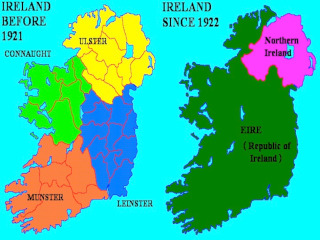
The six counties of what would become Northern Ireland opt out of the Irish Free State on December 7, 1922, and become a separate political entity with allegiance to England.

The Irish Free State Constitution Act 1922 (Session 2) is an Act of the Parliament of the United Kingdom, passed in 1922 to enact in UK law the Constitution of the Irish Free State, and to ratify the 1921 Anglo-Irish Treaty formally.

As originally enacted, the Irish Free State Constitution Act 1922 consists of a preamble, five sections (three of which are very brief), and a schedule. The schedule is the text of the Constitution of the Irish Free State (Saorstát Éireann) Act 1922, which had been passed in Ireland by the Third Dáil sitting as a constituent assembly and provisional parliament for the nascent Free State. This Irish Act itself has two schedules, the first being the actual text of the Constitution, and the second the text of the 1921 Treaty, formally the Articles of Agreement for a treaty between Great Britain and Ireland.

The Irish Act had been approved by the Irish constituent assembly on 25 October 25, 1922. The bill for the UK Act is introduced by the Prime Minister Bonar Law into the Parliament of the United Kingdom in November 1922. The bill’s third reading in the House of Commons is on November 30. The Act receives Royal assent on December 5, 1922.

On December 7, 1922, the day after the establishment of the Irish Free State, the Parliament of Northern Ireland addresses King George V requesting its secession from the Irish Free State. The address is unanimous, with the abstentionist Nationalist Party and Sinn Féin members absent. The King replies shortly thereafter to say that he has caused his Ministers and the Government of the Irish Free State to be informed that Northern Ireland is to do so.

After the Statute of Westminster 1931, the UK government recognises the right of the Irish government to amend or repeal the UK act, but in fact the Irish government does not do so until it is formally repealed as spent by the Statute Law Revision Act 2007. The Irish government amends the Irish act in 1933 and the 1937 Constitution of Ireland repeals the entire Free State constitution. The UK Judicial Committee of the Privy Council rules in 1935 that the 1933 Act had implicitly amended the UK Act with respect to the jurisdiction of the Free State. The Supreme Court of Ireland has taken the view that the Free State constitution was enacted by the Irish Act, not by the subsequent UK Act. This reflects the view of popular sovereignty rather than parliamentary sovereignty, with the constitution’s legitimacy ultimately springing from the 1922 Irish general election.


Leave a comment

The Octennial Act Receives Royal Assent

parliament-of-ireland

The Octennial Act, an act of the Parliament of Ireland which sets a maximum duration of eight years for the Irish House of Commons, receives royal assent on February 16, 1768. Before this, a dissolution of parliament is not required except on the demise of the Crown, and the previous three general elections were held in 1715, 1727, and 1761, on the respective deaths of Anne, George I, and George II. After the act, general elections are held in 1769, 1776, 1783, 1790, and 1798.

Limiting the duration of parliament is a prime objective of the Irish Patriot Party. Heads of bills are brought, by Charles Lucas in 1761 and 1763 and by Henry Flood in 1765, to limit parliament to seven years as the Septennial Act 1716 does for the Parliament of Great Britain. The heads are rejected by the Privy Council of Great Britain, which, under Poynings’ Law, has to pre-approve any bill before it is formally introduced in the Irish parliament.

Since the end of the Seven Years’ War in 1763, the British government has wished to increase the size of Irish regiments, the part of the British Army charged on the Irish exchequer rather than the British. In 1767, the Chatham Ministry appoints George Townshend, 4th Viscount Townshend, as Lord Lieutenant of Ireland and instructs him to secure the support of the Irish parliament for an Augmentation Bill to effect this increase. The British consider several possible concessions to win over the Irish Patriot Party, and at his speech from the throne, Townshend promises judicial tenure quamdiu se bene gesserint and hints at a Septennial Act.

Lucas again introduces heads of a Septennial Bill on October 20, 1767. Barry Maxwell introduces heads of a judicial tenure bill the same day. In November, the appointment of James Hewitt, 1st Baron Lifford, as Lord Chancellor of Ireland alienates the Undertakers who had hoped for the post. In addition, the British Privy Council adds a wrecking amendment to the judicial tenure bill, which causes the Irish parliament to reject the bill once returned to Dublin. The council also makes three amendments to Lucas’ bill – to the preamble, to extend the limit from seven to eight years, thus an Octennial Bill, and to bring forward the date of the next general election from 1774 to 1768. According to Francis Plowden, the Privy Council insists on the modification to eight years as a wrecking amendment, expecting that the Irish parliament will reject the bill on principle once any amendment has been made to it, and is disappointed when its amended bill is passed. William Edward Hartpole Lecky calls this “without foundation,” stating the actual reasons for eight years are that the Irish Parliament only meets every second year, and to reduce the chance of Irish and British general elections coinciding.

The Octennial Act reinvigorates the Commons, both with newly elected reformers and with MPs made more active by the prospect of imminent re-election. Changes include more assertiveness over supply bills and Poynings’ Law, easing the penal laws, and securing the Constitution of 1782. There are unsuccessful attempts to shorten the maximum duration, in 1773 by Sir William Parsons and in 1777 by Sir Edward Newenham.

The act is rendered moot when the Parliament of Ireland is abolished by the Acts of Union 1800. It is formally repealed by the Statute Law Revision (Ireland) Act 1879.