seamus dubhghaill

Promoting Irish Culture and History from Little Rock, Arkansas, USA


Leave a comment

Death of Edward Parry, Church of Ireland Bishop of Killaloe

Edward Parry, Church of Ireland Bishop of KillaloeCounty Clare, dies in Dublin on July 20, 1650, after contracting the plague.

Parry is born c. 1599 in Madyn Dyswy, AmlwchAnglesey, Wales, the son of Rhys Parry, a merchant of NewryCounty Down. The name of his mother is disputed. His siblings are Arthur, Grace and Magdalen. He is educated in Newry. In 1616, he enrolls as a student of Trinity College Dublin (TCD) where he graduates with a BA in 1620. He obtains his MA there in 1623 and a fellowship on November 24, 1624. In 1630 he graduates as a Doctor of Divinity and later becomes Pro-Vice-Chancellor of the college.

In Anglican politics Parry is regarded as a Laudian. In 1627, he is appointed Prebendary of Tipperkevin, a living belonging to St Patrick’s Cathedral, Dublin. In 1630, he is Incumbent of St. Bride’s Church, Dublin, where several of his children are baptised. In 1634, he is made Treasurer of Christ Church Cathedral, Dublin and chaplain to Lancelot BulkeleyArchbishop of Dublin. In 1635, he is appointed one of the High Commission for Ecclesiastical Causes. In 1636, he is appointed Prebendary of Stagonyl, another living belonging to St Patrick’s Cathedral, Dublin. By patent dated April 28, he is presented to St. Olave’s in Waterford where he is installed on May 11, but is also licensed to hold his other preferments at the same time. In 1640, he resigns from St. Olave’s and is appointed Dean of Lismore, County Waterford. Some of the Deanery lands had been seized by Richard Boyle, 1st Earl of Cork and Parry tries to get them back but fails. His successor as Dean of Lismore is his first cousin, Robert Parry. In 1643, he is Archdeacon of GlendaloughCounty Wicklow.

On December 29, 1646, King Charles I of England in a letter states he favours Parry for the See of the Diocese of Killaloe, County Clare. On March 20, 1647, a patent is issued confirming his appointment as Bishop of Killaloe and he is consecrated at Christ Church Cathedral, Dublin, on March 28, 1647, by Lancelot Bulkeley, Archbishop of Dublin, assisted by the Bishops of Kildare and Cloyne. However, as this is in the middle of the Irish Rebellion he was unable to travel to his diocese and remains in Dublin, where he resides in Chichester House, St. Stephen’s Street, which later houses the Parliament of Ireland. In the Hearth Money Rolls the house is assessed for eight hearths so is quite large. On July 9, 1647, he signs the petition of the clergy praying to be allowed the use of the Liturgy, then abolished by order of the commissioners under Oliver Cromwell. On account of his good character and the smallness of the revenues of Killaloe, the King permits him to hold his former preferments in commendam.

Parry marries the daughter of John Price and by her has six children, who are John Parry, Bishop of OssoryBenjamin Parry, Bishop of Ossory, Edward Parry, Robert Parry, Mary Parry who marries John Bulkeley, and Elinor Parry who is a love and correspondent of John Locke and later marries Richard Hawkshaw.

Parry dies in his house in St. Stephen’s Street on July 20, 1650, at the age of 51, after contracting the plague which rages there, and is buried in St. Audoen’s Church, Dublin. His will dated July 17, 1650, is proved in the Prerogative Court, Dublin. Its terms are: (1) his body is to be interred in St. Audeon’s Church near the doors, with his face to the east, where he also desires the body of his wife to be translated, and laid by his side, (2) he gives to his eldest daughter, Mary Parry, alias Bulkeley, a little silver watch, and her mother’s dear-head ring, (3) to his other daughter “Eleynor Parry” other ornaments that belonged to her mother, (4) to his sister “Madelius Evans” five pounds, (5) to other beneficiaries are given legacies out of the fifty pounds due to him by William Usher, (6) to his cousin, Robert Parry, he leaves his lexicon and other books, (7) to his cousin, Richard Parry, he leaves a gold ring, (8) to his cousin, Mary Parry, wife of Richard, he leaves a money legacy, and (9) he appoints his cousin, Robert Parry, as overseer of his will.

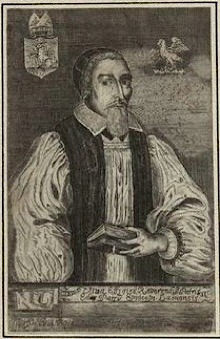
Parry writes a book entitled David restored; or an Antidote against the Prosperity of the Wicked, and the Afflictions of the Just, which is a sermon on the seventy-third Psalm. This is afterward published by his son, John Parry at Oxford in 1660. This work contains an engraved portrait of Edward Parry (above).

(Pictured: An engraved portrait by John Dickson of Dr. Edward Parry, Bishop of Killaloe, from a book authored by the bishop entitled “David restored; or an Antidote against the Prosperity of the Wicked, and the Afflictions of the Just”, published at Oxford in 1660.)

Leave a comment

Birth of Marmaduke Coghill, Member of Parliament

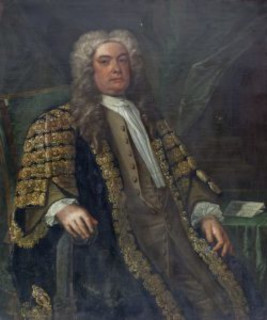
Marmaduke Coghill, member of Parliament for University of Dublin, judge of the prerogative court and Chancellor of the Exchequer of Ireland, is born in Dublin on December 28, 1673.

Coghill is the son of John Coghill of Knaresborough, North Yorkshire, judge of the prerogative court and one of the masters in chancery. His mother is the daughter of Tobias Cramer, of Ballyfoyle, County Kilkenny. Two elder sisters and a younger brother, James, survive infancy. He spends his childhood in Dublin.

Coghill occupies a prominent place in the life of Dublin, and is remarkable for his early display of ability. At the age of fourteen he enters the University of Dublin, graduating at the age of eighteen as a Bachelor of Laws. At the age of nineteen he is returned to Parliament and at the age of 26 he becomes judge of the prerogative court.

In Parliament, from 1692 to 1713 Coghill is a representative of the borough of Armagh, and from 1713 until his death in 1739, a representative of the University of Dublin. He is politically close to William Conolly, speaker of the Irish House of Commons, who dies in 1729. Upon Conolly’s death he succeeds him as a commissioner of the revenue. Over the following years he plays a prominent role in parliament, particularly on financial matters. He also builds up a close relationship with John Perceval, the British Prime Minister‘s chief advisor on Irish affairs.

Coghill becomes Chancellor of the Exchequer in 1735 and is regarded as an honest and able supporter of Irish interests. Outside parliament he is very active on boards, commissions and trusts, takes a hand in the building of Dr. Steevens’ Hospital and is pro-vice-chancellor of Trinity College Dublin. He lives in Belvedere House, now in the grounds of St. Patrick’s College, Dublin. He suffers from gout for a large part of his life.

From his father, Coghill, who never married, had inherited a lease from the Corporation of lands in Clonturk, where he erects a house which is afterwards known as Drumcondra House. He moves into Drumcondra House and lives there with his unmarried sister Mary until his death in 1738. He is buried in the family vault in St. Andrew’s Church, Dublin.

Upon Coghill’s death Mary is left, for her lifetime, his lands in the barony of Coolock, rents from his properties in Clonturk, all his household goods, and his coach, chariot and horses. In 1743, she erects the parish church of Clonturk, now Drumcondra Church, and places in it a statue of her brother by the Dutch sculptor Peter Scheemakers.


Leave a comment

Birth of Lawyer & Politician Philip Tisdall

philip-tisdall

Philip Tisdall, lawyer and politician who is a leading figure in the Irish Government for many years, is born on March 1, 1703, in County Louth.

Tisdall is the son of Richard Tisdall, who is MP for Dundalk in 1703–1713 and for Louth in 1717–1727, by his wife Marian Boyle, daughter of Richard Boyle, MP, a cousin of the Earl of Cork. His father is also Registrar of the Court of Chancery.

Tisdall is educated at Thomas Sheridan‘s school in Dublin, and at the University of Dublin, where he graduates Bachelor of Arts in 1722. He enters Middle Temple in 1723 and is called to the Irish Bar in 1733.

In 1736 he marries Mary Singleton, daughter of the Rev. Rowland Singleton and Elizabeth Graham, and niece and co-heiress of Henry Singleton, Chief Justice of the Irish Common Pleas, a marriage which brings him both wealth and influence. He quickly becomes one of the leaders of the Bar, partly through his legal ability and partly through his marriage into the wealthy and influential Singleton family. He is made a Bencher of the King’s Inns in 1742.

He sits in the Irish House of Commons as MP for Dublin University from 1739 to 1776 and then for the city of Armagh from 1776 until his death. He is elected as member for Armagh in 1768 but chooses to continue sitting for the University.

In 1742 Tisdall is appointed Third Serjeant, then Solicitor-General in 1751 and Attorney-General in 1760. He is also appointed judge of the Prerogative Court of Ireland, an office he holds from 1745 until his death. In 1763 he becomes Principal Secretary of State, and on February 28, 1764, he is appointed to the Privy Council of Ireland. For almost 20 years he is a crucial figure in the Irish Government, which relies on him on to manage the Irish House of Commons, a task which he performs with great skill and tact. Tisdall is almost all-powerful until 1767, when George Townshend, 1st Marquess Townshend, arrives as Lord Lieutenant of Ireland. Townshend has a mandate to restore the direct power of the Crown over Irish affairs and to bypass the Irish managers like Tisdall. To his credit, Townshend recognises that Tisdall’s support is still an asset to the Government and makes great efforts to conciliate him. Townshend lobbies hard for Tisdall to be appointed Lord Chancellor of Ireland, but comes up against the inflexible British reluctance, then and for many years after, to appoint an Irishman to this crucial office. He retains the confidence of successive Lords Lieutenants. In 1777, despite his age and failing health, he is asked to resume his role as Government leader in the House of Commons. He agrees, but dies at Spa, Belgium on September 11 of the same year.

Tisdall is strikingly dark in complexion, hence his nicknames “Black Phil” and “Philip the Moor,” and is described as “grave in manner and sardonic in temper.” Despite his somewhat forbidding appearance, he is a hospitable character, who is noted for entertaining lavishly, even when he is well into his seventies, both at his town house in South Leinster Street, and his country house at Stillorgan. John Scott, 1st Earl of Clonmell, who succeeds him as Attorney General, writes that Tisdall would have lived longer if he had adopted a more sedate lifestyle in his later years.