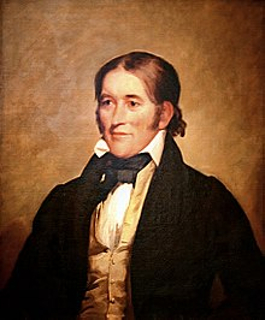
The Crockett family is of mostly French–Huguenot ancestry, although the family settles in Ireland before migrating to the Americas. Crockett is born in what is now Greene County, Tennessee (at the time part of North Carolina), close to the Nolichucky River and near the community of Limestone. He grows up in East Tennessee, where he gains a reputation for hunting and storytelling.
Crockett is made a colonel in the militia of Lawrence County, Tennessee and is elected to the Tennessee state legislature in 1821. In 1827, he is elected to the United States Congress where he vehemently opposes many of the policies of President Andrew Jackson, especially the Indian Removal Act. His opposition to Jackson’s policies leads to his defeat in the 1831 elections. He is re-elected in 1833, then narrowly loses in 1835, prompting his angry departure shortly thereafter to Texas, then the Mexican state of Tejas.
All that is certain about the fate of Crockett is that he dies fighting in the Battle of the Alamo in the Texas Revolution on the morning of March 6, 1836. According to many accounts, between five and seven Texans surrender during the battle, possibly to General Manuel Fernández Castrillón. General Antonio López de Santa Anna has ordered the Mexicans to take no prisoners, and he is incensed that those orders have been ignored. He demands the immediate execution of the survivors, but Castrillon and several other officers refuse to do so. Staff officers who had not participated in the fighting draw their swords and kill the unarmed Texians.
Crockett becomes famous during his lifetime for larger-than-life exploits popularized by stage plays and almanacs. After his death, he continues to be credited with acts of mythical proportion. In the 20th century these lead to television and movie portrayals, and he becomes one of the best-known American folk heroes.
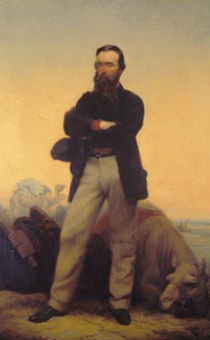
Burke is the second of three sons of James Hardiman Burke, an officer in the British army 7th Royal Fusiliers, and Anne Louisa Burke (nee O’Hara).
Burke enters the Royal Military Academy, Woolwich in May 1835. In December 1836 he fails his probationary exam and goes to Belgium to further his education. In 1841, he enters the Austrian army and spends most of his time posted to northern Italy. Towards the end of 1847 he suffers health problems and ultimately resigns from the Austrian army in June 1848.
After returning to Ireland in 1848, he joins the Irish Constabulary (later the Royal Irish Constabulary). He does his cadet training at Phoenix Park Depot in Dublin between November 1849 and January 1850. At the end of 1850 he transfers to the Mounted Police in Dublin.
Burke emigrates to Australia, arriving in Hobart, Tasmania on February 12, 1853, and promptly sails for Melbourne. On April 1, 1853, he joins the recently established Victoria Police force.
After the South Australian explorer John McDouall Stuart reaches the centre of Australia, the South Australian parliament offers a reward of £2,000 for the promotion of an expedition to cross the continent from south to north, generally following Stuart’s route. In June 1860, Burke is appointed to lead the Victorian Exploring Expedition with William John Wills, his third-in-command, as surveyor and astronomical observer.
The expedition leaves Melbourne on August 20, 1860, with a total of 19 men, 27 camels and 23 horses. They reach Menindee on September 23, 1860, where several people resign.
Cooper Creek, 400 miles further on, is reached on November 11, 1860, by the advance group, the remainder being intended to catch up. After a break, Burke decides to make a dash to the Gulf of Carpentaria, leaving on December 16, 1860. William Brahe is left in charge of the remaining party. The small team of Burke, William Wills, John King and Charley Gray reach the mangroves on the estuary of the Flinders River, near where the town of Normanton now stands, on February 9, 1861. They never see open ocean due to flooding rains and swamps.
Already weakened by starvation and exposure, progress on the return journey is slow and hampered by the tropical monsoon downpours of the wet season. Gray dies four days before they reach the rendezvous at Cooper Creek. The other three rest for a day when they bury him. They eventually reach the rendezvous point on April 21, 1861, nine hours after the rest of the party had given up waiting and left, leaving a note and some food, as they have not been relieved by the party supposed to be returning from Menindee.
Burke’s party attempts to reach Mount Hopeless, the furthest outpost of pastoral settlement in South Australia, which is closer than Menindee, but fail and return to Cooper Creek. While waiting for rescue Wills dies of exhaustion and starvation. Soon after, Burke also dies, at a place now called Burke’s Waterhole on Cooper Creek in South Australia. The exact date of Burke’s death is uncertain but has generally been accepted to be June 28, 1861.
King survives with the help of Aborigines until he is rescued in September by Alfred William Howitt. Howitt buries Burke and Wills before returning to Melbourne. In 1862 Howitt returns to Cooper Creek and disinters Burke and Wills, taking them first to Adelaide and then by steamer to Melbourne where they are laid in state for two weeks. On January 23, 1863, Burke and Wills receive a State Funeral and are buried in Melbourne General Cemetery. Ironically, on that same day John McDouall Stuart and his companions, having successfully completed the south-north crossing, are received back at a large ceremony in Adelaide.

 seamus dubhghaill