
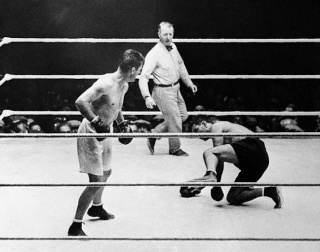
In a battle of Irish Americans, the Long Count Fight, or the Battle of the Long Count, a ten-round professional boxing rematch between world heavyweight champion Gene Tunney and former champion Jack Dempsey takes place at Soldier Field in Chicago, Illinois on September 22, 1927.
“Long Count” is applied to the fight because when Tunney is knocked down in the seventh round the count is delayed due to Dempsey’s failure to go to and remain in a neutral corner. Whether this “long count” actually affects the outcome remains a subject of debate. Tunney ultimately wins the bout in a unanimous decision.
Just 364 days earlier, on September 23, 1926 at Sesquicentennial Stadium in Philadelphia, Pennsylvania, Tunney beats Dempsey in a ten-round unanimous decision to claim the world heavyweight title. This first fight between Tunney and Dempsey is moved out of Chicago because Dempsey learned that Al Capone is a big fan of his, and he does not want Capone to be involved in the fight. Capone reportedly bets $50,000 on Dempsey for the rematch, which fuels false rumors of a fix. Dempsey is favored by odds makers in both fights, largely because of public betting which heavily tilts towards Dempsey.
The rematch held at Chicago’s Soldier Field draws a gate of $2,658,660 (approximately $22 million in today’s dollars). It is the first $2 million gate in entertainment history.
Despite the fact that Tunney had won the first fight by a wide margin on the scorecards, the prospect of a second bout creates tremendous public interest. Dempsey is one of the so-called “big five” sports legends of the 1920s and it is widely rumored that he had refused to participate in the military during World War I. He actually had attempted to enlist in the Army, but had been turned down. A jury later exonerates Dempsey of draft evasion. Tunney, who enjoys literature and the arts, is a former member of the United States Marine Corps. His nickname is The Fighting Marine.
The fight takes place under new rules regarding knockdowns: the fallen fighter has ten seconds to rise to his feet under his own power, after his opponent moves to a neutral corner (i.e., one with no trainers). The new rule, which is not yet universal, is asked to be put into use during the fight by the Dempsey camp, who had requested it during negotiations. Dempsey, in the final days of training prior to the rematch, apparently ignores the setting of these new rules. Also, the fight is staged inside a 20-foot ring, which favors the boxer with superior footwork, in this case Tunney. Dempsey likes to crowd his opponents, and normally fights in a 16-foot ring that offers less space to maneuver.
To this day boxing fans argue over whether Dempsey could or should have won the fight. What is not in dispute is that the public’s affection for Dempsey grew in the wake of his two losses to Tunney. “In defeat, he gained more stature,” wrote The Washington Post‘s Shirley Povich. “He was the loser in the battle of the long count, yet the hero.”
Tunney said that he had picked up the referee’s count at “two,” and could have gotten up at any point after that, preferring to wait until “nine” for obvious tactical reasons. Dempsey said, “I have no reason not to believe him. Gene’s a great guy.”
Dempsey later joins the United States Coast Guard, and he and Tunney become good friends who visit each other frequently. Tunney and Dempsey are both members of the International Boxing Hall of Fame.
In March 2011, the family of Gene Tunney donates the gloves he wore in the fight to the Smithsonian Institution‘s National Museum of American History.

 seamus dubhghaill