seamus dubhghaill

Promoting Irish Culture and History from Little Rock, Arkansas, USA


1 Comment

Execution of Maurice O’Neill, Irish Republican

Maurice O’Neill, an Irish Republican Army (IRA) Captain captured in 1942 after a shootout with Irish police (Garda Síochána), is executed on November 12, 1942, one of only two people executed in independent Ireland for a non-murder offence.

O’Neill is a farmer from an Irish republican family in the farming community of CahersiveenCounty Kerry. He and his older brother Sean are dedicated Irish republicans. He fights in the Irish Republican Army’s 1942-44 Northern Campaign and is assigned to the IRA’s General Headquarters (GHQ) at the time of his capture. In the early 1930s, his brother Sean serves in the IRAs Dublin Brigade and serves on GHQ Staff IRA in various capacities from 1945 to 1955.

On October 24, 1942, O’Neill is arrested after a raid by Garda Síochána in which Garda Detective Officer Mordant is shot and killed in Donnycarney, Dublin. The mission of the police raid is the capture of Harry White, the IRA Quartermaster General. White escapes capture and O’Neill is arrested but not charged with the murder of the Detective Officer but with “shooting with intent.” It is thought that Detective Officer Mordant’s death may have been a result of crossfire between Special Branch policemen.

In 1939, the Irish legislature, the Oireachtas, passes the Offences Against the State Act 1939, which establishes the Special Criminal Court (SCC). O’Neill is promptly tried in a military court and found guilty of a capital offence. Sentenced to death, and with no appeal provided for in the relevant law, he is executed on November 12, 1942, just 19 days after his arrest, by the Irish Army in Mountjoy Prison. His body is buried in the grounds of the prison. He is one of seven IRA men executed in Ireland between September 1940 and December 1944: Patrick MacGrathThomas HarteRichard GossGeorge Plant, and O’Neill are executed by firing squad, while two others are hanged – Tom Williams in Crumlin Road Gaol, Belfast, and Charlie Kerins in Mountjoy Prison, Dublin. O’Neill and Richard Goss are the only people executed by the Irish state for a non-murder crime.

The 25-year-old O’Neill’s execution provokes particularly widespread protests, as he is a popular figure in his native County Kerry. He apparently is stoic and calm when his fate becomes clear. In a letter to his elder brother, Sean, from Arbour Hill Prison, he writes: “I suppose you saw in the papers where I met my Waterloo last Saturday night. Well, such are the fortunes of war…there is only one sentence, death or release. So I believe it is the full penalty for me. There is no good in having false hopes, hard facts must be faced.” In his last letter to his father he writes: “I am glad that I am not being reprieved as the thought of the torture I would have to endure in Portlaoise makes me shudder.”

Many Irish republican prisoners are released in 1948 as is the body of O’Neill (on September 17, 1948). O’Neill is buried in the republican plot at Kilavarnogue Cemetery, Cahersiveen, County Kerry. His name is listed on a monument in Fairview Park, Dublin, with the names other IRA members of that period who lose their lives. The Maurice O’Neill Bridge to Valentia Island is built in 1970 and named in memory of the young farmer who had been executed in 1942. In Kilflynn, County Kerry, the Crotta O’Neill’s hurling club is named after him. In 2011, an Irish television documentary focuses on how O’Neill’s execution affected his family.

Leave a comment

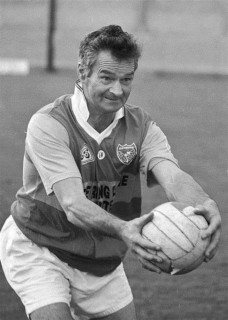
Birth of Gaelic Footballer Mick O’Connell

Michael “Mick” O’Connell, retired Gaelic footballer, is born on Valentia Island, County Kerry, on January 4, 1937. His league and championship career with the Kerry senior team spans nineteen seasons from 1956 to 1974. He is widely regarded as one of the greatest players in the history of the game.

O’Connell is raised in a family that has no real link to Gaelic football. His father is a fisherman who also works on the family’s small farm on the island. From an early age O’Connell shows his footballing talent and “inimitable signs of excellence.” He excels at the game in his youth and also at Cahersiveen CBS.

O’Connell begins his club football career with neighbouring Waterville. When a football club, Valentia Young Islanders, is founded on Valentia Island, as per GAA rules he switches allegiance to his local parish team. He wins three Kerry Senior Football Championship medals with the South Kerry divisional side.

O’Connell’s career with Kerry begins in 1955 when he lines out in the Munster Minor Championship. Kerry loses the replayed Munster final to Tipperary.

O’Connell quickly joins the Kerry senior football team, making his debut in 1956 against Tipperary in the Munster Championship. He later lines out in the Munster final against Cork, but loses out in a replay. In 1958 he wins the first of eight consecutive Munster Senior Football Championship titles, however, Kerry suffers a shocking defeat by Derry in the All-Ireland semi-final. In 1959 he is captain when Kerry wins the National Football League. He later guides his native-county to another Munster title, however, he has to retire due to injury in Kerry’s All-Ireland victory over Galway.

Following a second National League victory in 1961, O’Connell captures his second All-Ireland medal in 1962 when Kerry defeats Roscommon in the final. A third National League victory quickly follows at the start of 1963. After two All-Ireland defeats by Galway in 1964 and 1965 Kerry surrenders their provincial crown to Cork in 1966 and 1967. He wins a ninth Munster title in 1968, however, Kerry loses out to Down in the All-Ireland final. This defeat is followed by a great year of success in 1969 as he adds a fourth National League medal to his collection before winning a tenth Munster title. He later wins a third All-Ireland medal following a victory over Offaly.

In 1970 O’Connell enters the third decade of his inter-county football career, winning an eleventh Munster title in the process. A fourth All-Ireland medal quickly follows after a victory over Meath in the first 80-minute All-Ireland final. He claims two more National league medals in 1971 and 1972, before winning his twelfth and final provincial medal in 1972. That year Offaly later defeats Kerry in O’Connell’s last All-Ireland final appearance. In spite of this loss he is still presented with an GAA GPA All Star award. He retires from inter-county football in 1973.

In 1972 O’Connell marries his wife Rosaleen. They have three children, Máire, Mícheál and Diarmuid. Mícheál marries Emma, daughter of then President of Ireland Mary McAleese in December 2009.

In retirement from playing O’Connell publishes his autobiography, A Kerry Footballer, in 1974. Ten years later in 1984, the GAA’s centenary year, his reputation as one of the all-time greats is recognised when he is named in the midfield position on the GAA Football Team of the Century. In 2000 he is also named on the associations Football Team of the Millennium.


2 Comments

Birth of Irish Artist Charles Harper

skellig-arrival-by-charles-harper

Irish artist Charles Harper is born on July 30, 1943, on Valentia Island in County Kerry. He studies at the National College of Art and Design, Limerick School of Art and Design and the Graphic Studio in Dublin. He is taught by Maurice MacGonigal and Seán Keating. He also studies filmmaking in Germany.

Harper exhibits regularly in Ireland and abroad. His paintings are well known for their metaphoric themes, including boats, the human form, landscape and angels usually in painterly expressive form.

Harper is influenced by Francis Bacon and David Hockney which is apparent in his portrait work. In his treatment of the human head, the influence of Bacon is obvious as is the work of the Irish artist Louis Le Brocquy. He is also influenced by the Irish artist Patrick Collins. For Harper the actual act of painting is what matters as he sees the actual process as one of exploration and discovery. He says, “the process, the making excites me more than any end product.”

Harper represents Ireland at International Biennials in many countries throughout his career. He receives many national awards for his painting, including first prize for his work commemorating the 1916 Easter Rising at the Municipal Gallery of Modern Art in Dublin, the Carrols Open Award at the Irish Exhibition of Living Art in Dublin and The Arts councils Bonn an Uachtarain de Hide at the Oireachtas Art Exhibition. More recently he is awarded the BulBulia Award at the Royal Hibernian Academy in 2008.

Harper’s work is included in many important public and private collections including the San Francisco Museum of Modern Art, the Irish Museum of Modern Art and the Irish Arts Council. He is also a member of Aosdána and the Royal Hibernian Academy.

“Painting being a cultural and creative activity should be accessible to all. Though it may also confuse the viewer. I find this totally understandable and acceptable, as art should challenge our perception and established aesthetic.”

(Pictured: Skellig Arrival, acrylic on linen by Charles Harper)