seamus dubhghaill

Promoting Irish Culture and History from Little Rock, Arkansas, USA


Leave a comment

Six Free State Soldiers Killed in Three Separate Ambushes

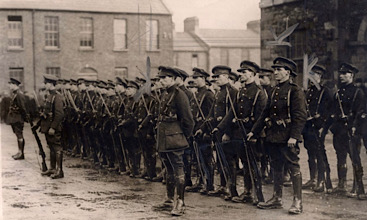
On August 29, 1922, six Irish Free State soldiers are killed in three separate ambushes, reflecting the intense and deadly engagements of the early Irish Civil War period.

The Irish Civil War (June 1922 – May 1923) erupts following the signing of the Anglo-Irish Treaty in 1921, which creates the Irish Free State. Pro-Treaty forces, forming the National Army, clash with anti-Treaty Irish Republican Army (IRA) elements refusing to accept the Treaty. This conflict includes both conventional and guerrilla phases, with August 1922 marking the end of the conventional campaign as Free State forces advance to secure towns in the south and southwest.

On this day, six Free State soldiers are killed in three distinct ambushes. Two soldiers died in Tullamore, County Offaly, one in Macroom, County Cork, and two in an ambush and firefight between Killorglin and Tralee, County Kerry. In Tullamore, Lieutenant Matthew Cullen of the 3rd Southern Division is fatally shot near Bonaterrin Hill, while Lieutenant Leahy is seriously wounded in the same attack. These ambushes are carried out by anti-Treaty forces and demonstrate the difficulties the National Army faces while attempting to secure supply routes and rural areas, even after major towns have fallen under Free State control.

These casualties underscore the dangers posed by guerrilla tactics, including ambushes, during the Irish Civil War. Free State soldiers are often young and inexperienced, and many fatalities occur in such rural confrontations. Despite these losses, the Free State maintains strategic momentum, continuing the offensive that eventually consolidates the new government’s control.

Overall, the Irish Civil War results in roughly 1,426 deaths in the Free State counties, with the National Army sustaining substantial casualties in actions like these ambushes. The conflict’s fatal events, including Tullamore on August 29, illustrate both the human cost of the war and the localized intensity of battles beyond major urban centers.

In summary, August 29, 1922, represents a notable moment in Irish Civil War history, highlighting the lethal impact of ambushes on Free State forces and the challenges of combatting anti-Treaty operations in rural Ireland. These events contribute to the broader struggle to establish the Irish Free State’s authority.

(Pictured: Irish Free State Army, 1922)


1 Comment

Execution of Maurice O’Neill, Irish Republican

Maurice O’Neill, an Irish Republican Army (IRA) Captain captured in 1942 after a shootout with Irish police (Garda Síochána), is executed on November 12, 1942, one of only two people executed in independent Ireland for a non-murder offence.

O’Neill is a farmer from an Irish republican family in the farming community of CahersiveenCounty Kerry. He and his older brother Sean are dedicated Irish republicans. He fights in the Irish Republican Army’s 1942-44 Northern Campaign and is assigned to the IRA’s General Headquarters (GHQ) at the time of his capture. In the early 1930s, his brother Sean serves in the IRAs Dublin Brigade and serves on GHQ Staff IRA in various capacities from 1945 to 1955.

On October 24, 1942, O’Neill is arrested after a raid by Garda Síochána in which Garda Detective Officer Mordant is shot and killed in Donnycarney, Dublin. The mission of the police raid is the capture of Harry White, the IRA Quartermaster General. White escapes capture and O’Neill is arrested but not charged with the murder of the Detective Officer but with “shooting with intent.” It is thought that Detective Officer Mordant’s death may have been a result of crossfire between Special Branch policemen.

In 1939, the Irish legislature, the Oireachtas, passes the Offences Against the State Act 1939, which establishes the Special Criminal Court (SCC). O’Neill is promptly tried in a military court and found guilty of a capital offence. Sentenced to death, and with no appeal provided for in the relevant law, he is executed on November 12, 1942, just 19 days after his arrest, by the Irish Army in Mountjoy Prison. His body is buried in the grounds of the prison. He is one of seven IRA men executed in Ireland between September 1940 and December 1944: Patrick MacGrathThomas HarteRichard GossGeorge Plant, and O’Neill are executed by firing squad, while two others are hanged – Tom Williams in Crumlin Road Gaol, Belfast, and Charlie Kerins in Mountjoy Prison, Dublin. O’Neill and Richard Goss are the only people executed by the Irish state for a non-murder crime.

The 25-year-old O’Neill’s execution provokes particularly widespread protests, as he is a popular figure in his native County Kerry. He apparently is stoic and calm when his fate becomes clear. In a letter to his elder brother, Sean, from Arbour Hill Prison, he writes: “I suppose you saw in the papers where I met my Waterloo last Saturday night. Well, such are the fortunes of war…there is only one sentence, death or release. So I believe it is the full penalty for me. There is no good in having false hopes, hard facts must be faced.” In his last letter to his father he writes: “I am glad that I am not being reprieved as the thought of the torture I would have to endure in Portlaoise makes me shudder.”

Many Irish republican prisoners are released in 1948 as is the body of O’Neill (on September 17, 1948). O’Neill is buried in the republican plot at Kilavarnogue Cemetery, Cahersiveen, County Kerry. His name is listed on a monument in Fairview Park, Dublin, with the names other IRA members of that period who lose their lives. The Maurice O’Neill Bridge to Valentia Island is built in 1970 and named in memory of the young farmer who had been executed in 1942. In Kilflynn, County Kerry, the Crotta O’Neill’s hurling club is named after him. In 2011, an Irish television documentary focuses on how O’Neill’s execution affected his family.