seamus dubhghaill

Promoting Irish Culture and History from Little Rock, Arkansas, USA


Leave a comment

The Battle of the Curragh

The Battle of the Curragh (Irish: Cath an Churraigh) is a battle fought on April 1, 1234, on the Curragh plain in County Kildare. The adversaries are men loyal to King Henry III of England on one side, and on the other side Richard Marshal, 3rd Earl of Pembroke and Lord of Leinster, who loses the battle and later dies from the wounds he suffers. The battle is a small affair in the number of knights involved but is still significant because it ends the career of the popular Richard Marshal.

The conflict between Richard Marshal and Henry III goes back several years, and centres particularly on the earl’s discontent with the influence that certain foreigners hold over the king. Most prominent among these is the Poitevin Peter des Roches, bishop of Winchester. In March 1234, a truce is reached between the king and Marshal, the condition of which is the removal of Peter des Roches from court. In the meanwhile, however, conflict has broken out in Ireland between Marshal’s brothers and some of the king’s supporters. These include Maurice FitzGerald, Justiciar of Ireland, Walter de Lacy, Lord of Meath, and Hugh de Lacy, 1st Earl of Ulster. Richard Marshal crosses the Irish Sea to Ireland to assist his brothers, where he meets with the enemies at the Curragh on April 1. Here he is defeated and captured. He is taken to Kilkenny Castle, where he dies from his injuries on April 16.

Richard Marshal had become highly popular in England because of his fight against foreign influence at court, and for this reason the accounts of the battle are idealised and not necessarily reliable. According to contemporary accounts, he is tricked into meeting his enemies at the Curragh and then deserted by his own forces. Rather than flee, he remains to fight against the odds, allegedly with only fifteen knights against 140. His popularity also means that his death is mourned in England, while the Poitevins, who are rumoured to have instigated the Irish war, fall further into disregard. Henry III nevertheless rewards Marshal’s Irish opponents richly.

The Curragh plains are later used as a location to recreate the Battle of Stirling Bridge in Mel Gibson‘s 1995 film Braveheart.

(Pictured: The Curragh plains in County Kildare)

Leave a comment

Hugh de Lacy Appointed 1st Earl of Ulster

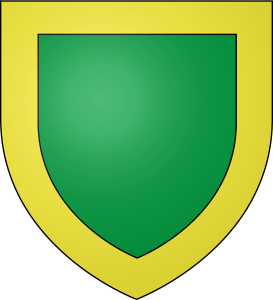
1st-earl-of-ulster-coat-of-arms

King John of England appoints Hugh de Lacy, a leading figure in the Norman invasion of Ireland in the 12th century, as the 1st Earl of Ulster on May 29, 1205.

Circa 1189 de Lacy is appointed Viceroy of Ireland, a position previously held by his father, Hugh de Lacy, Lord of Meath. He is replaced in 1190 by Guillaume le Petil. He is later reappointed to serve as viceroy from 1205 to 1210.

In 1199, King John authorises de Lacy to wage war on John de Courcy, who has conquered much of Ulster without help or permission from the King. Hugh captures de Courcy in 1204. An account of the capture appears in the Book of Howth.

After King John creates him Earl of Ulster in 1205, he makes what was de Courcy’s territory in Ulster the Earldom of Ulster. He grants Drogheda its charter and continues the conquest of the northeastern over-kingdom of Ulaid, building on de Courcy’s success, with the earldom spanning across the modern counties of Antrim and Down and parts of Londonderry.

In 1207, war breaks out between the Earl of Ulster and the justiciar. This brings King John to Ireland, where he expels the earl’s brother, Walter de Lacy, from Meath, and compels the earl himself to flee to Scotland.

For several years Ulster takes part in the wars in France, and de Lacy does not return to Ireland until 1221, when he allies himself with the O’Neills against the English. In 1226, his lands in Ulster are handed over to his brother Walter, but they are restored to him in the following year, after which date, he appears to loyally serve the king, being more than once summoned to England to give advice about Irish affairs.

De Lacy purportedly separates from his first wife and lives in adultery. He has legitimate and natural children. In 1226, his daughter by his first wife marries Alan, Lord of Galloway. He marries his second wife, Emmeline de Riddlesford, the daughter of Walter de Riddlesford around 1242. Hugh de Lacy dies shortly thereafter in 1242 or 1243. Emmeline’s second marriage takes place around 1243 with Stephen Longespee, grandson of Henry II of England, by whom she has two daughters, Ela Longespee, Lady of Ashby, and Emmeline Longespee, Lady of Offaly.

Left with no surviving legitimate children, the earldom of Ulster reverts to the crown upon de Lacy’s death.