
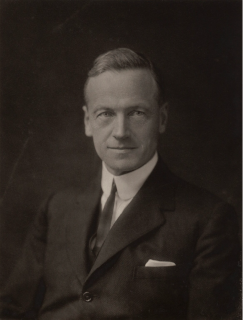
Walter Edward Guinness, 1st Baron Moyne, soldier, politician, traveler, and anthropologist, is born on March 29, 1880, in Dublin.
Guinness is the third son of Edward Cecil Guinness, 1st Earl of Iveagh, and Adelaide Maria Guinness, a cousin. He is educated at Eton College, where he displays a keen interest in the sciences, especially biology, and considerable athletic prowess. Forsaking an intention to enter the University of Oxford, he joins the Suffolk Yeomanry regiment of the British Army as a second lieutenant on November 15, 1899, and serves in the Second Boer War (1899–1902), where he is wounded and mentioned in dispatches.
On return from South Africa Guinness enters politics, unsuccessfully contesting Stowmarket in the 1906 United Kingdom general election as a Conservative Party candidate. In the following year he becomes MP for Bury St. Edmunds, holding the seat until 1931. He is also elected as a member of the London County Council (1907–10). He interrupts his career yet again at the outbreak of World War I and, rejoining the Suffolk Yeomanry, serves in Gallipoli and Egypt. By the end of the war he is a lieutenant colonel, three times mentioned in dispatches, with the Distinguished Service Order (DSO) in 1917 and a bar to it in 1918.
In the immediate postwar years Guinness devotes himself to his political career, and his work is soon rewarded with important appointments: Under-Secretary of State for War (1922) and Financial Secretary to the Treasury (1923). He serves for a second time at the Treasury (1924–5) under Winston Churchill, then Chancellor of the Exchequer. Sworn of the Privy Council in 1924, he enters the cabinet in November 1925 as Minister of Agriculture and Fisheries. After the defeat of the Conservatives in the 1929 United Kingdom general election, he gradually withdraws from the political scene, retiring from his parliamentary seat in 1931. He is raised to the peerage in 1932 as Baron Moyne of Bury St. Edmunds, Suffolk.
Always a keen traveler, during the following years Guinness makes several expeditions in search of biological specimens and archaeological material. He travels twice to New Guinea and also goes to Greenland and the Bay Islands near Honduras. These voyages are vividly described in his books Walkabout (1936) and Atlantic circle (1938). He still maintains a political profile, however, serving in several different capacities including financial commissioner to Kenya (1932) and chairman of the West India Royal Commission (1938–9). At the outbreak of World War II, he works as chairman of the Polish Relief Fund before being appointed as Joint Parliamentary Secretary at the Ministry of Agriculture on the formation of the Churchill government (1940). In 1941 he becomes Secretary of State for the Colonies and Leader of the House of Lords. Appointed Deputy Resident Minister of State in Cairo (August 1942), he becomes Minister-Resident for the Middle East in January 1944. On November 6, 1944, he is assassinated in Cairo by members of the ‘Stern Gang’, the Jewish terrorist group based in Palestine.
Guinness marries (1903) Lady Evelyn Hilda Stuart Erskine, daughter of the 14th Earl of Buchan. They have two sons and one daughter.
(Pictured: Walter Edward Guinness, 1st Baron Moyne of Bury St. Edmunds, bromide print, 1929, by Walter Stoneman, National Portrait Gallery)

 seamus dubhghaill