
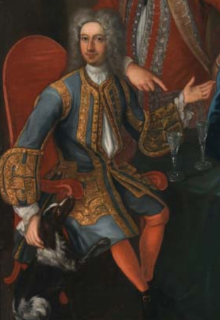
On April 27, 1739, Henry Barry, 4th Baron Barry of Santry, is tried by his peers in the Irish House of Lords for the murder of Laughlin Murphy in August 1738. They unanimously find him guilty but recommend him to the royal mercy. The Lord Lieutenant, William Cavendish, 3rd Duke of Devonshire, endorses this plea, and Barry is pardoned under the great seal on June 17. His estates, which had been forfeited for life, are restored in 1741.
Barry is born in Dublin on September 3, 1710, the only son of Henry Barry, 3rd Baron Barry of Santry, and Bridget Domvile, daughter of Sir Thomas Domvile, 1st Baronet, of Templeogue, and his first wife (and cousin) Elizabeth Lake, daughter of Sir Lancelot Lake. He succeeds to the title in 1735 and takes his seat in the Irish House of Lords.
Barry seems to be an extreme example of an eighteenth-century rake, a man of quarrelsome and violent nature, and a heavy drinker. He is a member of the notorious Dublin Hellfire Club. The club’s reputation never fully recovers from the sensational publicity surrounding his trial for murder, although there is no reason to think that any of his fellow members knew of or condoned the crime. There are widespread rumours that he had committed at least one previous murder which was successfully hushed up, although there seems to be no firm evidence for this.
On August 9, 1738, Barry is drinking with some friends at a tavern in Palmerstown, then a small village near Dublin. Drinking more heavily than usual, he attacks a drinking companion but is unable to draw his sword. Enraged, he runs to the kitchen, where he chances to meet Laughlin Murphy, the tavern porter, and for no known reason runs him through with his sword. He then bribes the innkeeper to let him escape. Murphy is taken to Dublin where he lingers for several weeks, dying on September 25, 1738.
Although Barry is not immediately apprehended, there is no reason to believe that the Crown intends that he should escape justice. The authorities clearly aim not only to prosecute him but to secure a conviction. Even in an age when the aristocracy enjoys special privileges, the murder of Murphy, who by all accounts was an honest and hardworking man with a wife and young family to support, shocks public opinion, whereas Barry is regarded, even among members of his own class, as a public nuisance. In due course, he is arrested and indicted for murder. He demands, as the privilege of peerage, a trial by his peers. The trial, which takes place in the Irish Houses of Parliament on April 27, 1739, arouses immense public interest.
Thomas Wyndham, the Lord Chancellor of Ireland, presides in his office Lord High Steward of Ireland, with 23 peers sitting as judges. The Attorney-General for Ireland, Robert Jocelyn, and the Solicitor-General for Ireland, John Bowes, lead for the prosecution.
Bowes dominates the proceedings, and his speeches make his reputation as an orator. Thomas Rundle, Bishop of Derry, who as a spiritual peer is only an observer at the trial, says, “I never heard, never read, so perfect a piece of eloquence…the strength and light of his reason, the fairness and candour.” The Bishop is scathing about the quality of counsel for the defence, describing the performance of Barry’s counsel as “detestable.” The defence case is that Murphy had died not from his wound but from a long-standing illness (or alternatively a rat bite), but in view of the medical evidence produced by the prosecution this is a hopeless argument. According to Bishop Rundle, Barry’s counsel fails even to mention the possibility that Murphy, who lingered for six weeks after being stabbed, might have died through inadequate medical care. Given the overwhelming evidence of Barry’s guilt, however, any defence would probably have been useless, and despite what is described as their “looks of horror,” his peers have little difficulty in finding him guilty. Wyndham, who had conducted the trial with exemplary fairness, pronounces the death sentence. His retirement soon afterward is generally thought to be due to the strain of the trial.
King George II, like all British monarchs, has the prerogative of mercy, and a campaign is launched by Barry’s friends and relatives to persuade the King to grant a pardon. Their plea concentrates on the victim’s low social standing, the implication being that the life of a peer is worth more than that of a tavern worker, despite the victim’s blameless character and the savage and wanton nature of the murder. The King proves reluctant to grant a pardon, and for a time it seems that Barry will be executed, but in due course, a reprieve is issued. Popular legend has it that his uncle, Sir Compton Domvile, through whose estate at Templeogue the River Dodder flows, secured a royal pardon for his nephew by threatening to divert the course of the river, thus depriving the citizens of Dublin of what is then, and remains long after, their main supply of drinking water.
On June 17, 1740, Barry receives a full royal pardon and the restoration of his title and estates. Soon afterward he leaves Ireland for good and settles in England. He is said to have had a personal audience with the King and thanked him in person for his clemency.
Barry’s last years are wretched. Although he has a second marriage shortly before his death, he is abandoned by all his former friends, is in great pain from gout, and is prone to depression. He dies in Nottingham on March 22, 1751, and is buried at St. Nicholas Church, Nottingham. On his death the title becomes extinct. His estates pass to his cousin, Sir Compton Domvile, 2nd Baronet, who makes unsuccessful efforts to have the barony revived. His widow Elizabeth outlives him by many years, dying in December 1816.
 seamus dubhghaill