
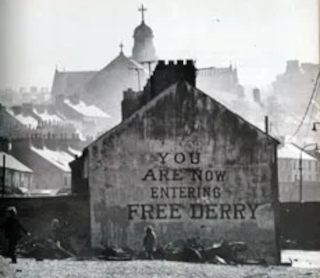
A Protestant march against the creation of “no-go” areas in Londonderry on June 3, 1972, ends in a bloody battle on the Craigavon Bridge. Soldiers use rubber bullets and water cannon to control the crowd when the so-called “Tartan gangs” at the tail end of the march begin to throw bottles and stones at the British Army.
The “no-go” areas, known as Free Derry, are areas where both the Irish Republican Army and Provisional Irish Republican Army can openly patrol, train and open offices with widespread support and without involvement of security services. Bogside, Creggan and Brandywell make up the area Free Derry, and it is still known by that name despite the barricades no longer being present.
The 10,000 strong march sets off from Irish Street at 1500 GMT to call for an end to the “no-go” areas on the east bank side of the River Foyle.
The biggest security operation since the start of the Troubles is set up for the march with soldiers on every corner. The bridge is the centre of the trouble as it joins the Protestant side of the town to the “no-go” Roman Catholic areas of Bogside and Creggan.
Despite pleas from march organisers for the violence to stop it does not end until the Ulster Defence Association (UDA) steps in. They form a human barrier between the protesters and the Army. The confrontation lasts an hour and results in one man being injured but no arrests.
A spokesman for the Army says, “Naturally it is regretted that we have to fire rubber bullets but there we are. The only alternative is the Bogside would be invaded by the Protestant marchers.”
Despite the violence, William Craig, the leader of the Ulster Vanguard movement, who organised the march, says the marches will go on. “We are no longer protesting – we are demanding action,” he says.
On July 31, 1972, the then Secretary of State for Northern Ireland William Whitelaw orders 20,000 soldiers to dismantle IRA barricades in the “no-go” areas of Derry and Belfast.
1972 becomes the bloodiest year of the Troubles. Some 470 people are killed that year, the overwhelming majority of them civilians.
(From: “1972: Protestant march ends in battle,” BBC On This Day, http://news.bbc.co.uk/onthisday)

 seamus dubhghaill