seamus dubhghaill

Promoting Irish Culture and History from Little Rock, Arkansas, USA


Leave a comment

Irish Nationalists Protest Across Northern Ireland

On August 14, 1969, in response to the escalating violence in Derry, County Londonderry, Irish nationalists hold protests across Northern Ireland, marking a turning point in the region’s political and sectarian conflict.

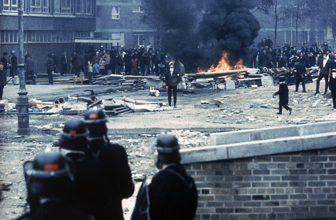
The unrest begins on August 12 with the Battle of the Bogside in Derry’s predominantly Catholic Bogside district. Tensions have been building for over a year due to long-standing nationalist grievances, including political discrimination and gerrymandering that has kept the city under Unionist control since 1925. The violence erupts during the annual Apprentice Boys’ march, when Protestant marchers pass through the Catholic area, provoking clashes with residents.

Thousands of Catholic/nationalist residents, organised under the Derry Citizens’ Defence Association, resist the Royal Ulster Constabulary (RUC) and loyalist attacks. They build barricades, set up first aid posts, and even petrol bomb workshops. The RUC uses tear gas for the first time in United Kingdom police history, and residents fear the arrival of the armed Ulster Special Constabulary (B-Specials). The Bogside becomes a no-go area known as “Free Derry.”

On August 13, nationalist protests spread to other towns, including Belfast, Armagh, Dungannon, and Newry. In Belfast, seven people are killed and hundreds wounded, with many Catholic civilians shot by police. Loyalists attack Catholic homes, and both republican and loyalist paramilitaries are involved. Over 150 homes are destroyed, and 1,800 families are displaced.

By August 14, the British government deploys 300 troops from the 1st Battalion, Prince of Wales’s Own Regiment of Yorkshire to County Londonderry, replacing the exhausted RUC. The move is initially welcomed by some residents, but it remains clear that the violence has not been contained. The deployment marks the start of Operation Banner, the British Army’s long-term presence in Northern Ireland.

The riots and protests are widely regarded as the beginning of the Troubles, a 30-year conflict. The British Army’s presence, the establishment of peace lines to separate Catholic and Protestant areas, and the Republic of Ireland’s call for a United Nations peacekeeping force reflect the deepening crisis.

In short, August 14, 1969, is the day British troops enter Northern Ireland to restore order after days of nationalist-led protests and riots, events that define the region’s political landscape for decades.

Leave a comment

Protestant March Ends in Bloody Battle on the Craigavon Bridge

A Protestant march against the creation of “no-go” areas in Londonderry on June 3, 1972, ends in a bloody battle on the Craigavon Bridge. Soldiers use rubber bullets and water cannon to control the crowd when the so-called “Tartan gangs” at the tail end of the march begin to throw bottles and stones at the British Army.

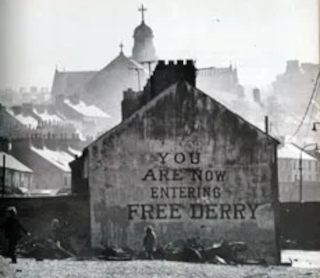
The “no-go” areas, known as Free Derry, are areas where both the Irish Republican Army and Provisional Irish Republican Army can openly patrol, train and open offices with widespread support and without involvement of security services. Bogside, Creggan and Brandywell make up the area Free Derry, and it is still known by that name despite the barricades no longer being present.

The 10,000 strong march sets off from Irish Street at 1500 GMT to call for an end to the “no-go” areas on the east bank side of the River Foyle.

The biggest security operation since the start of the Troubles is set up for the march with soldiers on every corner. The bridge is the centre of the trouble as it joins the Protestant side of the town to the “no-go” Roman Catholic areas of Bogside and Creggan.

Despite pleas from march organisers for the violence to stop it does not end until the Ulster Defence Association (UDA) steps in. They form a human barrier between the protesters and the Army. The confrontation lasts an hour and results in one man being injured but no arrests.

A spokesman for the Army says, “Naturally it is regretted that we have to fire rubber bullets but there we are. The only alternative is the Bogside would be invaded by the Protestant marchers.”

Despite the violence, William Craig, the leader of the Ulster Vanguard movement, who organised the march, says the marches will go on. “We are no longer protesting – we are demanding action,” he says.

On July 31, 1972, the then Secretary of State for Northern Ireland William Whitelaw orders 20,000 soldiers to dismantle IRA barricades in the “no-go” areas of Derry and Belfast.

1972 becomes the bloodiest year of the Troubles. Some 470 people are killed that year, the overwhelming majority of them civilians.

(From: “1972: Protestant march ends in battle,” BBC On This Day, http://news.bbc.co.uk/onthisday)