
The Battle of Collooney, also called the Battle of Carricknagat, occurs on September 5, 1798, during the Irish Rebellion of 1798 when a combined force of French troops and Irish rebels defeat a force of British troops outside of Collooney near Sligo.
A long-anticipated French landing to assist the Irish rebellion takes place on August 22, when almost 1,100 troops under the command of General Jean Joseph Amable Humbert land at Kilcummin Strand (Cill Chuimín), Killala Bay, County Mayo. Although the force is small, the remote location ensures an unopposed landing away from the tens of thousands of British soldiers concentrated in the east in Leinster, engaged in mopping up operations against remaining pockets of rebels. The nearby town of Killala is quickly captured after a brief resistance by local yeomen and Ballina is also taken two days later, following the rout of a force of cavalry sent from the town to oppose their march. Irish volunteers begin to trickle into the French camp from all over Mayo following the news of the French landing.
The victory of General Humbert at Castlebar, despite gaining him about 5,000 Irish recruits, does not lead to a renewed outbreak of the rebellion as hoped. A British army of some 26,000 men is assembled under Field Marshal Charles Cornwallis, 1st Marquess Cornwallis, the newly appointed Lord Lieutenant of Ireland, and is steadily moving towards his forces. Abandoning Castlebar, Humbert moves towards Ulster via Sligo with the intention of igniting a rising there.
The combined Franco-Irish forces march northeast towards Sligo on their way to County Donegal in Ulster. When they get to the village of Collooney they are confronted by a unit of British troops from the garrison in Sligo, which is approximately five miles to the north of Collooney. A minor battle ensues at Carricknagat, a small townland to the immediate north of Collooney, hence the alternate name for the battle: the Battle of Carricknagat.
On September 5, 1798, the Franco-Irish troops push north through County Sligo but are halted by a cannon which the British forces have installed above Union Rock near Collooney.
A young Irish aide to General Humbert, Lieutenant Bartholomew Teeling, distinguishes himself during the encounter. Teeling clears the way for the advancing Irish-French army by single-handedly disabling a British gunnery post located high on Union Rock when he breaks from the French ranks and gallops toward the gunner’s position. Teeling is armed with a pistol and he shoots the cannon’s marksman and captures the cannon. After the loss of the cannon position, the French and Irish advance and the British retreat toward their barracks at Sligo, leaving 120 dead and 100 prisoners.
Colonel Charles Vereker, who commands the Limerick militia in the standoff, is awarded a peerage for his role in the battle.
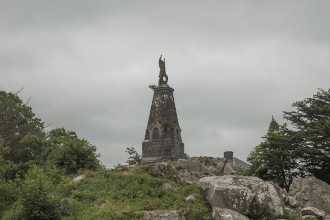
In 1898, the centenary year of the battle, a statue of Teeling is erected in Carricknagat. Johnnie Woods of Aughamore, Sligo, County Sligo, a far-famed reliable scaffolder, erects the spire for this monument.
(Pictured: The monument commemorating the battle)

 seamus dubhghaill