
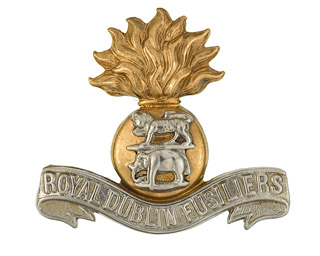
The Royal Dublin Fusiliers, an infantry regiment of the British Army, is created on July 1, 1881, as part of the British Army’s Childers Reforms by amalgamating the 102nd Regiment of Foot (Royal Madras Fusiliers) and the 103rd Regiment of Foot (Royal Bombay Fusiliers), both originally European regiments of the East India Company transferred to the British Army in 1861. The regiment’s home depot is located in Naas, County Kildare, and it recruits primarily from counties Dublin, Kildare, Wicklow, and Carlow. Initially, it consists of two regular battalions, with additional battalions raised during wartime.
The regiment serves in the Second Boer War (1899–1902) in Southern Africa, participating in key actions such as the Siege of Ladysmith and battles at Colenso and Tugela Heights. Notably, a detachment escorts an armoured train carrying war correspondent Winston Churchill, which is ambushed by Boer forces.
During World War I, the Royal Dublin Fusiliers expand to six additional battalions and see action on the Western Front, the Mediterranean, and the Middle East. The regiment suffers heavy casualties at battles such as Le Cateau and the Gallipoli landings at Helles, where only 11 of 1,100 men survive the landing. Members of the regiment are awarded three Victoria Crosses for acts of bravery during the war.
Following the establishment of the Irish Free State in 1922, the Royal Dublin Fusiliers, along with four other southern Irish regiments, is disbanded. The regiment’s history and the service of its soldiers are commemorated by the Royal Dublin Fusiliers Association, which maintains archives, exhibitions, and digitised collections of letters and records from World War I. These archives provide insight into the experiences of Irish soldiers and the conditions they face on the front lines.
The regiment is remembered for its courage and sacrifice, with dedicated websites and museum collections preserving its history, medals, and personal accounts of soldiers. The Royal Dublin Fusiliers remain a significant part of Irish military heritage, reflecting both the contributions of Irish soldiers to the British Army and the complex history of Ireland during the early 20th century.


