
The Dublin Harp Society is founded on July 13, 1809, by John Bernard Trotter, a former secretary to Charles James Fox and a passionate supporter of Irish music, to revive and preserve the ancient Irish harp tradition, and it flourishes briefly with contributions from prominent patrons and musicians before closing in 1812 due to financial difficulties.
Inspired by the Belfast Irish Harp Society, Trotter aims to create a society that will extend the revival of the Irish harp to the capital and broaden its audience across Ireland. The society’s purpose is to rescue the old Irish harp from oblivion, teach blind and talented harpers, and promote Irish music through public events, publications, and performances.
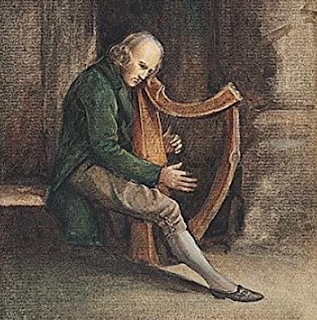
Trotter gathers an influential list of subscribers, including Thomas Moore, the poet and songwriter, and Sir Walter Scott, the Scottish novelist. He brings to Dublin Patrick Quin (pictured), a blind harper from Portadown, County Armagh, as the society’s instructor. Quin is one of the last of the traditional blind harpers and performs extensively at society events, including Turlough O’Carolan commemorations, delighting patrons and audiences. The Bishop of Kildare, Charles Dalrymple Lindsay, also supports the society by providing a house in Glasnevin for the instruction of harpers.
The society engages in multiple avenues to revive Irish harp music. In addition to the previously mentioned Turlough O’Carolan commemorations, circulars and subscription notices are published to drum up public support and secure funding. The Society hosts concerts and gatherings at prominent Dublin locations, offering elaborate performances for subscribers. Tuition and mentorship to young Irish harpers is provided, particularly to blind musicians, as part of a broader cultural and philanthropic effort. Trotter also personally subsidizes the society, contributing £200 annually, which helps maintain performances and attract participants.
Despite early enthusiasm, the society struggles financially due to Trotter’s generous hospitality and personal funding of its activities. By the close of 1812, the Dublin Harp Society becomes defunct when Trotter goes bankrupt. The society attempts to publish rules and regulations in 1810 and conduct active recruitment of subscribers and pupils, but it cannot be sustained beyond three years.
Although short-lived, the Dublin Harp Society contributes significantly to the preservation and promotion of the Irish harp, inspiring subsequent societies and harp revival initiatives in Ireland. It highlights the importance of cultural patrimony, music education, and public patronage, acting as a bridge between the older harp traditions and the modern revival movements seen in later 19th-century Ireland.
In summary, the Dublin Harp Society represents an early 19th-century endeavor to revive Ireland’s venerable harp tradition through education, sponsorship, and celebration of master harpers, leaving a lasting mark on the cultural memory of Irish music.


