The Dublin Harp Society is founded on July 13, 1809, by John Bernard Trotter, a former secretary to Charles James Fox and a passionate supporter of Irish music, to revive and preserve the ancient Irish harp tradition, and it flourishes briefly with contributions from prominent patrons and musicians before closing in 1812 due to financial difficulties.
Inspired by the Belfast Irish Harp Society, Trotter aims to create a society that will extend the revival of the Irish harp to the capital and broaden its audience across Ireland. The society’s purpose is to rescue the old Irish harp from oblivion, teach blind and talented harpers, and promote Irish music through public events, publications, and performances.
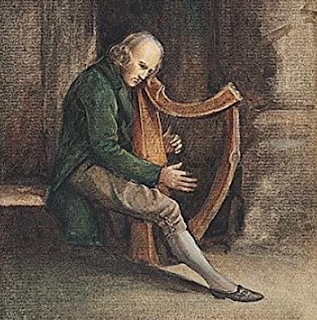
Trotter gathers an influential list of subscribers, including Thomas Moore, the poet and songwriter, and Sir Walter Scott, the Scottish novelist. He brings to Dublin Patrick Quin (pictured), a blind harper from Portadown, County Armagh, as the society’s instructor. Quin is one of the last of the traditional blind harpers and performs extensively at society events, including Turlough O’Carolan commemorations, delighting patrons and audiences. The Bishop of Kildare, Charles Dalrymple Lindsay, also supports the society by providing a house in Glasnevin for the instruction of harpers.
The society engages in multiple avenues to revive Irish harp music. In addition to the previously mentioned Turlough O’Carolan commemorations, circulars and subscription notices are published to drum up public support and secure funding. The Society hosts concerts and gatherings at prominent Dublin locations, offering elaborate performances for subscribers. Tuition and mentorship to young Irish harpers is provided, particularly to blind musicians, as part of a broader cultural and philanthropic effort. Trotter also personally subsidizes the society, contributing £200 annually, which helps maintain performances and attract participants.
Despite early enthusiasm, the society struggles financially due to Trotter’s generous hospitality and personal funding of its activities. By the close of 1812, the Dublin Harp Society becomes defunct when Trotter goes bankrupt. The society attempts to publish rules and regulations in 1810 and conduct active recruitment of subscribers and pupils, but it cannot be sustained beyond three years.
Although short-lived, the Dublin Harp Society contributes significantly to the preservation and promotion of the Irish harp, inspiring subsequent societies and harp revival initiatives in Ireland. It highlights the importance of cultural patrimony, music education, and public patronage, acting as a bridge between the older harp traditions and the modern revival movements seen in later 19th-century Ireland.
In summary, the Dublin Harp Society represents an early 19th-century endeavor to revive Ireland’s venerable harp tradition through education, sponsorship, and celebration of master harpers, leaving a lasting mark on the cultural memory of Irish music.
Boland is enrolled in the IRB along with his younger brothers Harry in 1904, following in the footsteps of his father. He and his brothers Harry and Ned subsequently join the Irish Volunteers when that organisation is established in 1913, serving in the same company as Arthur Griffith. When news breaks out of the Easter Rising in 1916 he immediately leaves his job, however, he is bitterly disappointed when he finds out that the order has been countermanded. When the rebellion begins in earnest on Easter Monday, he makes his way to Jacob’s Mill where he fights under Thomas MacDonagh. Following the official surrender, he is arrested and interned at Frongoch internment camp in Wales, where he comes into contact with other notable revolutionary leaders, including his brother Harry’s friend Michael Collins.
Boland is released after a general amnesty in December 1916, however, he remains involved in revolutionary circles, although he declines to rejoin the IRB, believing the organisation is no longer needed. He is arrested and imprisoned in Belfast from May to December 1918 for practising military drills in the Dublin Mountains. Meanwhile, a number of his colleagues secure their release by winning seats in the 1918 United Kingdom general election.
Boland and his brothers are opposed to the Anglo-Irish Treaty of 1921. He is Battalion Commandant of 3 Battalion, 2 Dublin Brigade (South Dublin) in Blessington, County Wicklow, but is captured early on in the Irish Civil War on July 7, 1922, and is interned until his release in July 1924. On the outside, his brother Harry dies some days after being shot, in August 1922, after two National Army officers attempt to arrest him at the Grand Hotel in Skerries, County Dublin. Boland applies to the Irish government for a service pension under the Military Service Pensions Act of 1934 and is awarded 11 and 5/12 years of service at Grade C for his service with the Irish Volunteers and the IRA between April 1, 1916 and September 30, 1923.
Following the end of the Irish Civil War, Boland helps to build up Sinn Féin as the main Republican party. While still imprisoned, he is selected to stand for Dáil Éireann as the Teachta Dála (TD) for Roscommon, Harry’s old seat, for the 1923 Irish general election, in which he is successful. He is among those in Kilmainham Gaol who go on hunger strike in October 1923. The hunger strike does not result in his release and he credits his practice of yoga with keeping him alive at the time.[3]
Boland is eventually released from the custody of the state in July 1924. Upon his release, he becomes secretary of Sinn Féin and stands on the executive of the party.
Boland is among the first in Sinn Féin to call for an end to the party’s abstentionism from DáilÉireann, believing it to be a political dead end. Party leader Éamon de Valera proposes that the party abandon this policy and take their seats in the Dáil if changes are made to the oath of allegiance to the British monarch. His proposal is defeated and de Valera and his supporters, including Boland, leave Sinn Féin. Shortly after this split, a new party emerges called Fianna Fáil, with de Valera acting as leader and the other disillusioned Republican TDs joining. Boland is vital in transferring many members from Sinn Féin to Fianna Fáil. Fianna Fáil briefly also has an abstentionist policy but in 1927 a new law forces Fianna Fáil TDs to take the oath of allegiance and take their seats in the Dáil. Fianna Fáil dismisses the oath as “an empty formula.”
Boland works alongside Seán Lemass in building up Fianna Fáil’s grassroots support and organisation, giving particular attention to the party’s rural apparatus. In the September 1927 Irish general election Fianna Fáil comes within four seats of the ruling Cumann na nGaedheal party. The latter forms a coalition of sorts with the Farmers’ Party and returns to government.
Following the 1932 Irish general election, Fianna Fáil forms a new government. Boland is appointed Government Chief Whip, a position which allows him to attend cabinet meetings but not vote at them.
Fianna Fáil remains in power with an increased mandate following the 1933 Irish general election and Boland is promoted to the position of Minister for Posts and Telegraphs. Despite being the Minister in charge of the postal service, he does not own a telephone until some time later. During his tenure, the postal service makes considerable progress. It is also during this time that the Post Office becomes a paying concern. During his time as minister, he oversees a major expansion of the telephone service in Ireland, improvements in the transmission capacity of Radio Éireann, and construction of new provincial post offices and a new central postal sorting office.
Boland is acting Minister for Justice briefly for a time when P. J. Ruttledge is ill. It is during this time that he declares the Irish Republican Army a proscribed organisation.
A cabinet reshuffle in 1936 sees Boland become Minister for Lands. The Land Act 1939 reforms land distribution, broadening the criteria by which the state can take control over undeveloped land while offering the tenant of the land more favourable terms of compensation. He is critical of the policy of the Minister for Industry and Commerce, Seán Lemass, of centralising industrial development in Dublin. He instead wishes to see a more decentralised economy based around food production. The differing viewpoint causes a rift between Boland and Lemass, but despite this Boland favoured Lemass’s policy of state intervention in the economy over Seán MacEntee‘s more laissez-faire approach.
In 1937 Boland is highly vocal during the drafting of a new constitution of Ireland by Fianna Fáil against any word which would give the Catholic Church special status, something heavily considered at the time. He declares that if the constitution elevates the position of the Catholic Church above others, it would be sectarian, anti-republican, and a hindrance to any prospects of Irish reunification. As a compromise, the term “special position” is used in the approved text of the Constitution.
Following the outbreak of World War II in 1939, known in Ireland as the Emergency, there is a cabinet reshuffle, and Boland is appointed as Minister for Justice. He takes over at a time when the IRA has once again declared war against the British state and has begun their Sabotage Campaign. He is charged with the task of crushing the organisation and preventing the IRA from drawing the Irish state into conflict with the United Kingdom. Although he always considers himself a republican, he takes a hardline against the IRA and uses his powers to order the internment of hundreds of IRA members before introducing military courts and special criminal courts.
In 1940, several imprisoned IRA members go on hunger strike but Boland refuses to grant their release. Two of the men eventually die, one of whom is the nephew of one of his Fianna Fáil colleagues. Tony D’Arcy dies at the age of 32 on April 16, 1940, as a result of a 52-day hunger strike, and Jack McNeela dies three days later after 55 days on hunger strike. These deaths spark reprisals by the IRA on the Garda Síochána. Boland subsequently introduces tougher measures by setting up a military court with the death penalty and no provision for appeal except for a review by the government. In all, twelve men are found guilty with six of them facing death and the remaining six having their sentences changed to imprisonment. Among those executed is Charlie Kerins, an acting Chief of Staff of the IRA.
As Minister of Justice, Boland is also asked to enforce policies of wartime censorship, however, finding the idea of the state censorship distasteful he establishes a censorship board to avoid accusations of bias.
During the Emergency, Boland is also responsible for the detention of several foreign agents in pursuit of Ireland’s strict policy of neutrality. During this time some 500 individuals are interned and 600 are sentenced under the newly introduced Offences against the State Act, 1939. By 1943 the IRA is in disarray, particularly after the Chief of Staff is arrested and imprisoned, leaving the organisation without leadership. Boland and Fianna Fáil feel their hardline is backed by the electorate following strong returns for the party at the 1944 Irish general election.
In 1947, Boland is among four leading Fianna Fáil figures (including de Valera) involved in the “Locke’s Distillery Scandal”, an accusation brought by Oliver J. Flanagan that foreign businessmen are bribing members of Fianna Fáil to gain the right to purchase the distillery. A tribunal of inquiry finds no evidence to support the claims, but the event taints the public’s view of Fianna Fáil.
By 1948, Fianna Fáil has been in government for an uninterrupted 16 years. With World War II finally over, the electorate seeks change and a fresh start. Arising to meet this desire is the new political party Clann na Poblachta. Led by Seán MacBride, this new party seeks to kick off a new post-war political era in Ireland, and to do this means removing Fianna Fáil from power. Many in Clann na Poblachta have republican backgrounds and in some ways, the party can be partially described as an organic reaction to Fianna Fáil and Boland’s hardline stance during the war years. Many in political circles, including inside Fianna Fáil, believe Clann na Poblachta can be a new force to reckon with.
However, de Valera always holds a reputation for being cunning in selecting the dates of general elections, and he once again cements that notion, when he calls for a general election in early 1948 before Clann na Poblachta is completely ready to contest a national election. At the 1948 Irish general election Clann na Poblachta and other Fianna Fáil opponents do well, but not as well as expected. To remove Fianna Fáil from government, every single party in the Dáil and several independents have to form the unwieldy “First Inter-Party Government.” The coalition sees Clann na Poblachta forced to work with Fine Gael, considered the traditional “enemy” of Irish republicanism. By 1951, the coalition collapses and Fianna Fáil returns to government following that year’s election, with Boland re-appointed Minister for Justice.
Boland does not seek ministerial office in 1957 when Fianna Fáil returns to power after its defeat in 1954. However, his son, Kevin, is appointed to the cabinet as Minister for Defence at the beginning of his first term in the Dáil. By this stage, Boland is beginning to be seen as an aging warhorse, with his base in Roscommon starting to slip and Fianna Fáil unhappy that he is unable to get a Fianna Fáil running mate elected alongside himself.
At the 1961 Irish general election, Boland is defeated for the first time in fourteen general election campaigns. Despite losing his Dáil seat, he subsequently secures election to Seanad Éireann. Four years later in 1965, he returns to the Seanad, this time as a nominee by the Taoiseach Seán Lemass.
In 1970, the outbreak of the Arms Crisis sees Kevin Boland resign as a Minister and as Secretary of Fianna Fáil in protest at the government’s policy on Northern Ireland and in response to the sackings of Charles Haughey and Neil Blaney from the cabinet over allegations they had arranged for weapons to be provided to the Provisional IRA. Gerald Boland, in a similar protest, resigns as a vice president and as a trustee of Fianna Fáil, although he remains a member of the party. He also articulates his loss of confidence in the leadership of TaoiseachJack Lynch.
Boland dies in Dublin at the age of 87 on January 5, 1973. He is buried in the republican plot in Glasnevin Cemetery, Glasnevin, County Dublin. His wife, Annie Boland, predeceases him in 1970. He is survived by his three daughters and four sons.
O’Riordan is born at 37 Pope’s Quay, Cork, County Cork, on November 11, 1917, the youngest of five children. His parents come from the West Cork Gaeltacht of Ballingeary–Gougane Barra. Despite his parents being native speakers of the Irish language, it is not until he is interned during World War II that he learns Irish.
As a teenager, O’Riordan joins the republican youth movement, Fianna Éireann, and then the Irish Republican Army (IRA). Much of the IRA at the time is inclined toward left-wing politics. A lot of its activity at the time involves street fighting with the quasi-fascistBlueshirt movement, and he fights the Blueshirts on the streets of Cork in 1933–34. He Is friends with left-wing inclined republicans such as Peadar O’Donnell and Frank Ryan, and in 1934, he follows them into the Republican Congress – a short-lived socialist republican party.
O’Riordan joins the Communist Party of Ireland (1933) in 1935 while still in the IRA and works on the communist newspaper The Irish Workers’ Voice. In 1937, following the urgings of Peadar O’Donnell, several hundred Irishmen, mostly IRA or ex-IRA men, go to fight for the Spanish Republic in the Spanish Civil War with the XVth International Brigade. They are motivated in part by enmity towards the 800 or so Blueshirts, led by Eoin O’Duffy who went to Spain to fight on the “nationalist” side in the Irish Brigade. He accompanies a party led by Frank Ryan. In the Republic’s final offensive of July 25, 1938, he carries the flag of Catalonia across the River Ebro. On August 1 he is severely injured by shrapnel on the Ebro front. He is repatriated to Ireland the following month, after the International Brigades are disbanded.
In 1938, O’Riordan is offered an Irish Army commission by the Irish Free State but chooses instead to train IRA units in Cork. As a result of his IRA activities during World War II, he is interned in the Curragh Camp from 1939 until 1943 where he is Officer Commanding of the Cork Hut and partakes in Máirtín Ó Cadhain‘s Gaelic League classes as well as publishes Splannc (Irish for “Spark”, named after Vladimir Lenin‘s newspaper). He is secretary of the “Connolly group,” composed of leftist internees. Following his release from internment, he terminates his IRA membership.
In 1944, O’Riordan is founding secretary of the Liam Mellows Branch of the Labour Party. This branch becomes infamous for what is regarded during the period as its controversial nature and becomes an intractable enemy of Branch Chair Timothy Quill. The branch is initially established by former members of the Curragh Camp’s Communist Group, including Bill Nagle and Jim Savage. During this time, the Irish Transport and General Workers’ Union (ITGWU) disaffiliates from the Labour Party and the National Labour Party is established on the basis that communists have infiltrated the party. Quill, who is made branch chair by the Labour Party, allegedly has O’Riordan and his fellow members expelled, with the branch being dissolved. O’Riordan later accuses Quill of antisemitism and both Quill and Timothy J. Murphy of “red-baiting.” In 2001, he claims that any attempt to raise the issue of defence of communist Spain “was shouted down at Labour Party Conferences.” In 1945, he is a founding secretary of the Cork Socialist Party.
O’Riordan subsequently works as a bus conductor in Cork and is active in the ITGWU. He stands as a Cork Socialist Party candidate in the 1946 Cork Boroughby-election, placing third behind Fianna Fáil‘s Patrick McGrath and Fine Gael‘s Michael O’Driscoll with 3,184 votes. Afterward, he moves to Dublin where he lives in Victoria Street with his wife Kay, and continues to work as a bus conductor and remains active in the ITGWU.
In 1948, O’Riordan is a founding secretary of the Irish Workers’ League and general secretary thereafter, and of its successor organisation the Irish Workers’ Party from 1962 to 1970.
O’Riordan meets and befriends folk musician Luke Kelly, and the two develop a “personal-political friendship.” Kelly endorses him for election, and holds a rally in his name during campaigning in 1965.
In all O’Riordan runs for election five times, campaigning throughout for the establishment of a socialist republic in Ireland but given Ireland’s Catholic conservatism and fear of communism, he does so without success. He does, however, receive playwright Seán O’Casey‘s endorsement in 1951. O’Casey writes: “Mr. O’Riordan is his own message. He has nothing to sell but his soul. But he hasn’t done that, though he will be told he’ll lose it by holding on to it.”
O’Riordan’s participation in the Spanish Civil War is always an important part of his political identity. In 1966, he attends the International Brigades’ Reunion in Berlin and is instrumental in having Frank Ryan’s remains repatriated from Germany to Ireland in 1979.
O’Riordan is a member of the Irish Chile Solidarity Committee and attends the 1st Party Congress of the Communist Party of Cuba in 1984. He also campaigns on behalf of the Birmingham Six and attends their appeal trial in 1990. He serves between 1970 and 1983 as General Secretary of the Communist Party of Ireland (CPI) and from 1983 to 1988 as National Chairman of the party publishing many articles under the auspices of the CPI. Hus staunchly pro-Soviet direction of the party leads to a number of members leaving to form the EurocommunistIrish Marxist Society.
O’Riordan’s last major public outing is in 2005 at the re-dedication of the memorial outside Dublin’s Liberty Hall to the Irish veterans of the Spanish Civil War. With other veterans, he Is received by President of IrelandMary McAleese. He is also presented with Cuba’s Medal of Friendship by the Cuban Consul Teresita Trujillo to Ireland on behalf of Cuban President Fidel Castro.
In 1969, according to Soviet dissident Vasili Mitrokhin, O’Riordan is approached by IRA leaders Cathal Goulding and Seamus Costello with a view to obtaining guns from the Soviet KGB to defend Irish republican areas of Belfast during the communal violence that marked the outbreak of the Troubles. Mitrokhin alleges that O’Riordan then contacts the Kremlin, but the consignment of arms does not reach Ireland until 1972. The operation is known as Operation Splash.
In the meantime, the IRA has split into the Provisional IRA and the Official IRA and it is the latter faction who receives the Soviet arms. Mitrokhin’s allegations are repeated in Boris Yeltsin‘s autobiography. After the split in the Republican movement, O’Riordan unsuccessfully attempts to bring about a reunification of the two sides.
O’Riordan’s book, Connolly Column: The Story of the Irishmen who fought for the Spanish Republic, 1936–1939, published in 1979, deals with the Irish volunteers of the International Brigade who fought in support of the Spanish Republic against Francisco Franco in the Spanish Civil War (1936–39). An updated version of the book is reprinted in 2005 and is launched by the Lord Mayor of Dublin, Cllr. Michael Conaghan at a book launch at SIPTU headquarters, Liberty Hall. The book is the inspiration for Irish singer-songwriter Christy Moore‘s famous song Viva la Quinta Brigada.
In 1991, O’Riordan’s wife, Kay Keohane of Clonakilty, County Cork dies at their home at the age of 81. He continues to live in their family home before moving to Glasnevin in 2000 to be close to his son Manus who lives nearby. In 1999, he describes himself as an atheist and believes that communism will rise again. He lives there until falling ill in November 2005 and is taken to the Mater Hospital. His health rapidly deteriorates and he quickly develops Alzheimer’s disease. Soon afterward he is moved to St. Mary’s Hospital in the Phoenix Park where he spends the final few months of his life, before his death at the age of 88 on May 18, 2006. Then Labour Party leader Ruairi Quinn praises O’Riordan after his death, saying, “As leader of the Labour Party I had the honour of ensuring he received a special citation at our 2001 national conference. Michael O’Riordan stood out against the tide of Irish conservatism and clerical domination that kept Ireland backward and isolated in the 1930s, 1940s and 1950s.”
O’Riordan’s funeral at Glasnevin Crematorium is attended by over a thousand mourners. Following a wake the previous night at Finglas Road, hundreds turn up outside the house of his son and traffic grinds to a halt as family, friends and comrades – many of whom are waving the red flag of the Communist Party of Ireland – escort O’Riordan to Glasnevin Cemetery. A secular ceremony takes place led by Manus O’Riordan (Head of Research at SIPTU) with contributions from O’Riordan’s family, Communist Party general secretary Eugene McCartan and IBMT representative Pauline Frasier.
Boland is born in Manchester, Lancashire, England, on October 6, 1856. His parents, Patrick Boland and Eliza Boland (née Kelly), are both Great Famine emigrants from Connacht in Ireland. His father is reputed to be a member of the IRB and his mother is a first cousin of ColonelThomas J. Kelly.
Patrick and his brothers may have been involved in the IRB campaign to rescue Kelly and Timothy Deasy from a Manchester police van. Ten-year-old Boland is believed to have been a scout for the party that attacks the van and kills a police officer. As he grows older, he becomes more involved in the movement himself.
Boland moves to Dublin in around 1881 and becomes a foreman with a company paving the streets of Smithfield, Dublin. He is transferred from the Manchester Fenians to the Dublin section. He marries Kate Woods in 1882.
Boland is awarded the Royal Humane Society‘s medal in the same year for “jumping off the Metal Bridge” to save a life.
Boland’s involvement in the Invincibles and the Phoenix Park Murders remains unclear. He works with Joe Brady and is named by informers as a member of the IRB’s Dublin Directory in 1882, while another informer names him as a member of the Invincibles and claims that he gave orders to Brady. He is questioned at Dublin Castle, but when a warrant is issued for his arrest on January 25, 1883, he and Kate had fled to New York.
Boland finds work as an engineer with De Castro & Donner, a sugar-refining company in Brooklyn. He also becomes involved in Clan na Gael and gets to know John Devoy very well. He possibly secretly returns to Ireland in 1883 as he reputedly takes part in IRB meetings that are believed to lead to the formation of the Gaelic Athletic Association (GAA). According to his grandson, Kevin Boland, he is in attendance as a member of the already established General Council at the historic meeting in Hayes’ Hotel in Thurles, County Tipperary.
Boland’s first child, Nellie, is born in the United States, while his second child, Gerald is conceived there, but is born in Manchester in May 1885.
The Boland family returns to Dublin in 1885 where Boland resumes work with the Dublin Corporation, this time directly employed and, by 1891, has been promoted from foreman to overseer. He is a leading figure in the Paviors’ Society. He is also under continuous surveillance by the police as his IRB role continues. He is named number 59 of 63 “dangerous Fenians” in the Dublin Metropolitan Police District in September 1886.
The Bolands’ third child, Harry, is born in 1887. Boland’s involvement in the nationalist movement increases and, after the split over Charles Stewart Parnell‘s leadership of the Irish Parliamentary Party (IPP), he becomes one of the main Parnellite organisers in Dublin. At Parnell’s funeral procession in 1891, he and seven colleagues head a contingent of 2,000, each wielding a camán (hurley) draped in black. He also organises the funeral of his friend Pat Nally, a former member of the IRB’s Supreme Council with whom Boland had originally conspired in Manchester.
In 1892, Boland is brought before the courts charged with keeping drink for the purposes of sale without a license. In court, he is able to show that, in fact, the premises is the new premises of the Nally Branch of the GAA and that the bar is attached to the club. The case is dismissed.
Boland is elected President of the Dublin County Committee of the GAA in 1892 and to the Dublin seat of GAA Central Council for the next two years. The Bolands have two more children, Kathleen in 1889 and Ned in 1893.
In 1894, Boland is elected to the Supreme Council of the IRB.
Boland falls ill in October 1894 with a serious brain disorder. He has received head injuries at two previous incidents. According to accounts, he is hit in the head protecting Parnell from assailants before his last trip to Wicklow and suffers a concussion. The injury also causes an undetected skull fracture. He is also involved in a bombing of the offices of the Parnell’s newspaper United Ireland in 1891 following an attempted takeover by Healyites, during which he is struck in the head.
Boland fails to recover and dies in Dublin on March 11, 1895. Around 1,500 mourners on foot follow his open hearse at his funeral. The group includes three members of parliament, eight city councillors and prominent Nationalists, including Arthur Griffith, James Bermingham and Fred Allan. He is buried at Glasnevin Cemetery, Glasnevin, County Dublin. Following his death, two funds are raised to save his wife and young family from destitution. Enough money is raised to acquire a tobacconists business for Kate Boland.
A snappy dresser who earns the nickname “the yellow rose of Finglas,” Tunney is sometimes seen as pompous, a perception possibly attributable to his acting background, which once leads to an audition at Dublin’s Abbey Theatre.
In 1963 Tunney joins Fianna Fáil, and stands for the party at the 1965 Irish general election but is not elected. He is elected to Dáil Éireann as a Fianna Fáil TD for the Dublin North-West constituency at the 1969 Irish general election. He serves continuously in the Dáil until losing his seat at the 1992 Irish general election, having been a TD for Dublin Finglas from 1977 to 1981 when Dublin constituencies are reconfigured as 3-seaters, before being returned for Dublin North-West in 1981.
During this period Tunney serves as Parliamentary Secretary to the Minister for Education (after 1978, Minister of State at the Department of Education) in three governments. He serves as Leas-Ceann Comhairle of Dáil Éireann from 1981 to 1982, and from 1987 to 1993. He is also chair of the Fianna Fáil parliamentary party for ten years. He is a member of Dublin City Council, and serves as Lord Mayor of Dublin from 1984 to 1985.
Following Tunney’s death, TaoiseachBertie Ahern describes him as “a parliamentarian and a gentleman who was passionately committed to serving his country.” Ahern adds, “he was not only a man of substance but one of style. From the flower that was always in his buttonhole to the elegance of his language in both Irish and English he had a commanding and stylish presence.”
Fine Gael leader Michael Noonan says Tunney had gained “the widespread affection and respect of colleagues of all political parties.”
Leader of the Labour PartyRuairi Quinn describes Tunney as a “thoughtful and courteous colleague” who carried out his duties with “fairness but also with wit and style.”
Bowman works mostly as a freelance journalist. He co-presents a radio show, The Rude Awakening, on Dublin’s FM104 with Scott Williams, George Hellis and Margaret Callanan for two years between 1993 and 1994 before joining the Sunday Independent newspaper as a columnist. He later presents television programmes on RTÉ, such as the quiz show Dodge the Question.
Bowman dies in a fall at his home on Fitzgerald Street in Harold’s Cross, Dublin, on March 6, 2000. He is found lying in the kitchen near the foot of the stairs. His death is believed to be the result of a fall down the stairs or from a stool, which is found nearby. He is buried in Glasnevin Cemetery, Glasnevin, County Dublin. Tributes are paid to him by party political leaders. He is survived by his parents, his sister Emma, his brothers Abie and Daniel and his only son Saul Philbin Bowman.
TaoiseachBertie Ahern says that he is deeply saddened on learning the news of Bowman’s death. His thoughts and prayers he says are with his family at this very sad time.
The leader of the Labour Party, Ruairi QuinnTD, expresses his shock and sadness on hearing of the death. He says that Bowman was without doubt one of the bright lights of Irish journalism. He extends his deepest sympathies to Bowman’s son, Saul, and to his parents John and Eimer.
The Fine Gael leader, John Bruton, says that few people he knew brought a smile to the face of anyone they met more readily. He says that his infectious good humour and iconoclastic attitude to life conveyed itself to all with whom he came into contact. He adds that Bowman will be missed for many years to come.
The editor of the Sunday Independent, Aengus Fanning, says that Bowman was one of the most brilliant journalists of his generation.
Dwyer runs a off-licence/grocery shop in Rathmines and is a member of the Rathmines Urban Council. He marries Marie Molloy in 1914, they have no children. He is a member of the Peace Committee of ten men which sit in May 1922 and bring about the agreement between Michael Collins and Éamon de Valera.
On December 20, 1922, Dwyer is shot dead in his shop at 5 Rathmines Road, Dublin, by anti-Treaty IRA Volunteer Robert Bonfield. At about 4:50 p.m., Dwyer is talking to a customer when a young man enters the shop. Addressing Dwyer, the young man asks “Are you Mr. O’Dwyer?” Dwyer replies yes and the young man says that he has a note for him. The young man reaches into the pocket of his overcoat a draws a revolver. He fires twice at Dwyer at point-blank range and he dies instantly. The customer and a shop assistant give chase but are unable to catch the assassin. Two republicans, Frank Lawlor and the actual assassin, Robert Bonfield, are later killed by Free State forces in revenge for the shooting of Dwyer.
Bracken is the third child and second of three sons of Joseph Kevin (J. K.) Bracken and Hannah Bracken (née Ryan). The family moves to Kilmallock, County Limerick, in 1903, the year before his father’s death. By 1908, his mother takes the family to live in Glasnevin, a new suburb in north Dublin, and subsequently off the North Circular Road. He is educated in St. Patrick’s National School, Drumcondra, and at the Christian Brothers‘ O’Connell School in North Richmond Street. He is a mischievous, delinquent child, one time throwing a schoolfellow into the Royal Canal. In February 1915 he is sent to Mungret College, a Jesuit boarding school near Limerick. He is not amenable to the regime and runs away on several occasions, finding accommodation in local hotels under a false name.
At the end of 1915 Bracken goes to Australia with £14 in his pocket. He is first based in Echuca, Victoria, where he is put up in a convent. Later he moves to other houses run by religious orders. A voracious reader, he claims that he is doing research for a life of CardinalPatrick Francis Moran, and signs himself “Brendan Newman Bracken.” He seeks admission as a pupil to Riverview, the fashionable Jesuit school in Sydney, claiming that he had been educated at Clongowes Wood College. Unfortunately for him, a priest who had just come out from Clongowes exposes him. Opinionated and argumentative, he does not conceal his skepticism about the Catholic religion. For a time, he teaches in a Protestant school in Orange, New South Wales.
Bracken returns to Ireland in 1919. By this time his mother has remarried and is living with her new husband, Patrick Laffan, on a farm in Beauparc, County Meath. After a short stay there, he moves to Liverpool and finds employment as a teacher at the Liverpool Collegiate School, claiming that he had been to the University of Sydney. He teaches at the school for two terms in 1920, earning extra money as tutor to a young boy. With his savings he is able to gain admission to Sedbergh School, a public school in the town of Sedbergh in Cumbria, North West England, giving his name as Brendan Rendall Bracken, born 1904, and stating that his parents had perished in a bush fire in Australia, leaving him money to complete his education. He remains only one term but distinguishes himself by winning a prize for history. After Sedbergh, Bracken teaches at Rottingdean preparatory school and then at Bishops Stortford School. He cuts a flamboyant figure and drops the name of famous acquaintances with gay abandon. He stands over 6 feet and has a powerful presence and a domineering personality; his mop of red hair and pale freckled skin combine with black teeth to give him a bizarre appearance.
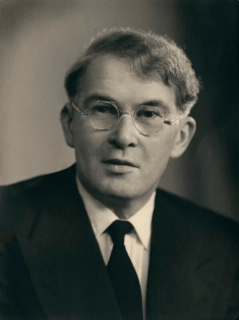
In 1922 Bracken moves to London. He takes charge of the Illustrated Review when its editor, Hilaire Belloc, resigns. Renamed English Life and covering political and social events, it affords Bracken an opportunity to meet prominent people, including J. L. Garvin, editor of The Observer. In autumn 1923 Garvin introduces him to Winston Churchill, who had lost his parliamentary seat in 1922 and decided to contact Leicester West in the 1923 United Kingdom general election. Bracken offers his services as campaign manager. The friendship between Churchill and Bracken is soon so close that Bracken is rumoured to be Churchill’s natural son. Churchill’s wife Clementine dislikes Bracken and discourages the friendship.
Meanwhile Bracken enjoys the life of a ubiquitous socialite and builds up his career in publishing. He becomes a director of Eyre & Spottiswoode in 1926, starting The Banker, a monthly magazine, for them, and acquiring the Financial News in 1928 and a half-share in The Economist. To these are added in due course the Investors Chronicle and The Practitioner. His success in business enables him to acquire a home in North Street in 1928, near the Houses of Parliament. He is driven about in a chauffeured Hispano-Suiza car.
In 1929, Bracken has himself adopted as conservative candidate for Paddington North, a marginal seat. After a hard-fought campaign characterised by minor violence provoked by Bracken’s intemperate language, he wins the seat by 528 votes. At one point a rumour is put about that Bracken is in reality a Polish Jew, which he has to disprove by exhibiting a copy of his birth certificate. His background is a subject of speculation among acquaintances, and in throwaway remarks he gives different fictitious versions of it, Ireland figuring in none of them. He does however remain in constant touch with his mother, to whom he seems to have been deeply devoted, until her death in 1928. However, he has as little contact as possible with his brother and sisters, although he does give assistance to some of them and their families at various times.
In parliament Bracken voices right-wing views on economic issues and is an enthusiastic imperialist. After Churchill resigns from the conservative front bench in 1930 because they would not oppose the Labour government’s proposal for Indian self-government, he is supported by Bracken. During the 1930s, when Churchill is in the wilderness, disagreeing with the party leadership on India and on what he sees as a policy of appeasement toward Hitler‘s Germany, Bracken is his sole political ally. Stanley Baldwin calls him Churchill’s “faithful chela.”
In September 1939, Churchill joins Neville Chamberlain‘s war cabinet as First Lord of the Admiralty. Bracken is appointed his parliamentary private secretary, continuing in that role when Churchill becomes Prime Minister. Despite the king’s opposition, Churchill insists in June 1940 that Bracken should be appointed a privy councillor. Bracken shuts up his house and moves to the Prime Minister’s residence for the duration of the war. As a confidant of the Prime Minister, he often acts as a go-between with other politicians and newspapermen. He is allowed to oversee patronage and takes a special interest in ecclesiastical appointments. In July 1941, he is persuaded by Lord Beaverbrook and Churchill to become Minister for Information. He wins over most of the proprietors by giving them more news, often on a confidential basis, and censorship is kept to a minimum. The BBC is also allowed a fair measure of freedom as long as it behaves responsibly; under the leadership of Cyril Radcliffe, the civil service head of the ministry, it operates more smoothly. Bracken was generally acclaimed for that success.
After the resignation of the Labour ministers from the government at the end of the war in Europe, Bracken joins the cabinet as First Lord of the Admiralty. He is prominent in the general election campaign that follows and is the only conservative minister apart from Churchill to give more than one radio broadcast. He is accused, probably unjustly, of provoking Churchill to take extreme positions, and blamed when the conservatives are heavily defeated at the polls. Bracken himself loses Paddington North to Lt. Gen. Sir Noel Mason-MacFarlane. However, he is soon back in parliament representing Bournemouth, and as front-bench spokesman is an uncompromising opponent of the nationalisation measures of the Labour government (1945–51). He is out of sympathy with the leftward drift of the conservative party associated with Rab Butler and Harold Macmillan.
In December 1951, when Churchill is again Prime Minister, Bracken declines an invitation to serve as Colonial Secretary, pleading that his recurring sinusitis makes it impossible. He resigns his seat in the House of Commons and is created a peer, Viscount Bracken of Christchurch in Hampshire, but never takes his seat in the House of Lords. Although he retires from politics, he remains close to political events through his friendship with Churchill. He is deeply involved in concealing the severe stroke that Churchill suffers in 1953, so that he can carry on as Prime Minister.
In the postwar period, Bracken has important business interests. The Financial News group acquires the Financial Times in 1945, and he is returned as chairman of the expanded company. He writes a weekly Financial Times column until 1954. He oversees the building near St. Paul’s of a new head office, named “Bracken House” after his death. He is also chairman of the Union Corporation mining house, with interests in South Africa, which he frequently visits. From 1950 he is chairman of the board of governors of Sedbergh School, where he goes frequently and often walks for miles across the fells. He organises and finances the restoration of the eighteenth-century school building as a library, with a commemoratory inscription, “Remember Winston Churchill.”
From 1955 Bracken is a trustee of the National Gallery. He is an unrelenting opponent of the proposal to return to Ireland the impressionist paintings bequeathed to it by Hugh Lane, because a codicil willing them to Dublin has not been witnessed. Throughout the postwar period he carries on a prolific correspondence with friends such as Lord Beaverbrook, the American ambassador Lewis Douglas, and the Australian entrepreneur W. S. Robinson. These are a valuable and entertaining source on the political history of the time.
In January 1958, Bracken, who has always been a heavy smoker, is diagnosed with throat cancer. He lingers on until August 8, 1958, when he dies at the flat of his friend Sir Patrick Hennessy in Park Lane. He resists efforts made to reconcile him to the church of Rome. By his own wish he is cremated, and his ashes are scattered on Romney Marsh, Kent. On his instructions his papers are burned by his chauffeur. His estate comes to £145,032.
(From: “Bracken, Brendan” by Charles Lysaght, Dictionary of Irish Biography, www. dib.ie, October 2009 | Pictured: Brendan Bracken, bromide print by Elliott & Fry, January 13, 1950, National Portrait Gallery, London)
She studies in the school of Old Irish established by Professor Osborn Bergin and is strongly influenced by the Irish Australian professor O’Daly. She later teaches Latin through Irish at Ballingeary and becomes proficient in French, German, Italian and Spanish.
She spends the last £100 of her scholarship on a dowry for her marriage to Sean MacGearailt, later first Accountant General of Revenue in the Irish civil service, with whom she lives originally in Glasnevin and then in Dalkey.
She is a founder member of the radical Craobh an Chéitinnigh, the Keating branch of Conradh na Gaeilge, composed mainly of Dublin-based Kerry people and regarded, by themselves at least, as the intellectual focus of the League.
In August 1904, some six years after the establishment of the earliest women’s hurling teams, the rules of camogie (then called camoguidheacht), first appears in Banba, a journal produced by Craobh an Chéitinnigh. Camogie had come to public attention when it was showcased at the annual Oireachtas (Conradh na Gaeilge Festival) earlier that year, and it differed from men’s hurling in its use of a lighter ball and a smaller playing-field. Ní Chinnéide and Cáit Ní Dhonnchadha, like Ní Chinnéide, an Irish-language enthusiast and cultural nationalist, are credited with having created the game, with the assistance of Ní Dhonnchadha’s scholarly brother Tadhg Ó Donnchadha, who drew up its rules. She is on the first camogie team to play an exhibition match in Navan, County Meath, in July 1904, becomes an early propagandist for the game and, in 1905, is elected president of the infant Camogie Association.
She first visits the Blasket Islands in 1932 with her daughter Niamh, who dies tragically young. In the summer of 1934, she puts the idea into Peig Sayers‘s head to write a memoir. According to a later interview with Ní Chinnéide “she knew and admired her gift for easy conversation, her gracious charm as a hostess, her talent for illustrating a point she was making by a story out of her own experience that was as rich in philosophy and thought as it was limited geographically.” Peig answers that she has “nothing to write.” She had learned only to read and write in English at school and most of it has been forgotten.
Ní Chinnéide suggests Peig should dictate her memoir to her son Micheal, known to everyone on the island as An File (“The Poet”), but Peig “only shook her head doubtfully.” At Christmas, a packet arrives from the Blaskets with a manuscript, she transcribes it word for word and the following summer brings it back to the Blaskets to read it to Peig. She then edits the manuscript for the Talbot Press. Peig becomes well known as a prescribed text on the Leaving Certificate curriculum in Irish.
Ní Chinnéide has an acting part in the first modern play performed in Irish on the stage, Casadh an tSugáin by Douglas Hyde in 1901. She is later author of children’s plays staged by An Comhar Drámuidhachta at the Oireachtas and the Peacock Theatre, of which Gleann na Sidheóg and An Dúthchas (1908) are published. She is a broadcaster in Irish on 2RN, a wholly owned subsidiary of Raidió Teilifís Éireann, after its foundation in 1926 and author of a translation of Grimms’ Fairy Tales (1923). She is president of the Gaelic Players Dramatic group during the 1930s and a founder of the Gaelic Writers Association in 1939.
She soon becomes interested in writing children’s plays, including Gleann na Sidheóg (Fairy Glen, 1905) and Sidheoga na mBláth (Flower Fairies, 1909. Although there is little information available on the staging of her first play, by the time her second children’s play, Sidheóga na mBláth, is published in An Claidheamh Soluis in December 1907, “Éire Óg” (“Young Ireland”) branches of Conradh na Gaeilge have been established in conjunction with adults’ branches. Patrick Pearse in particular voices the expectation that this play will be staged by many “Éire Óg” branches “before the New Year is very old,” thus indicating the immediate take up of such plays. Indeed, a week after the play’s publication, it is staged in the Dominican College in Donnybrook, Dublin, where Ní Chinnéide had spent several years as an Irish teacher.
Seán Hales, Irish political activist and member of Dáil Éireann from May 1921 to December 1922, is shot and killed in Dublin on December 7, 1922, by republican gunmen on orders from Liam Lynch directing the Irish Republican Army (IRA) to kill, amongst others, all deputies and senators who had voted for the Public Safety Act (September 28, 1922) which established military courts with the power to impose the death penalty.
Hales is born John Hales in Ballinadee, Bandon, County Cork, on March 30, 1880, the eldest child of five sons and four daughters of Robert Hales, a farmer, and Margaret (née Fitzgerald) Hales. He is educated at Ballinadee national school and Warner’s Lane school, Bandon. After leaving school he goes to work on his father’s farm. He plays hurling with Valley Rovers GAA club and is the Munster champion in the 56-lb. weight-throwing competition. From an early age he follows in his father’s footsteps and becomes involved in the republican movement.
Hales joins the Irish Volunteers in 1915 and becomes captain of the Ballinadee company in 1916. Arrested under the Defence of the Realm Act after the 1916 Easter Rising, he is imprisoned in Frongoch internment camp in Wales. After his release, in April 1917 he becomes executive of the short-lived Liberty League promoted by Count George Plunkett. When the League merges with Sinn Féin, he helps reorganise the Volunteers. With his brothers, Tom, William, and Donal, he continues his father’s fight on behalf of evicted tenants and becomes involved with the anti-British Bandon People’s Food Committee and the anti-landlord Unpurchased Tenants’ Association. He helps in the Sinn Féin takeover of The Southern Star newspaper and is a member of the new board of directors. In 1919 he becomes battalion commander of the first (Bandon) battalion 3rd Cork Brigade of the Irish Republican Army, the name by which the Irish Volunteers increasingly became known. He leads the attack on TimoleagueRoyal Irish Constabulary (RIC) barracks in February 1920, and the ambush of an Essex Regiment patrol at Brinny in August 1920. The military patrol at Brinny manages to surprise the ambushers and Lieutenant Tim Fitzgerald of Bandon is the first Volunteer to be killed in action in west Cork. Hales then commands the assault on two truckloads of British troops at Newcestown Cross in which a British officer is killed and several soldiers are wounded.
Hales is appointed section commander of the west Cork flying column in 1920 and takes part in the major action at Crossbarry on March 19, 1921. In retaliation for the burning of the Hales home in March 1921, he leads a contingent of Volunteers and burns Castle Bernard, the residence of the Earl of Bandon. The occupant, Lord Bandon, is held hostage until General Strickland, the British OC in Cork, guarantees he will not execute Volunteers in Cork prison. The British authorities yield and there is an end to the policy of executing prisoners of war in the Cork area.
At the 1922 Irish general election, Hales is elected to the Third Dáil as a pro-Treaty Sinn Féin Teachta Dála (TD) for the same constituency. He receives 4,374 first preference votes (7.9%). Shortly afterward, the Irish Civil War breaks out between the pro-Treaty faction, who are in favour of setting up the Irish Free State and the anti-Treaty faction, who would not accept the abolition of the Irish Republic.
On December 7, 1922, Hales is killed by anti-Treaty IRA men as he leaves the Dáil. Another TD, Pádraic Ó Máille, is also shot and badly wounded in the incident. His killing is in reprisal for the Free State’s execution of anti-treaty prisoners. In revenge for Hales’ killing, four republican leaders, Joe McKelvey, Rory O’Connor, Liam Mellows and Richard Barrett, are executed the following day, December 8, 1922.
Hales is given a military funeral to the family burial place at St. Patrick’s Cemetery, Bandon.
According to information passed on to playwrightUlick O’Connor, an anti-Treaty IRA volunteer named Owen Donnelly of Glasnevin is responsible for the killing of Hales. Seán Caffrey, an anti-treaty intelligence officer told O’Connor that Donnelly had not been ordered to kill Hales specifically but was following the general order issued by Liam Lynch to shoot all deputies and senators they could who had voted for the Public Safety Act (September 28, 1922) which established military courts with the power to impose the death penalty.
A commemorative statue of Hayes is unveiled at Bank Place in Bandon in 1930.