seamus dubhghaill

Promoting Irish Culture and History from Little Rock, Arkansas, USA


Leave a comment

Birth of N.I. Footballer Robert Dennis “Danny” Blanchflower

danny-blanchflower

Robert Dennis “Danny” Blanchflower, former Northern Ireland international footballer and football manager, is born on February 10, 1926 in the Bloomfield district of Belfast, the first of five children born to John and Selina Blanchflower.

Blanchflower is educated at Ravenscroft public elementary school and is awarded a scholarship to Belfast College of Technology. He leaves school early to become an apprentice electrician at Gallaher’s cigarette factory in Belfast. He also joins the Air Raid Precautions and, in 1943, joins the Royal Air Force after lying about his age. By 1946, after a trainee navigator course at St. Andrews University and further training in Canada, he is back at Gallaher’s in Belfast and building a reputation as an outstanding footballer.

Blanchflower signs with Glentoran F.C. in 1946 before crossing the Irish Sea and signing with Barnsley F.C. for £6000 in 1949 at the age of 23. He transfers from Barnsley to Aston Villa F.C. for a fee of £15,000 and makes his First Division debut in March 1951. He makes 155 senior appearances for Villa before being bought by Tottenham Hotspur F.C. in 1954 for a fee of £30,000. During his ten years playing at White Hart Lane he makes 337 League appearances and 382 total appearances.

The highlight of his time with the Spurs comes in the 1960–61 season, while serving as captain, the Spurs win their first 11 games and eventually win the league by 8 points. They beat Leicester City F.C. in the final of the FA Cup, becoming the first team in the 20th century to win the League and Cup double and a feat not achieved since Aston Villa in 1897.

In 1962, Blanchflower again captains the Spurs team to victory in the FA Cup in 1962, narrowly missing out on a second double when they finish a close third in the league behind Ipswich Town F.C. and Burnley F.C. In 1963, he captains the team to victory over Atlético Madrid in the final of the European Cup Winners’ Cup, making Spurs the first English team to win a European trophy.

Between 1949 and 1963, he earns 56 caps for Northern Ireland, often playing alongside his brother Jackie until the younger Blanchflower’s playing career is cut short as a result of injuries sustained in the Munich air disaster of February 1958. In 1958, captains his country when they reached the quarter-finals of the World Cup.

On December 4, 1957, he captains the Northern Ireland team against Italy in Belfast in a bad tempered game that comes to be known as the “Battle of Belfast.” Blanchflower attempts to keep the peace as the game turns nasty.

Blanchflower announces his retirement as a player on April 5, 1964, having played nearly 400 games in all competitions for the Spurs and captains them to four major trophies.

Following his retirement as a player, Blanchflower coachs for the Spurs for a number of years. Manager Bill Nicholson intends for Blanchflower to be his successor but, when Nicholson resigns in 1974, Blanchflower is passed over in favour of Terry Neill. He leaves the Spurs and becomes manager of Northern Ireland for a brief spell in 1978 before being appointed boss of Chelsea F.C. The team wins only three of fifteen games under his charge and he leaves the team in September 1979.

On May 1, 1990, Tottenham holds a testimonial match for Blanchflower at White Hart Lane, but at this point he is in the early stages of what is later diagnosed as Alzheimer’s disease and Parkinson’s disease. He is eventually placed in a Staines nursing home where he dies as a result of pneumonia on December 9, 1993, at the age of 67.

Blanchflower’s hometown of Belfast has honoured him with an Ulster History Circle plaque, located at his childhood home at 49 Grace Avenue, recognising the late sportsman as one of the greatest players in the history of Tottenham Hotspur FC.

1 Comment

The 1996 Docklands Bombing

docklands-bombing

The Docklands bombing, also known as the Canary Wharf bombing or the South Quay bombing, occurs on February 9, 1996, marking the end of the Irish Republican Army‘s (IRA) seventeen-month ceasefire.

At about 7:01 PM on February 9, the Provisional Irish Republican Army detonates a large bomb in a small lorry about 80 yards from South Quay Station on the Docklands Light Railway in the Canary Wharf financial district of London. The bomb, containing 500 kg of ammonium nitrate fertilizer and sugar and a detonating cord made of semtex, PETN, and RDX high explosives, is placed directly under the point where the tracks cross Marsh Wall.

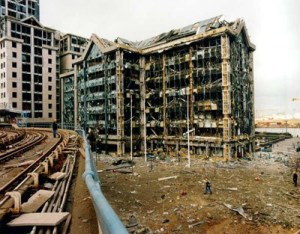
The IRA sends telephone warnings 90 minutes prior to the detonation and the area is evacuated. However, two men working in the newsagents shop directly opposite the explosion, Inam Bashir and John Jeffries, are not evacuated in time and are killed in the explosion. Thirty-nine people require hospital treatment as a result of the blast and falling glass. A portion of the South Quay Plaza is destroyed, and the explosion leaves a crater ten metres wide and three metres deep. The shockwave from the blast causes windows to rattle five miles away.

Approximately £100 million worth of damage is done by the blast. The Midland Bank building is damaged beyond economic repair and is demolished. South Quay Plaza I and II are severely damaged and require complete rebuilding. The station itself is extensively damaged, but both it and the bridge under which the bomb is exploded are reopened within weeks.

The bombing marks the end of a 17-month IRA ceasefire during which Irish, British, and American leaders work for a political solution to the troubles in Northern Ireland. IRA member James McArdle is convicted of conspiracy to cause explosions and sentenced to 25 years in prison, but murder charges are dropped. McArdle is released under the terms of the Good Friday Agreement in June 2000 with a royal prerogative of mercy from Queen Elizabeth II.

dockland-bombing-damage

The IRA describes the deaths and injuries as a result of the bomb as “regrettable,” but says that they could have been avoided if police had responded promptly to “clear and specific warnings.” Commissioner of the Metropolitan Police Sir Paul Condon says, “It would be unfair to describe this as a failure of security. It was a failure of humanity.”

Gerry Adams, the leader of Sinn Féin, the political wing of the IRA, speaks of the need to continue the peace process. British Prime Minister John Major says there is now “a dark shadow of doubt” where optimism has existed.

On February 28, Prime Minister Major and Taoiseach of the Republic of Ireland John Bruton, announce that all-party talks will be resumed in June. Major’s decision to drop the demand for IRA decommissioning of weapons before Sinn Fein is allowed into talks leads to criticism from the press, which accuse him of being “bombed to the table.”


Leave a comment

Hillary Clinton Announced for Induction into Irish America Hall of Fame

hillary-clintonOn February 2, 2015, Irish America magazine announces that Hillary Rodham Clinton will be inducted into the Irish America Hall of Fame in March, in recognition of her work on the Irish peace process.

Clinton travels frequently to Ireland as First Lady and as U.S. Secretary of State, and often talks about the end of the civil strife, known as The Troubles, as a crowning foreign policy achievement of her husband’s administration. On her visit to Belfast in 2012, she pledges to continue to support peace in Ireland in whatever way possible.

“Hillary Rodham Clinton is one of the unsung heroes of the success of the Irish peace process,” says Niall O’Dowd, publisher of Irish America magazine. “As First Lady, U.S. Senator, and Secretary of State she always gave the issue top priority to help ensure it remained at the top of the U.S. foreign policy agenda. During that historic first trip to Northern Ireland with Bill Clinton in 1995, which I was privileged to be on, she galvanized women’s groups on both sides by meeting with them, shaping their agenda, and making sure they always had a friend in the U.S. administration. More than that, she constantly stayed involved, never giving up her focus on bringing an end to Europe’s longest conflict at the time.”

On the eve of St. Patrick’s Day, Clinton delivers the keynote address at the luncheon in Manhattan of high profile Irish-Americans who each year honor elected officials and others. She describes sitting at a table in Belfast, over cups of tea, with women from both sides of the conflict and watching as they discover how much they share.

She does not portray herself as instrumental to the Good Friday Agreement that President Clinton brokered in 1998, but says her outreach to women in Belfast on multiple visits during that period had played a critical role.

“You cannot bring peace and security to people just by signing an agreement,” she says. “In fact, most peace agreements don’t last.” She says that when “the work of peace permeates down to the kitchen table, to the backyard, to the neighborhood, around cups of tea, there’s a much greater chance the agreement will hold.”

Previous inductees into the Irish America Hall of Fame include former President John F. Kennedy, former President Bill Clinton, Vice President Joseph R. Biden, Jr., and former Maryland Governor Martin O’Malley, who addressed the luncheon in 2014 in a mix of English and Irish.


Leave a comment

Bloody Sunday in Derry, Northern Ireland

bogside-mural

Bloody Sunday, sometimes referred to as the Bogside Massacre, occurs on January 30, 1972, in the Bogside area of Derry, Northern Ireland. Twenty-six unarmed civilians are shot by British soldiers of the 1st Battalion, Parachute Regiment, as they march in protest of internment (imprisonment without trial). Thirteen people are killed on the spot, and another dies over four months later as a result of his injuries.

The march, organised by the Northern Ireland Civil Rights Association and the Northern Resistance Movement, begins at about 2:45 PM at Bishop’s Field and is to conclude at the Guildhall, in the city centre, where a rally is to take place. There are as many as 15,000 people in the march, with many joining along the route.

As the march makes its way along William Street and nears the city centre, its path is blocked by British Army barricades. The organisers then redirect the march down Rossville Street with the intention of holding the rally at Free Derry Corner instead. Some of the marchers, however, break away from the march and begin throwing stones at soldiers manning the barricades. The soldiers fire rubber bullets, CS gas, and water cannon to try and disperse the rioters and observers report that this rioting is not intense.

Some of the marchers spot British paratroopers hiding in a derelict three-story building overlooking William Street and begin throwing stones at the windows. At about 3:55 PM, the first shots are fired as these paratroopers open fire with real bullets. Civilians Damien Donaghy and John Johnston are shot and wounded while standing on waste ground opposite the building. The soldiers claim Donaghy is holding a black cylindrical object.

At 4:07 PM, the paratroopers are ordered to go through the barricades and arrest rioters. On foot and in armoured vehicles, the paratroopers chase people down Rossville Street and into the Bogside. Two people are knocked down by the vehicles. Although Brigadier Pat MacLellan orders that only one company of paratroopers be sent on foot through the barricades and that they should not chase people down Rossville Street, Lieutenant Colonel Derek Wilford disobeys this order. This results in no separation between the rioters and the peaceful marchers.

There are many claims of paratroopers beating people, clubbing them with rifle butts, firing rubber bullets at them from close range, making threats to kill, and hurling abuse. One group of paratroopers take up position at a low wall about 80 yards in front of a rubble barricade that stretches across Rossville Street. Some of the people near the barricade throw stones at the soldiers but they are not close enough to hit the soldiers. The soldiers then open fire on the people at the barricade, killing six and wounding another.

A large group of people flee or are chased into the car park of Rossville Flats, which is like a courtyard, surrounded on three sides by high-rise flats. The soldiers open fire, killing one civilian, Jackie Duddy, who is shot in the back, and wounding six others.

Other people flee into the car park of Glenfada Park, which is also a courtyard-like area surrounded by flats. From a distance of approximately 50 yards, the soldiers shoot at people across the car park. Two civilians are killed and at least four others wounded. The soldiers pass through the car park and out the other side. Some soldiers exit the southwest corner, where they shoot and kill two civilians. The remainder exit the southeast corner and shoot four more civilians, killing two.

Only about ten minutes elapse between the time soldiers first drive into the Bogside and the time the last of the civilians is shot. Under the command of Major Ted Loden, more than 100 rounds are fired by the soldiers.

Some of those shot are given first aid by civilian volunteers, either on the scene or after being carried into nearby homes. The first ambulances arrive at 4:28 PM. The injured are then driven to the hospital, either in civilian cars or in ambulances. The three boys killed at the rubble barricade are driven to hospital by the paratroopers after, as witnesses claim, they lifted the bodies by the hands and feet and dumped them in the back of their vehicle as if they were “pieces of meat.”

In April 1972, the British government releases a report exonerating British troops from any illegal actions during the protest. The shootings act as a rallying call for the Irish Republican Army (IRA) as their numbers swell and Irish indignation over Britain’s Northern Ireland policies grow. As a result, Britain increases its military presence in the North while removing any vestige of Northern self-rule. On July 21, 1972, the IRA explode 20 bombs simultaneously in Belfast, killing British military personnel and a number of civilians. Britain responds by instituting a new court system composed of trial without jury for terrorism suspects and conviction rates exceed 90 percent. No criminal charges have ever been brought against the participating members of the British military.


Leave a comment

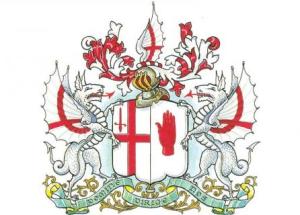
Creation of The Honourable The Irish Society

irish-society-coat-of-arms

On January 28, 1613, The Honourable The Irish Society, a consortium of livery companies of the City of London, is created by Royal Charter of James I of England to undertake the Plantation in the North West of Ulster that is then being driven by the English Crown.

Following the Gaelic defeat in the Nine Years’ War in 1603 and the Flight of the Earls in 1607, northwest Ulster is left open to colonisation. James I sets out to defend against a future attack from within or without. He finds that the town of Derry can become either a great asset as a control over the River Foyle and Lough Swilly, or it can become an inviting back door should the people of the area turn against him. He pressures the guilds of the City of London to fund the resettlement of the area, including the building of a new walled city. This results in the creation of the Society.

The city of Derry is renamed Londonderry in recognition of the London origin of the Irish Society. County Coleraine is enlarged and renamed County Londonderry after its new county town. The rural area of the county is subdivided between the Great Twelve livery companies, while the towns and environs of Londonderry and Coleraine are retained by the Irish Society.

In January 1635, the Irish Society, as well as the City of London, are found guilty of mismanagement and neglect of Derry plantation. They are sentenced to a fine of £70,000 and forfeiture of Derry property. The Society is suppressed in 1637 but is revived by Oliver Cromwell in 1650 and again after the Restoration by Londonderry’s 1662 royal charter.

The Society is involved in several controversies over the years including a dispute over fishing rights with the Church of Ireland and Bishop of Derry and a lawsuit brought by The Skinners’ Company in 1832 over the distribution of profits. The Society also has some disputes with the corporations over ownership and development of property. During the 17th and 18th centuries, four of the twelve livery companies sell their estates, with the Irish Society requiring a bond of indemnity in each case. Leases to middlemen granted by the remaining companies expire at various times during the nineteenth century, after which the companies “enormously increased the rental.”

The Society finances the building of the Guildhall in Derry. Construction begins in 1887 and it is opened in July 1890, at a cost of £19,000.

The Society remains in existence today as a relatively small grant-giving charitable body. Its educational grants are funded by its remaining property, including the Walls of Derry, a tourist attraction and heritage site, and fisheries on the River Bann. The Society is based in London, but maintains a “representative” resident in County Londonderry.


Leave a comment

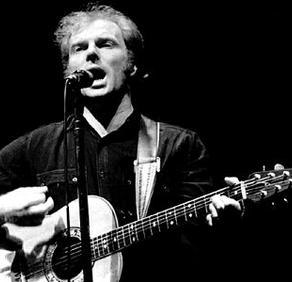
Van Morrison Inducted Into Rock & Roll Hall of Fame

van-morrisonVan Morrison, known as “Van the Man” to his fans, is inducted into the Rock and Roll Hall of Fame in Cleveland, Ohio, on January 23, 1993.

Born George Ivan Morrison in Belfast in 1945, Morrison has received six Grammy Awards (1996-2007), the 1994 Brit Award for Outstanding Contribution to Music, and has been inducted into the Irish Music Hall of Fame (September 1999) and the Songwriters Hall of Fame (June 2003). In 2015 he is knighted by Queen Elizabeth II for his musical achievements and his services to tourism and charitable causes in Northern Ireland.

Morrison’s influence can readily be heard in the music of a diverse array of major artists and according to The Rolling Stone’s Encyclopedia of Rock and Roll, “his influence among rock singers/song writers is unrivaled by any living artist outside of that other prickly legend, Bob Dylan. Echoes of Morrison’s rugged literateness and his gruff, feverish emotive vocals can be heard in latter day icons ranging from Bruce Springsteen to Elvis Costello.”

Morrison is inducted into the Hall along with luminaries Ruth Brown, Cream, Creedence Clearwater Revival, The Doors, Frankie Lymon & The Teenagers, and Etta James. In his induction speech of Morrison, the Band’s Robbie Robertson says, “In the tradition of the great Irish poets and the great soul singers, he is the Caruso of rock and roll.” Morrison becomes notable as the first living inductee into the Rock and Roll Hall of Fame not to attend his own ceremony. Robertson accepts the award on Morrison’s behalf.

This “Caruso of rock and roll” and magnificent songwriter is also one of the most curmudgeonly live performers in rock and roll history. The satirical Onion newspaper writes of him, “Morrison deserves a spot in the Rock Hall based on his record-breaking streak of 4,256 consecutive shows performed without cracking a smile.”