
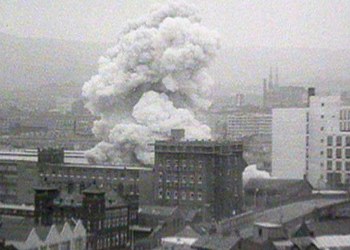
At least twenty Provisional Irish Republican Army (IRA) bombs explode in Belfast on July 21, 1972, during the Troubles in what has become known as “Bloody Friday.” Most of the bombs are car bombs and most target infrastructure, especially the transport network. Nine people are killed, including two British soldiers and five civilians, while 130 are injured.
In late June and early July 1972, a British government delegation led by William Whitelaw holds secret talks with the Provisional IRA leadership. As part of the talks, the IRA agrees to a temporary ceasefire beginning on June 26. The IRA leaders seek a peace settlement that includes a British withdrawal from Northern Ireland by 1975 and the release of republican prisoners. However, the British refuse and the talks break down. The ceasefire comes to an end on July 9.
Bloody Friday is the IRA’s response to the breakdown of the talks. According to the IRA’s Chief of Staff, Seán Mac Stíofáin, the main goal of the bombing operation is to wreak financial harm. It is a “message to the British government that the IRA could and would make a commercial desert of the city unless its demands were met.” Some also see it as a reprisal for Bloody Sunday in Derry six months earlier. The attack is carried out by the IRA’s Belfast Brigade and the main organiser is Brendan Hughes, the brigade’s Officer Commanding.
The bombings occur during an 80-minute period on the afternoon of Friday, July 21. At least 24 bombs are planted. At least 20 explode and the rest fail to detonate or are defused. At the height of the bombing, the middle of Belfast “resembled a city under artillery fire; clouds of suffocating smoke enveloped buildings as one explosion followed another, almost drowning out the hysterical screams of panicked shoppers.” According to The Guardian, “for much of the afternoon, Belfast was reduced to near total chaos and panic. Thousands streamed out of the stricken city…and huge traffic jams built up. All bus services were cancelled, and on some roads, hitchhikers frantically trying to get away lined the pavements.”
Nine people are killed and 130 are injured, some of them horrifically mutilated. Of those injured, 77 are women and children. All of the deaths are caused by two of the bombs – at Oxford Street bus depot and at Cavehill Road. The Oxford Street bomb kills two British soldiers and four Ulsterbus employees. One employee is a Royal Ulster Constabulary (RUC) reservist, one is an Ulster loyalist paramilitary, and the other two are civilians. The Cavehill Road bomb kills three civilians.
The IRA’s Belfast Brigade claims responsibility for the bombings and says that it had given warnings to the security forces before the bombs exploded. It says that the Public Protection Agency, the Samaritans and the press “were informed of bomb positions at least 30 minutes to one hour before each explosion.” Mac Stíofáin says, “It required only one man with a loud hailer to clear each target area in no time” and alleged that the warnings for the two bombs that claim lives are deliberately ignored by the British for “strategic policy reasons.”


 The
The 
 After nearly two years of talks, the

 seamus dubhghaill