seamus dubhghaill

Promoting Irish Culture and History from Little Rock, Arkansas, USA


Leave a comment

Birth of Brian Warfield, Founding Member of The Wolfe Tones

Brian Warfield

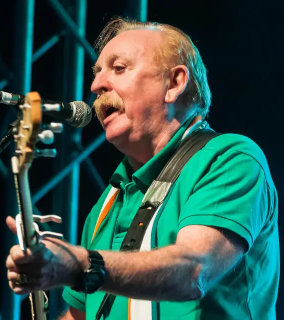
Patrick Brian Warfield, vocalist, banjo, harp and bodhrán player and lead songwriter with long-standing Irish band The Wolfe Tones, is born on April 2, 1946, in the National Maternity Hospital, Dublin. He introduces many of the songs at the Wolfe Tones live concerts and is a keen historian.

Warfield is raised in the Dublin suburb Inchicore, the second born in a family of four boys. Today, he and his wife June Warfield (née Radburn) reside in Blessington, County Wicklow.

Warfield is one of the founding members and lead singers of the Irish Folk band, The Wolfe Tones. He has written many songs for the band, notably “Up and Away (The Helicopter Song),” “Irish Eyes” and “My Heart is in Ireland.” “Let the People Sing” is written in dedication to those Irish ballad singers who were banned from singing Irish songs. It has been performed by many Celtic and Irish Rebel bands, including Celtic band Charlie and the Bhoys. The song is popular among fans of Celtic F.C. and a version is performed by The Malleys, omitting the second verse, at Celtic Park on match days.

Warfield’s affiliation with Celtic F.C. leads to him being asked to write a song for the club to celebrate its 100th anniversary. As a result, “Celtic Symphony” is composed. It is a song popular with many Celtic fans, but controversial due to its chorus, which features the words “ooh, ah, up the RA.” This is often seen as being a pro-Irish Republican Army (IRA) stance, but according to Warfield, the words were included in the balladic tradition of writing what is observed at the time.

As a songwriter, Warfield’s writing is typically a social commentary on Ireland and its issues. For the 2012 album, Child of Destiny, Warfield composes “Swing A Banker,” which is a comical ballad referring to Irish bankers as chickens. The music video is recorded outside the Treasury Building in Dublin.

The Wolfe Tones continue to tour but have announced that they are set to retire in 2024, after 60 years of performing together. In addition to gigs in the United States, there will be concerts at Galway Airport, Castlebar, County Mayo, and in the 3Arena in Dublin, with the band’s final gig taking place in Belfast in October 2024.

As of January 2024, Warfield has not communicated with his brother Derek Warfield since he left The Wolfe Tones in 2001.


Leave a comment

Irish Celtic Rock Band Horslips Disbands

horslips

Horslips, the Irish Celtic rock band regarded as the “founding fathers of Celtic rock,” disbands on October 12, 1980. The name originates from a spoonerism on The Four Horsemen of the Apocalypse which becomes “The Four Poxmen of The Horslypse.”

Barry Devlin, Eamon Carr and Charles O’Connor meet when they work at the Ark advertising company in Dublin. They are cajoled into pretending to be a band for a Harp Lager commercial but need a keyboard player. Devlin says he knows a Jim Lockhart who would fit the bill. The four enjoy the act so much that they decide to try being proper rock performers. They join guitarist Declan Sinnott, a colleague of Eamon Carr’s from Tara Telephone and, briefly, Gene Mulvaney to form Horslips (originally Horslypse) in 1970.

The band goes professional on St. Patrick’s Day 1972 having shed Mulvaney and released a single, “Johnny’s Wedding”, on their own record label, Oats. Declan Sinnott leaves soon after, primarily due to his annoyance at the group appearing in an advert for Mirinda orange drink. He is replaced by Gus Guest briefly, then Johnny Fean.

Following the release of six studio albums between 1972 and 1977, the ever-ambitious band tries to make it in the United States. In 1977 they produce Aliens, about the experience of the Irish in nineteenth-century America, which includes very little folk music. The Man Who Built America (1978), produced by Steve Katz of Blood, Sweat & Tears and The Blues Project fame, concerns Irish emigration to the United States and is commercially their most successful album. The heavier sound does bring some acceptance in America, but they lose their folk base and their freshness. Short Stories, Tall Tales (1979) is their last studio album and is panned by the record company and critics alike.

At a time when The Troubles are at its peak, Horslips plays gigs in both Northern Ireland and the Republic of Ireland without prejudice and are accepted everywhere. Their last recordings are from live performances at the Whitla Hall at Queen’s University Belfast in April and May 1980. A few months later, on October 12, 1980, they play their final gig in the Ulster Hall. They make no public announcement. They simply give an encore, The Rolling Stones‘ song “The Last Time,” and the final act is Charles O’Connor throwing his mangled fiddle into the audience. Ten years after they formed, they disband.

Although Horslips has limited commercial success when the band is playing in the 1970s, there is a revival of interest in their music in the late 1990s and they come to be regarded as one of the defining bands of the Celtic rock genre. There have since been small scale reunions including appearances on The Late Late Show and RTɑs Other Voices. The band reforms for two Irish shows in the Odyssey Arena in Belfast and the 3Arena in Dublin at the end of 2009 and have continued to play shows since then.