seamus dubhghaill

Promoting Irish Culture and History from Little Rock, Arkansas, USA


Leave a comment

Death of Columba, Founder of the Monastery of Iona

Columba (or Colum Cille), Irish abbot and missionary evangelist credited with spreading Christianity in what is today Scotland at the start of the Hiberno-Scottish mission., dies on June 9, 597.

He is born into the Cenél Conaill, a branch of the Northern Uí Néill, then Ireland’s most powerful dynasty. His place of birth is reputedly Gartan in modern day County Donegal, though there is no contemporary evidence for this.

His is the son of Fedlimid, who is said to be a great-grandson of Niall Nóigiallach, and his wife Eithne. The Irish form of his name, Colum Cille, has been taken to mean ‘Dove of the Church’. He is fostered and baptised by a priest named Cruithnechán, who lives near his birthplace. It is reputed that he undergoes schooling in bardic studies. His biographer, Adomnán (c. 624–704), states that he receives monastic training under a bishop whom he names variously as Findbarr or Finnio, who can most likely be identified as Finnian of Movilla. Otherwise little is known of his early life.

Adomnán states that Columba leaves Ireland in his forty-second year. Later tradition records that his departure is an act of penitence for instigating the battle of Cúl Dreimhne in 561, supposedly because he surreptitiously copies a Psalter lent to him by his former master, Finnian. Adomnán simply states, however, that he leaves Ireland to become a “pilgrim for Christ.” He probably also wishes to sever himself from the secular concerns arising from his family connections. Whatever the reason, he remains in Scotland for the rest of his life, returning to Ireland only on a few occasions.

His choice of Iona, an island off the Ross of Mull on the western coast of Scotland, as a monastic refuge is influenced by the contacts that his family has with the kingdom of Dál Riata and its rulers. Certainly it is under Dál Riata patronage that he subsequently founds the island monasteries of Campus Lunge (on Tiree) and Hinba, which more recent opinion takes to have been the island of Colonsay. He also founds churches in Inverness, probably following on his meeting with and likely conversion of Bridei I, king of the Picts. All of Iona’s foundations, on both sides of the Irish Sea, are under the headship of the abbot of the mother-house, and many of the abbots of the most important houses of the paruchia of Iona are of Columba’s kin-group. Although many foundations elsewhere in Scotland and in Northumbria are later attributed to him, it is doubtful whether Iona evangelises outside of Ireland, Dál Riata and Pictland. Yet there can be no doubt of his political influence. He “ordains” Áedán king of Dál Riata, and his influence and connections enable him to strengthen the alliance between the Uí Néill and Dál Riata.

One of the few, if not the only, times he leaves Scotland is toward the end of his life, when he returns to Ireland to found the monastery at Durrow.

According to traditional sources, Columba dies in Iona on Sunday, June 9, 597, and is buried by his monks in the abbey he created. However, Dr. Daniel P. McCarthy disputes this and assigns a date of 593 to Columba’s death. The Annals record the first raid made upon Iona in 795, with further raids occurring in 802, 806 and 825. Columba’s relics are finally removed in 849 and divided between Scotland and Ireland.

Colmcille is one of the three patron saints of Ireland, after Patrick and Brigid of Kildare. He is the patron saint of the city of Derry, where he founded a monastic settlement in c. 540. The Catholic Church of Saint Colmcille’s Long Tower, and the Church of Ireland St. Augustine’s Church both claim to stand at the spot of this original settlement. The Church of Ireland Cathedral, St. Columb’s Cathedral, and the largest park in the city, St. Columb’s Park, are named in his honour. The Catholic Boys’ Grammar School, St. Columb’s College, has him as Patron and namesake.

St. Columba’s National School in Drumcondra is a girls’ school named after the saint.

St. Colmcille’s Primary School and St. Colmcille’s Community School are two schools in Knocklyon, Dublin, named after him, with the former having an annual day dedicated to the saint on June 9.

The town of Swords, Dublin is reputedly founded by Colmcille in 560 AD. St. Colmcille’s Boys’ National School and St. Colmcille’s Girls’ National School, both located in the town of Swords, are also named after the Saint as is one of the local Gaelic teams, Naomh Colmcille.

The Columba Press, a religious and spiritual book company based in Dublin, is named after Colmcille.

Aer Lingus, Ireland’s national flag carrier has named one of its Airbus A330 aircraft in commemoration of the saint (reg: EI-DUO).

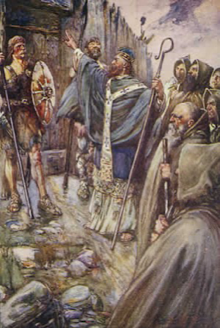
(Pictured: Columba banging on the gate of Bridei, son of Maelchon, King of Fortriu)


Leave a comment

Death of Mary McShain, Landowner & Benefactor

Mary McShain, Irish American landowner and benefactor, dies at Killarney House in Killarney, County Kerry on December 2, 1998.

McShain is born Mary Horstmann in Philadelphia, Pennsylvania on March 27, 1907. Her parents are Ignatius J. Horstmann and his wife Pauline. She is the fifth of six children. She attends St. Leonard’s Academy in Philadelphia and Rosemont College in Rosemont, Pennsylvania. In 1927 she marries John McShain, building contractor who works on the reconstruction of the White House and the building of the Jefferson Memorial, the Pentagon, and the John F. Kennedy Center for the Performing Arts. They are both interested in horse breeding and racing, establishing a stable of racehorses in 1952. They expand this stable to Ireland in 1955, hiring first Vincent O’Brien and then John Oxx as trainers. Their greatest success is the horse Ballymoss.

The McShains move to Ireland in 1960, buying Killarney House in County Kerry and a large portion of the Kenmare estate, which had been owned by the Earls of Kenmare since the 16th century. They gift Innisfallen Island and the ruins of an abbey to the Irish state in 1973, bestowing guardianship of Ross Island and its castle to the state. For a nominal fee, they turn over the entire estate to the state in 1979, stipulating a life tenancy of the house and some land, with the rest of the land being incorporated into Killarney National Park.

McShain is a Dame of Malta and a Lady of the Grand Cross of the Holy Sepulchre. She receives the Pro Ecclesia et Pontifice cross in 1976. She is awarded two honorary doctorates in 1977, one from La Salle University in Philadelphia and one from her alma mater, Rosemont College.

McShain dies at Killarney House on December 2, 1998. She is buried beside her husband in Holy Cross Cemetery, Philadelphia. Her daughter, Pauline McShain, is a sister of the Society of the Holy Child Jesus and dies on March 8, 2019 due to complications of pneumonia.

(Pictured: John and Mary McShain with Lakes of Killarney in the background sometime in the late 1950s)


Leave a comment

St. Columba Arrives on the Isle of Iona

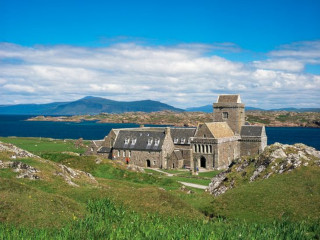
iona-abbey-isle-of-iona

St. Columba, an Irish monk, and twelve followers arrive on the tiny isle of Iona, barely three miles long by one mile wide, on May 12, 563, establishing a monastic community and building his first Celtic church. Iona has an influence out of all proportion to its size on the establishment of Christianity in Scotland, England and throughout mainland Europe.

Once settled, Columba sets about converting most of pagan Scotland and northern England to the Christian faith. Iona’s fame as a missionary centre and outstanding place of learning eventually spreads throughout Europe, turning it into a place of pilgrimage for several centuries to come. Iona becomes a sacred isle where kings of Scotland, Ireland and Norway are buried.

Columba is born of royal blood in 521 AD in Ireland, or Scotia as it is then called. He is the grandson of the Irish King Niall. He leaves Ireland for Scotland not as a missionary but as an act of self-imposed penance for a bloody mess he had caused at home. He had upset the king of Ireland by refusing to hand over a copy of the Gospel he had illegally copied, leading to a pitched battle in which Columba’s warrior family prevailed. Full of remorse for his actions and the deaths he had ultimately caused, he flees, ultimately settling on Iona as it is the first place he finds from which he is unable to see his native Ireland. One of the features on the island is even called “The Hill with its back to Ireland.”

Columba, however, is not the shy retiring type and sets about building Iona’s original abbey from clay and wood. In this endeavour he displays some strange idiosyncrasies, including banishing women and cows from the island. The abbey builders have to leave their wives and daughters on the nearby Eilean nam Ban (Woman’s Island). Stranger still, he also banishes frogs and snakes from Iona, although how he accomplishes this feat is not well documented.

The strangest claim of all however is that Columba is prevented from completing the building of the original chapel until a living person has been buried in the foundations. His friend Oran volunteers for the job and is duly buried. It is said that Columba later requests that Oran’s face be uncovered so he can bid a final farewell to his friend. Oran’s face is uncovered and he is found to be still alive but utters such blasphemous descriptions of Heaven and Hell that Columba orders that he be covered up immediately.

Over the centuries the monks of Iona produce countless elaborate carvings, manuscripts and Celtic crosses. Perhaps their greatest work is the exquisite Book of Kells, which dates from 800 AD, currently on display in Trinity College, Dublin. Shortly after this, in 806 AD, come the first of the Viking raids and many of the monks are slaughtered and their work destroyed.

The Celtic Church, lacking central control and organisation, diminishes in size and stature over the years to be replaced by the much larger and stronger Roman Church. Even Iona is not exempt from these changes and in 1203 a nunnery for the Order of the Black Nuns is established and the present-day Benedictine abbey, Iona Abbey, is built. The abbey is a victim of the Reformation and lay in ruins until 1899 when restoration is started.

No part of Columba’s original buildings have survived, however on the left hand side of the abbey entrance can be seen a small roofed chamber which is claimed to mark the site of the Columba’s tomb.

(From: “St. Columba and the Isle of Iona” by Ben Johnson, historic-uk.com, pictured is the Iona Abbey and Nunnery)


Leave a comment

Discovery of the Derrynaflan Chalice

derrynaflan-chalice

The Derrynaflan Chalice, an 8th- or 9th-century chalice, is found as part of the Derrynaflan Hoard of five liturgical vessels on February 17, 1980 near Killenaule, County Tipperary. According to art historian Michael Ryan the hoard “represents the most complex and sumptuous expression of the ecclesiastical art-style of early-medieval Ireland as we know it in its eighth- and ninth-century maturity.” The group is among the most important surviving examples of Insular metalwork.

The hoard is probably secreted during the turbulent 10th to 12th centuries, when Viking raids and dynastic turmoil create many occasions when valuables are hidden. The early and later 10th century is marked by a particular concentration of hoarding in Ireland.

Derrynaflan, the site of an early Irish abbey, is a small island of dry land situated in a surrounding area of peat bogs, in the townland of Lurgoe, County Tipperary, northeast of Cashel. The monastery is an important foundation in the period preceding the Viking raids. The present modest ruins of a small Cistercian nave-and-chancel abbey church there, however, date from a later period.

The Derrynaflan Hoard is discovered on February 17, 1980 by Michael Webb from Clonmel and his son, also Michael, while they are exploring the ancient monastic site of Derrynaflan with a metal detector. They have permission of the owners of the land on which the ruins stand to visit the site but they have no permission to dig on the lands. A preservation order had been made in respect of the ruin under the National Monuments Act, 1930, so that it is an offence to injure or to interfere with the site. The discovery is initially kept secret for three weeks.

The behaviour of the Webbs, and nearly seven years of litigation, culminating in the Supreme Court action where they unsuccessfully seek over £5,000,000 for the find, leads to the replacement of Irish laws of treasure trove by the law in the National Monuments (Amendment) Act, 1994, with a new Section 2 being included in the legislation.

The Ardagh Chalice dates from around the same period, perhaps a century earlier, of the Derrynaflan Hoard and is found close by in neighbouring County Limerick. At the time, the ruling dynasty in Tipperary and most of Munster are the Eóganachta, while their longtime allies and possible cousins the Uí Fidgenti rule in the Limerick area. Feidlimid mac Cremthanin, king-bishop of Cashel, who becomes King of Munster in 821 and dies in 847, is a patron of the monastic foundation at Derrynaflan and has been suggested as a possible patron of the chalice.

As a masterpiece of Insular art, the Derrynaflan chalice is included in the exhibition “The Work of Angels: Masterpieces of Celtic Metalwork, 6th–9th Centuries AD” (London, 1989). The Derrynaflan Hoard is donated to the Irish State and the items are now on display in the National Museum of Ireland.