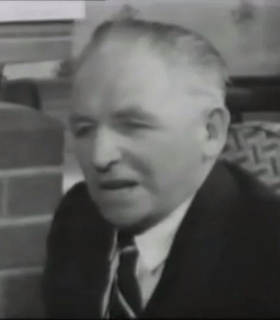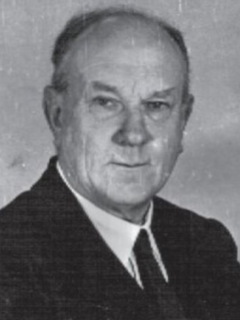
John Joe Rice, Sinn Féin politician and republican activist who serves as a Teachta Dála (TD) for the Kerry South constituency from 1957 to 1961, is born in Cork, County Cork, on June 19, 1893.
Rice is raised in the townland of Kilmurry near Kenmare, County Kerry. He is the son of George Rice, a draper’s assistant, and Ellen Rice (née Ring). After national school he becomes a clerk with the Great Southern and Western Railway company working at stations in Kenmare, Killorglin, and Killarney.
Rice joins the Irish Volunteers in 1913 but does not take part in the 1916 Easter Rising. For a time, he shares lodgings in Rock Street, Tralee, with Austin Stack, and like Stack he is a Gaelic Athletic Association (GAA) member, playing hurling with Kenmare. At the outbreak of the Irish War of Independence (1919-1921), he becomes Officer Commanding of the 5th Battalion of the Kerry No. 2 Brigade. He also holds the post of second in command of that brigade, under Humphrey Murphy. On April 26, 1921, he attends the meeting in Kippagh, County Tipperary, that sees the establishment of the First Southern Division. After the truce, Murphy is transferred to command Kerry No. 1 Brigade, and Rice becomes commanding officer of Kerry No. 2.
Rice opposes the Anglo-Irish Treaty and leads the brigade throughout the Irish Civil War (1922-1923). When Michael Collins comes to Killarney on April 22, 1922, to speak in favour of the agreement, he is met at the train station by a group of fifty men, led by Rice, who attempt to prevent him from speaking. The meeting goes ahead despite several attempts by the group to stop it. During the civil war he leads his men into Limerick, briefly seizing Rathkeale, but for the most part they are on the defensive. In September he commands a force of seventy republicans to take Kenmare. This is a rare and morale-boosting success. When the First Southern Division council meets on February 26-28, 1923, he is one of only two senior officers, among a group of eighteen, who feel that it is worth fighting on.
Shortly after the civil war, Rice marries Nora Aherne, a Cumann na mBan member; they have one son, George. After the war he continues to be active in the Irish Republican Army (IRA) and Sinn Féin. He attends IRA executive meetings in 1923 and is involved in attempts to reorganise the IRA in 1924. He is a delegate to the Sinn Féin ardfheis in 1926, opposing the proposal of Éamon de Valera that abstention be a matter of policy rather than principle. He is elected as a Sinn Féin TD for the Kerry South constituency at the 1957 Irish general election. He does not take his seat in the Dáil due to the Sinn Féin policy of abstentionism. He is one of four Sinn Féin TDs elected at the 1957 Irish general election, the others being Ruairí Ó Brádaigh, John Joe McGirl and Eighneachán Ó hAnnluain. During his time as a TD, he campaigns against the Special Powers Act, which grants the Irish state extra abilities to deal with and punish suspected members of the IRA. He is defeated at the 1961 Irish general election.
In 1966, Rice and fellow Kerry Republican John Joe Sheehy are expelled from Sinn Féin, as are many others, by the new Marxist-Leninist party leadership that had recently come into power. This move both foreshadows and fuels the split in 1969/1970 of both the IRA and Sinn Féin, which leads to the creation of the Marxist-Leninist Official IRA and the more traditional but still left-wing Provisional IRA, and in parallel Sinn Féin – The Workers’ Party and “Provisional” Sinn Féin. Rice gives his support to the Provisionals.
Rice drives an oil lorry for a time and then becomes manager of the Tralee branch of Messrs Nash, mineral water manufacturers and bottlers. He remains in this position until his retirement in 1965. He dies on July 24, 1970, at his son’s residence in Oakview, Tralee.
Rice’s sister, Rosalie, is a member of Cumann na mBan during the 1916 Easter Rising and is arrested for sending a telegram alerting the Irish Republican Brotherhood (IRB) in the United States to the rising. His cousins Eugene and Timothy Ring are members of the IRB and are also involved with the telegram. His grandfather, Timothy Ring, was a Fenian who fought in the uprising. Two of his cousins are members of the Royal Irish Constabulary (RIC) who both help the republican side during the Irish revolutionary period.