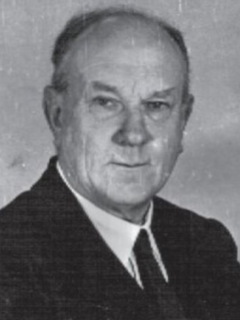
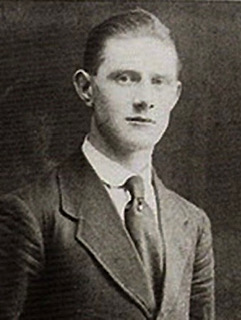
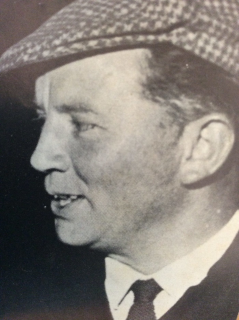
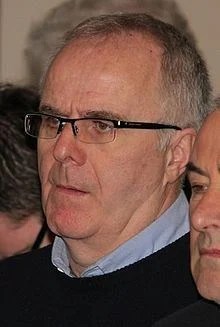
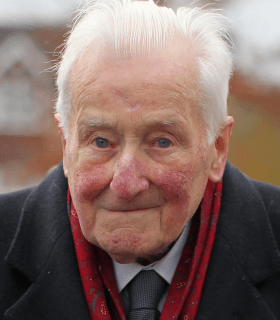
Rice joins the Irish Volunteers in 1913 but does not take part in the 1916 Easter Rising. For a time, he shares lodgings in Rock Street, Tralee, with Austin Stack, and like Stack he is a Gaelic Athletic Association (GAA) member, playing hurling with Kenmare. At the outbreak of the Irish War of Independence (1919-1921), he becomes Officer Commanding of the 5th Battalion of the Kerry No. 2 Brigade. He also holds the post of second in command of that brigade, under Humphrey Murphy. On April 26, 1921, he attends the meeting in Kippagh, County Tipperary, that sees the establishment of the First Southern Division. After the truce, Murphy is transferred to command Kerry No. 1 Brigade, and Rice becomes commanding officer of Kerry No. 2.
Rice opposes the Anglo-Irish Treaty and leads the brigade throughout the Irish Civil War (1922-1923). When Michael Collins comes to Killarney on April 22, 1922, to speak in favour of the agreement, he is met at the train station by a group of fifty men, led by Rice, who attempt to prevent him from speaking. The meeting goes ahead despite several attempts by the group to stop it. During the civil war he leads his men into Limerick, briefly seizing Rathkeale, but for the most part they are on the defensive. In September he commands a force of seventy republicans to take Kenmare. This is a rare and morale-boosting success. When the First Southern Division council meets on February 26-28, 1923, he is one of only two senior officers, among a group of eighteen, who feel that it is worth fighting on.
Shortly after the civil war, Rice marries Nora Aherne, a Cumann na mBan member; they have one son, George. After the war he continues to be active in the Irish Republican Army (IRA) and Sinn Féin. He attends IRA executive meetings in 1923 and is involved in attempts to reorganise the IRA in 1924. He is a delegate to the Sinn Féin ardfheis in 1926, opposing the proposal of Éamon de Valera that abstention be a matter of policy rather than principle. He is elected as a Sinn Féin TD for the Kerry South constituency at the 1957 Irish general election. He does not take his seat in the Dáil due to the Sinn Féin policy of abstentionism. He is one of four Sinn Féin TDs elected at the 1957 Irish general election, the others being Ruairí Ó Brádaigh, John Joe McGirl and Eighneachán Ó hAnnluain. During his time as a TD, he campaigns against the Special Powers Act, which grants the Irish state extra abilities to deal with and punish suspected members of the IRA. He is defeated at the 1961 Irish general election.
In 1966, Rice and fellow Kerry Republican John Joe Sheehy are expelled from Sinn Féin, as are many others, by the new Marxist-Leninist party leadership that had recently come into power. This move both foreshadows and fuels the split in 1969/1970 of both the IRA and Sinn Féin, which leads to the creation of the Marxist-Leninist Official IRA and the more traditional but still left-wing Provisional IRA, and in parallel Sinn Féin – The Workers’ Party and “Provisional” Sinn Féin. Rice gives his support to the Provisionals.
Rice drives an oil lorry for a time and then becomes manager of the Tralee branch of Messrs Nash, mineral water manufacturers and bottlers. He remains in this position until his retirement in 1965. He dies on July 24, 1970, at his son’s residence in Oakview, Tralee.
Rice’s sister, Rosalie, is a member of Cumann na mBan during the 1916 Easter Rising and is arrested for sending a telegram alerting the Irish Republican Brotherhood (IRB) in the United States to the rising. His cousins Eugene and Timothy Ring are members of the IRB and are also involved with the telegram. His grandfather, Timothy Ring, was a Fenian who fought in the uprising. Two of his cousins are members of the Royal Irish Constabulary (RIC) who both help the republican side during the Irish revolutionary period.
In 1921, McCaughey’s family moves to the Ardoyne district in north Belfast. Hus father is a founding member of the Irish republican Dungannon Clubs and organizes the first branch of Sinn Féin in County Tyrone. As a teenager he joins the Gaelic League and Sinn Féin and also becomes a long time student and teacher of the Irish language in the Glens of Antrim. He joins the IRA in 1935 and in 1938 is promoted to Officer Commanding (O/C) of its Northern Command, headquartered near the town of Carrickmore, County Tyrone, which is the ancestral home of Joseph McGarrity and Patrick McCartan, both leaders of the Irish republican organization Clan na Gael. In December 1939, he is arrested and imprisoned at the Curragh Camp. After being released in 1940 he returns to the Northern Command of the IRA. He is held in high regard and is considered to be one of the best officers of the northern IRA. At the time of his arrest in Rathmines, Dublin, on September 2, 1941, he is acting Chief of Staff.
In September 1941, McCaughey is found guilty by a Dublin court of having detained and assaulted Stephen Hayes, IRA Chief of Staff, who was accused of being a spy for the Irish Free State government. Hayes escapes and later testifies against him at a Military Court. He is sentenced to death by firing squad. His sentence is commuted to a life sentence of penal servitude.
Imprisoned in Portlaoise Prison on July 24, 1941, McCaughey joins other IRA prisoners in the ongoing blanket protest. Refusing to wear a criminal’s prison clothes, he is kept in solitary confinement and spends nearly five years naked except for a blanket. This form of resistance by Irish republican prisoners is also used in the 1980s blanket protests in the Maze prison (also known as “Long Kesh”) and the HM Prison Armagh (women’s prison) in Northern Ireland. He and other Irish republican prisoners endure years of hardships. Sitting month after month, year after year in bleak solitary cells, they are taken out once a week for a bath, and for the rest of the week live the life of an animal trapped in a burrow. That they do not go mad is a remarkable comment on mans capacity for survival. During his almost five years in Portlaoise, he Is never permitted to have visitors.
McCaughey commences a hunger strike on April 19, 1946. After ten days, he stops taking water and dies on May 11, 1946, the twenty-third day of his protest. An inquest is held in the prison at which the prison doctor admits that during his over four and a half years of imprisonment that McCaughey had never been allowed out in the fresh air or sunlight and that “he would not treat his dog the way Seán McCaughey had been treated in Portlaoise.”
McCaughey is the last person to die on hunger strike in the Irish state. There is a long history of hunger striking in Ireland – within the 20th century a total of 22 Irish republicans die on hunger strike with survivors suffering long-term health and psychological effects. Four men die during the 1920 Cork hunger strike. The largest hunger strike in Irish history is the 1923 Irish hunger strikes, during which five men die. Ten men die during the 1981 Irish hunger strike.
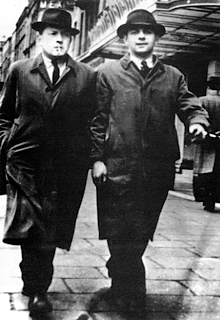
(Pictured: Seán McCaughey (right) and Charlie McGlade, O’Connell Street, Dublin, 1941)
Byrne is born on November 23, 1900, in the National Maternity Hospital, Holles Street, Dublin, the elder among one son and one daughter of Vincent Byrne, carpenter, of 33 Denzille Street (now Fenian Street), and his wife Margaret (née White). By 1911 the family is living with maternal relatives at 1 Anne’s Lane. Educated at St. Andrew’s national school, Westland Row, he is apprenticed as a cabinet maker under Thomas Weafer, a company captain in the Irish Volunteers, who is subsequently killed in the 1916 Easter Rising. At the age of fourteen, he joins the Irish Volunteers in January 1915, and is posted to the 2nd Battalion of the Dublin Brigade. His training includes lectures on street fighting by James Connolly. During the 1916 rising he serves with the 2nd Battalion in Jacob’s biscuit factory under Thomas MacDonagh. At the surrender he is slipped out a factory window to safety by a priest who is acting as an intermediary. Arrested in his home a week later, he is held in Richmond Barracks with other youngsters, all of whom are released after an additional week. Active in the post-rising reorganisation of the Dublin Brigade, he claims to have voted twenty times for Sinn Féin candidates in the 1918 United Kingdom general election in Ireland.
In November 1919, Byrne is recruited to an elite counter-intelligence squad of the Dublin Brigade, whose primary mission is the assassination of plainclothes detectives of the Dublin Metropolitan Police’s (DMP) political (‘G’) division. He participates in the attempted ambush of the Lord Lieutenant of Ireland, John French, at Ashtown, Dublin, on December 19, 1919, a combined operation of the Dublin and the 3rd Tipperary brigades. In March 1920, he leaves his civilian employment with the Irish Woodworkers, Crow Street, when the squad is constituted as a full-time, paid, GHQ guard, under direct orders from Michael Collins. Dubbed “The Twelve Apostles,” the squad also includes James Slattery, a workmate of Byrne since their apprenticeships. For the duration of the Irish War of Independence, Byrne takes part in the stakeouts and killings of police detectives and military intelligence agents. His witness statement to the Bureau of Military History recounts his participation in some fifteen such operations. On Bloody Sunday he commands an IRA detail that kills two of the “Cairo Gang“ agents in their boarding house at 38 Upper Mount Street on November 21, 1920. He takes part in The Custom House raid on May 25, 1921.
Owing largely to his devoted allegiance to Collins, Byrne supports the Anglo–Irish Treaty of December 1921, regarding it as a stepping stone to complete independence. Enlisting in the National Army, he serves in the Dublin Guard. Promoted five times from January 1922 to February 1923, he rises in rank from company sergeant to commandant. He is OC of the guard at the handover of Dublin Castle from British to Irish authority on January 16, 1922. During ensuing months he commands guard details at government buildings and the Bank of Ireland, College Green, Dublin. In March 1922, he foils an attempt by Anti-Treaty forces to seize the bank with the aid of mutinous soldiers within the building’s guard. Having displayed courage and presence of mind throughout the incident, he is promoted captain in the field. Resenting the role given to ex-British-army officers in the National Army, and feeling that the political elite of the Free State are betraying the national interest, he is among the group of officers involved in the failed army mutiny of 1924, and accordingly is forced to resign his commission on March 21. He then works as a carpenter on the industrial staff of the Office of Public Works (OPW), and in the post office stores, St. John’s Road, Kilmainham, Dublin, until his retirement.
Byrne is a founding member of both the Association of Dublin Brigades and the 1916–1921 Club. Long lived, and a willing raconteur with a colourful turn of phrase, he becomes probably the best known of Collins’s squad (of which he is the last surviving member), granting many interviews to journalists and historians. He expresses no misgivings about his role as a revolutionary hit man, arguing the necessity of the ruthless methods employed, which deterred potential informers, and eventually won the struggle by crippling British intelligence.
Byrne lives in Dublin at 59 Blessington Street, and later at 227 Errigal Road, Drimnagh. His last address is 25 Lein Road, Artane. His wife Eileen predeceases him. He dies on December 13, 1992, survived by two daughters and one son. He is buried at Balgriffin Cemetery, Balgriffin, County Dublin.
(From: “Byrne, Vincent (‘Vinnie’)” by Lawrence William White and Pauric J. Dempsey, Dictionary of Irish Biography, http://www.dib.ie, October 2009)
McGeown joins the IRA’s youth wing, Fianna Éireann, in 1970. He is first arrested at the age of 14, and in 1973 he is again arrested and interned in Long Kesh Detention Centre until 1974. In November 1975, he is arrested and charged with possession of explosives, bombing the Europa Hotel, and IRA membership. At his trial in 1976 he is convicted and receives a five-year sentence for IRA membership and two concurrent fifteen-year sentences for the bombing and possession of explosives, and is imprisoned at Long Kesh with Special Category Status.
In March 1978, McGeown attempts to escape along with Brendan McFarlane and Larry Marley. The three have wire cutters and dress as prison officers, complete with wooden guns. The escape is unsuccessful, and results in McGeown receiving an additional six-month sentence and the loss of his Special Category Status.
McGeown is transferred into the Long Kesh Detention Centre’s H-Blocks where he joins the blanket protest and dirty protest, attempting to secure the return of Special Category Status for convicted paramilitary prisoners.He describes the conditions inside the prison during the dirty protest in a 1985 interview:
“There were times when you would vomit. There were times when you were so run down that you would lie for days and not do anything with the maggots crawling all over you. The rain would be coming in the window and you would be lying there with the maggots all over the place.“
In late 1980, the protest escalates and seven prisoners take part in a fifty-three-day hunger strike, aimed at restoring political status by securing what are known as the “Five Demands:”
The right not to wear a prison uniform.
The right not to do prison work.
The right of free association with other prisoners, and to organise educational and recreational pursuits.
The right to one visit, one letter and one parcel per week.
Full restoration of remission lost through the protest.
The strike ends before any prisoners die and without political status being secured. A second hunger strike begins on March 1, 1981, led by Bobby Sands, the IRA’s former Officer Commanding (OC) in the prison. McGeown joins the strike on July 9, after Sands and four other prisoners have starved themselves to death. Following the deaths of five other prisoners, his family authorises medical intervention to save his life after he lapses into a coma on August 20, the 42nd day of his hunger strike.
McGeown is released from prison in 1985, resuming his active role in the IRA’s campaign and also working for Sinn Féin, the republican movement’s political wing. In 1988, he is charged with organising the Corporals killings, an incident where two plain-clothes British Army soldiers are killed by the IRA. At an early stage of the trial his solicitor, Pat Finucane, argues there is insufficient evidence against McGeown, and the charges are dropped in November 1988. McGeown and Finucane are photographed together outside Crumlin Road Courthouse, a contributing factor to Finucane being killed by the Ulster Defence Association (UDA) in February 1989. Despite suffering from heart disease as a result of his participation in the hunger strike, McGeown is a member of Sinn Féin’s Ard Chomhairle and is active in its Prisoner of War Department. In 1993, he is elected to Belfast City Council.
McGeown is found dead in his home on October 1, 1996, after suffering a heart attack. Sinn Féin chairman Mitchel McLaughlin says his death is “a great loss to Sinn Féin and the republican struggle.” McGeown is buried in the republican plot at Belfast’s Milltown Cemetery. His death is often referred to as the “11th hunger striker.” In 1998, the Pat McGeown Community Endeavour Award is launched by Sinn Féin president Gerry Adams, with Adams describing McGeown as “a modest man with a quiet, but total dedication to equality and raising the standard of life for all the people of the city.” A plaque in memory of McGeown is unveiled outside the Sinn Féin headquarters on the Falls Road on November 24, 2001, and a memorial plot on Beechmount Avenue is dedicated to the memory of McGeown, Kieran Nugent and Alec Comerford on March 3, 2002.
In October 1964, during the general election campaign, a photo of McMillen is placed in the window of the election office in Divis Street flanked on one side by the Starry Plough flag and on the other by the tricolour. His campaign draws national attention after Ian Paisley demands that police remove the tricolour from McMillen’s election offices. The RUC raids the premises and confiscates the flag, sparking several days of rioting during which McMillen leads several thousand protesters in defiantly displaying the tricolour. He recalls the IRA gaining a “couple of dozen recruits” following the election, but he finishes at the bottom of the poll with 3,256 votes (6%). Around this time, he succeeds Billy McKee as the Officer commanding (OC) of the Belfast Brigade.
McMillen is keen to work for the unity of Protestant and Catholic workers. Roy Garland recalls that McMillan’s grandfather was master of an Orange lodge in Edinburgh and McMillan knew of that heritage and the meaning of the colours of the Irish flag. He prominently displays in his election offices a verse of a poem by John Frazier, a Presbyterian from County Offaly: “Till then the Orange lily be your badge my patriot brother. The everlasting green for me and we for one and other.”
In 1967, McMillen is involved in the formation of the Northern Ireland Civil Rights Association (NICRA) and is a member of a three-man committee which draws up the Association’s constitution. The NICRA’s peaceful activities result in violent opposition from many unionists, leading to fears that Catholic areas will come under attack. In May 1969, when asked at an IRA army council meeting by Ruairí Ó Brádaigh how many weapons the Belfast Brigade has for defensive operations, McMillen states they have only one pistol, a machine gun and some ammunition.
By August 14, 1969, serious rioting has broken out in Belfast and Catholic districts come under attack from both civilian unionists and the RUC. McMillen’s IRA command by this point still has only a limited number of weapons because the leadership in Dublin are reluctant to release guns. While he is involved in some armed actions on this day, he is widely blamed by those who established the Provisional IRA for the IRA’s failure to adequately defend Catholic neighbourhoods from Ulster loyalist attack. He is arrested and temporarily detained by the RUC on the morning of August 15 but is released shortly afterward.
McMillen’s role in the 1969 riots is very important within IRA circles, as it is one of the major factors contributing to the split in the movement in late 1969. In a June 1972 lecture organised by Official Sinn Féin in Dublin, he defends his conduct, stating that by 1969 the total membership of the Belfast IRA is approximately 120 men, and their armaments have increased to a grand total of 24 weapons, most of which are short-range pistols.
In September, McMillen calls a meeting of IRA commanders in Belfast. Billy McKee and several other republicans arrive at the meeting armed and demand McMillen’s resignation. He refuses, but many of those unhappy with his leadership break away and refuse to take orders from him or the Dublin IRA leadership. Most of them join the Provisional Irish Republican Army, when this group splits off from the IRA in December 1969. McMillen himself remains loyal to the IRA’s Dublin leadership, which becomes known as the Official IRA. The split rapidly develops into a bitter rivalry between the two groups. In April 1970, he is shot and wounded by Provisional IRA members in the Lower Falls area of Belfast.
In June 1970, McMillen’s Official IRA have their first major confrontation with the British Army, which had been deployed to Belfast in the previous year, in an incident known as the Falls Curfew. The British Army mounts an arms search in the Official IRA stronghold of the Lower Falls, where they are attacked with a grenade by Provisional IRA members. In response, the British flood the area with troops and declare a curfew. This leads to a three-day gun battle between 80 to 90 Official IRA members led by McMillen and up to 3,000 British troops. Five civilians are killed in the fighting and about 60 are wounded. In addition, 35 rifles, 6 machine guns, 14 shotguns, grenades, explosives and 21,000 rounds of ammunition, all belonging to the OIRA, are seized. McMillen blames the Provisionals for instigating the incident and then refusing to help the Officials against the British.
This ill-feeling eventually leads to an all-out feud between the republican factions in Belfast in March 1971. The Provisionals attempt to kill McMillen again, as well as his second-in-command, Jim Sullivan. In retaliation, McMillen has Charlie Hughes, a young PIRA member, killed. Tom Cahill, brother of leading Provisional Joe Cahill, is also shot and wounded. After these deaths, the two IRA factions in Belfast negotiate a ceasefire and direct their attention instead at the British Army.
When the Northern Ireland authorities introduce internment in August 1971, McMillen flees Belfast for Dundalk in the Republic of Ireland, where he remains for several months. During this time, the Official IRA carries out many attacks on the British Army and other targets in Northern Ireland. However, in April 1972, the organisation in Belfast is badly weakened by the death of their commander in the Markets area, Joe McCann. In May of that year, the Dublin leadership of the OIRA calls a ceasefire, a move which McMillen supports. Nevertheless, in the year after the ceasefire, his command kills seven British soldiers in what they term “retaliatory attacks.” McMillen serves on the Ard Chomhairle (leadership council) of Official Sinn Féin.
By 1974, a group of OIRA members around Seamus Costello are unhappy with the ceasefire. In December 1974, they break away from the Official movement, forming the Irish Republican Socialist Party (IRSP) and the Irish National Liberation Army (INLA). Some OIRA members under McMillen’s command, including the entire Divis Flats unit, defect to the new grouping. This provokes another intra-republican feud in Belfast. The feud begins with arms raids on OIRA dumps and beatings of their members by the INLA. McMillen, in response is accused of drawing up a “death list” of IRSP/INLA members and even of handing information on them over to the loyalist Ulster Volunteer Force (UVF).
The first killing comes on February 20, 1975, when the OIRA shoot dead an INLA member named Hugh Ferguson in west Belfast. A spate of shootings follows on both sides.
On April 28, 1975, McMillen is shot dead by INLA member Gerard Steenson, as he is shopping in a hardware shop on Spinner Street with his wife Mary. He is hit in the neck and dies at the scene. His killing is unauthorised and is condemned by INLA/IRSP leader Seamus Costello. Despite this, the OIRA tries to kill Costello on May 9, 1975, and eventually kills him two years later. McMillen’s death is a major blow to the OIRA in Belfast.
Seán Hales, Irish political activist and member of Dáil Éireann from May 1921 to December 1922, is shot and killed in Dublin on December 7, 1922, by republican gunmen on orders from Liam Lynch directing the Irish Republican Army (IRA) to kill, amongst others, all deputies and senators who had voted for the Public Safety Act (September 28, 1922) which established military courts with the power to impose the death penalty.
Hales is born John Hales in Ballinadee, Bandon, County Cork, on March 30, 1880, the eldest child of five sons and four daughters of Robert Hales, a farmer, and Margaret (née Fitzgerald) Hales. He is educated at Ballinadee national school and Warner’s Lane school, Bandon. After leaving school he goes to work on his father’s farm. He plays hurling with Valley Rovers GAA club and is the Munster champion in the 56-lb. weight-throwing competition. From an early age he follows in his father’s footsteps and becomes involved in the republican movement.
Hales joins the Irish Volunteers in 1915 and becomes captain of the Ballinadee company in 1916. Arrested under the Defence of the Realm Act after the 1916 Easter Rising, he is imprisoned in Frongoch internment camp in Wales. After his release, in April 1917 he becomes executive of the short-lived Liberty League promoted by Count George Plunkett. When the League merges with Sinn Féin, he helps reorganise the Volunteers. With his brothers, Tom, William, and Donal, he continues his father’s fight on behalf of evicted tenants and becomes involved with the anti-British Bandon People’s Food Committee and the anti-landlord Unpurchased Tenants’ Association. He helps in the Sinn Féin takeover of The Southern Star newspaper and is a member of the new board of directors. In 1919 he becomes battalion commander of the first (Bandon) battalion 3rd Cork Brigade of the Irish Republican Army, the name by which the Irish Volunteers increasingly became known. He leads the attack on TimoleagueRoyal Irish Constabulary (RIC) barracks in February 1920, and the ambush of an Essex Regiment patrol at Brinny in August 1920. The military patrol at Brinny manages to surprise the ambushers and Lieutenant Tim Fitzgerald of Bandon is the first Volunteer to be killed in action in west Cork. Hales then commands the assault on two truckloads of British troops at Newcestown Cross in which a British officer is killed and several soldiers are wounded.
Hales is appointed section commander of the west Cork flying column in 1920 and takes part in the major action at Crossbarry on March 19, 1921. In retaliation for the burning of the Hales home in March 1921, he leads a contingent of Volunteers and burns Castle Bernard, the residence of the Earl of Bandon. The occupant, Lord Bandon, is held hostage until General Strickland, the British OC in Cork, guarantees he will not execute Volunteers in Cork prison. The British authorities yield and there is an end to the policy of executing prisoners of war in the Cork area.
At the 1922 Irish general election, Hales is elected to the Third Dáil as a pro-Treaty Sinn Féin Teachta Dála (TD) for the same constituency. He receives 4,374 first preference votes (7.9%). Shortly afterward, the Irish Civil War breaks out between the pro-Treaty faction, who are in favour of setting up the Irish Free State and the anti-Treaty faction, who would not accept the abolition of the Irish Republic.
On December 7, 1922, Hales is killed by anti-Treaty IRA men as he leaves the Dáil. Another TD, Pádraic Ó Máille, is also shot and badly wounded in the incident. His killing is in reprisal for the Free State’s execution of anti-treaty prisoners. In revenge for Hales’ killing, four republican leaders, Joe McKelvey, Rory O’Connor, Liam Mellows and Richard Barrett, are executed the following day, December 8, 1922.
Hales is given a military funeral to the family burial place at St. Patrick’s Cemetery, Bandon.
According to information passed on to playwrightUlick O’Connor, an anti-Treaty IRA volunteer named Owen Donnelly of Glasnevin is responsible for the killing of Hales. Seán Caffrey, an anti-treaty intelligence officer told O’Connor that Donnelly had not been ordered to kill Hales specifically but was following the general order issued by Liam Lynch to shoot all deputies and senators they could who had voted for the Public Safety Act (September 28, 1922) which established military courts with the power to impose the death penalty.
A commemorative statue of Hayes is unveiled at Bank Place in Bandon in 1930.
McCartney takes part in the civil rights march in Derry on January 30, 1972, an event widely known as Bloody Sunday. One of his cousins, James Wray, is one of fourteen men shot and killed by the 1st Battalion, Parachute Regiment of the British Army on that march. As a result of this incident, he joins the Provisional IRA several months later. In 1974, Martin McGuinness, who commands the IRA in Derry, instructs him to beat up an Irish National Liberation Army (INLA) man, Patsy O’Hara, who McGuinness calls a “scumbag” and a “hood.” On January 12, 1979, at Belfast‘s Crown Court, he and another man, Eamonn MacDermott, are convicted of the murder of Detective Constable Patrick McNulty of the Royal Ulster Constabulary (RUC), who was shot several times outside a garage in Derry on January 27, 1977. He is also convicted of IRA membership and the murder of businessman Jeffery Agate in February 1977 and is sentenced to life imprisonment. The murder convictions are overturned in 2007.
McCartney spends 53 days on hunger strike, from October 27 to December 18. From 1989–91 he is Officer Commanding of the IRA prisoners in the H-Blocks and is released in 1994.
Following his release, McCartney is active with ex-prisoners’ groups Tar Abhaile and Coiste na n-Íarchimí, and is the first member of Sinn Féin to hear his own voice heard on television after the lifting of the British broadcasting ban in 1994. He is arrested on April 4, 2002, following a breach of security at Belfast’s police headquarters, but is released without charge the following day. Later that year, on September 5, he is the first former IRA member to appear before the Bloody Sunday Inquiry, and encourages anyone with information, including paramilitaries, to come forward. He is a member of the Legislative Assembly (MLA) for Foyle from July 15, 2004, until February 3, 2020.
On February 15, 2007, McCartney and MacDermott have their murder convictions quashed by the Court of Appeal, following an investigation by the Criminal Cases Review Commission (CCRC) in 2002. The Secretary of State for Northern Ireland declines to compensate McCartney and MacDermott on the grounds that they have not proven themselves innocent. The decision is appealed to the Supreme Court of the United Kingdom which, in May 2011, finds in favour of the applicants, opening the way for a substantial compensation claim from both for their prison terms of 15 and 17 years.
McCorley is born into a Roman Catholic family at 67 Hillman Street in Belfast on September 6, 1901. He is one of three children born to Roger Edmund McCorley, a meat carver in a hotel, and Agnes Liggett. He has two elder brothers, Vincent and Felix. He joins the Fianna in his teens. His family has a very strong republican tradition, and he claims to be the great-grandson of the United Irishmen folk hero Roddy McCorley, who was executed for his part in the Irish Rebellion of 1798.
McCorley is noted for his militancy, as he is in favour of armed attacks on British forces in Belfast. The Brigade’s leaders, by contrast, in particular, Joe McKelvey, are wary of sanctioning attacks for fear of loyalist reprisals on republicans and the Catholic population in general. In addition, McCorley is in favour of conducting an armed defense of Catholic areas, whereas McKelvey does not want the IRA to get involved in what he considers to be sectarian violence. McCorley writes later that in the end, “the issue settled itself within a very short space of time, when the Orange mob was given uniforms, paid for by the British, and called the Ulster Special Constabulary (USC).” The role of the USC, a temporary police force raised for counter-insurgency purposes, in the conflict is still debated, but republicans maintain that the organization was responsible for the indiscriminate killings of Catholics and nationalists.
On January 26, 1921, McCorley, is involved in the fatal shooting of three Auxiliary Division officers in their beds in the Railway View hotel in central Belfast. Shortly afterwards, he and another IRA man, Seamus Woods, organize an active service unit (ASU) within the first battalion of the Belfast Brigade, with the intention of carrying out attacks, with or without the approval of the Brigade leadership. The unit consists of 32 men. McCorley later writes, “I issued a general order that, where reprisal gangs [State forces] were cornered, no prisoners were to be taken.” In March 1921, he personally leads the ASU in the killing of three Black and Tans in Victoria Street in central Belfast. He is responsible for the deaths of two more Auxiliaries in Donegall Place in April. In reprisal for these shootings, members of the RIC assassinate two republican activists, the Duffin brothers in Clonard Gardens in west Belfast. On June 10, 1921, both and Woods and McCorley units are involved in the killing a RIC man who is suspected in the revenge killings of the Duffin brothers. Two RIC men and a civilian are also wounded in that attack.
Thereafter, there is what historian Robert Lynch has described as a “savage underground war” between McCorley’s ASU and RIC personnel based in Springfield Road barracks and led by an Inspector Ferris. Ferris is accused of murdering the Lord Mayor of Cork Thomas Mac Curtain and had been posted to Lisburn for his safety. Ferris himself is among the casualties, being shot in the chest and neck, but surviving. McCorley claims to have been one of the four IRA men who shot Ferris. In addition, his men bomb and burn a number of businesses including several cinemas and a Reform Club. In May 1921, however, thirteen of his best men are arrested when surrounded by British troops during an operation in County Cavan. They are held in Crumlin Road Gaol and sentenced to death.
On June 3, McCorley organizes an attack on Crumlin Road Gaol in an attempt to rescue the IRA men held there before they are executed. The operation is not a success; however, the condemned men are reprieved after a truce is agreed between the IRA and British forces in July 1921. On Bloody Sunday (July 10, 1921), he is a major leader in the defense of nationalist areas from attacks by both the police and loyalists. On that day twenty people are killed before he negotiates a truce beginning at noon on July 11. At least 100 people are wounded, about 200 houses are destroyed or badly damaged – most of them Catholic homes, leaving 1,000 people homeless.
In April 1922, McCorley becomes leader of the IRA Belfast Brigade after Joe McKelvey goes south to Dublin to join other IRA members who are against the Anglo-Irish Treaty. With McKelvey’s departure, Seamus Woods becomes Officer Commanding of the IRA’s 3rd Northern Division, which has up to 1,000 members, with McCorley designated as Vice Officer Commanding. McCorley for his part, supports the Treaty, despite the fact that it provides for the partition of Ireland and the continued British rule in Northern Ireland. The reason for this is that Michael Collins and Eoin O’Duffy have assured him that this is only a tactical move and indeed, Collins sends men, money and weapons to the IRA in the North throughout 1922.
However, McCorley’s command sees the collapse of the Belfast IRA. In May 1922, the IRA launches an offensive with attacks all across Northern Ireland. In Belfast, he carries out an assault on Musgrave Street RIC barracks. He also conducts an arson campaign on businesses in Belfast. His men also carry out a number of assassinations, including that of Ulster Unionist PartyMPWilliam J. Twaddell, which causes the internment of over 200 Belfast IRA men.
To escape from the subsequent repression, McCorley and over 900 Northern IRA men flee south, to the Irish Free State, where they are housed in the Curragh. McCorley is put in command of these men. In June 1922, the Irish Civil War breaks out between Pro and Anti-Treaty elements of the IRA. He takes the side of the Free State and Michael Collins. After Collins is killed in August 1922, his men are stood down. About 300 of them join the National Army and are sent to County Kerry to put down anti-Treaty guerrillas there. In the Spring of 1923, bitterly disillusioned by the brutal counterinsurgency against fellow republicans, he resigns his command.
McCorley later asserts that he “hated the Treaty” and only supported it because it allowed Ireland to have its own armed forces. Both he and Seamus Woods are severe critics of the Irish Free State inertia towards Northern Ireland after the death of Michael Collins. He comments that when Collins was killed “the Northern element gave up all hope.”
In 1936 McCorley is instrumental in the establishment of the All-Ireland Old IRA Men’s Organization, serving as Vice-President with President Liam Deasy (Cork No. 3 Brigade) and Secretary George Lennon (Waterford No. 2 Brigade).
McKee joins Fianna Éireann in 1936. He is arrested following a raid on a Gaelic Athletic Association (GAA) club in 1938, being imprisoned in Crumlin Road Gaol for several months. Following his release from prison, he joins the Irish Republican Army (IRA) in 1939. During World War II, the IRA carries out a number of armed actions in Northern Ireland known as the Northern Campaign. He is arrested and imprisoned in Crumlin Road Gaol until 1946 for his role in this campaign. In 1956, the IRA embarks on another armed campaign against partition, known as the Border Campaign. He is again arrested and interned for the duration of the campaign. He is released in 1962.
As the 1960s proceed, McKee drifts away from the IRA. He grows very disillusioned with the organisation’s increasing emphasis on socialism and reformist politics over “armed struggle.” He is a devout Roman Catholic, who attends Mass daily. As a result, he is very uncomfortable with what he feels are “communist” ideas coming into the republican movement.
During the 1969 Northern Ireland riots, severe rioting breaks out in Belfast between Irish Catholicnationalists, Protestantloyalists, and the RUC. McKee is highly critical of the IRA’s failure to defend Catholic areas during these disturbances. On August 14, 1969, McKee, Joe Cahill and a number of other Irish Republican activists occupy houses at Kashmir Street, however, being poorly armed they fail to prevent Irish Catholics in Bombay Street and parts of Cupar Street and Kashmir Street being driven from their homes in the sectarian rioting that engulfs parts of the city. In the aftermath of the riots, he accuses Billy McMillen, the IRA’s Belfast commander, and the Dublin-based IRA leadership, of having failed to direct a clear course of action for the organization in civil disturbances. On September 22, 1969, he and a number of other IRA men arrive with weapons at a meeting called by McMillen and try to oust him as head of the Belfast IRA. They are unsuccessful but announce that they will no longer be taking orders from the IRA leadership in Dublin. In December 1969, the IRA splits into the Provisional IRA which is composed of traditional militarists like McKee, and the Official IRA which is composed of the remnants of the pre-split Marxist leadership and their followers. He sides with the Provisionals and joins the IRA Army Council in September 1970.
McKee becomes the first OC of the Provisional IRA Belfast Brigade. From the start, there is intermittent feuding between McKee’s men and his former comrades in the Official IRA, as they vie for control of nationalist areas. However, the Provisionals rapidly gain the upper hand, due to their projection of themselves as the most reliable defenders of the Catholic community.
McKee himself contributes greatly to this image by an action he undertakes on June 27, 1970, the Battle of St Matthew’s. Rioting breaks out in the Ardoyne area of north Belfast after an Orange Order parade, and three Protestants are killed in gun battles between the Provisional IRA and loyalists. In response, loyalists prepare to attack the vulnerable Catholic enclave of Short Strand in east Belfast. When McKee hears about this, he drives to Short Strand with some men and weapons and takes up position at St Matthew’s Church. In the ensuing five-hour gun battle, he is wounded and one of his men is killed, along with at least four Protestants.
On April 15, 1971, McKee, along with Proinsias Mac Airt, is arrested by the British Army when found in possession of a handgun. He is charged and convicted for possession of the weapon and imprisoned in Crumlin Road Gaol, and Joe Cahill takes over as OC of the Belfast Brigade.
In 1972, McKee leads a hunger strike protest in an effort to win recognition of IRA prisoners as political prisoners. Republicans who are interned already have special status, but those convicted of crimes do not. On June 19, the 35th day of hunger strike, he is close to death, William Whitelaw concedes Special Category Status (SCS) which, although not officially awarding political status, is tacit recognition of the political nature of the incarceration. Prisoners wear their own clothes, have no prison work, can receive one visit and food parcel per week and unlimited letters.
McKee is released on September 4, 1974, and resumes his position as OC of the Belfast Brigade. At this time the Provisional IRA calls a ceasefire, and he is involved, with Ruairí Ó Brádaigh, in secret peace talks in Derry with the Northern Ireland Office. He is also involved in talks with Protestant clergy in Feakle, County Clare, in December 1974, where he voices his desire to end the violence.
However, in the same period, McKee authorises a number of sectarian attacks on Protestants as well as renewed attacks on rival republicans in the Official IRA. For this he is heavily criticised by a group of Provisional IRA activists grouped around Gerry Adams.
A faction led by Adams manages to get McKee voted off the IRA Army Council in 1977, effectively forcing him out of the leadership of the organisation. His health suffers in this period, and he does not resume his IRA activities. He joins Republican Sinn Féin after a split in Sinn Féin in 1986. At age 89, reflecting on his involvement in the Republican cause he says, “From the time I was 15 until 65 I was in some way involved. I have had plenty of time since to think if I was right or I was wrong. I regret nothing.”
In later years McKee, Brendan Hughes and Tommy McKearney are critical of the Belfast Agreement and of the reformist politics of Sinn Féin. In 2016 he sends a message of support to the launch of the hardline new Republican party Saoradh, reportedly the political wing of the New IRA.
McKee dies in Belfast at the age of 97 on June 11, 2019. His funeral takes place on June 15, 2019, in west Belfast. His coffin is carried on a gun carriage. He is buried in Milltown Cemetery.
Whitty is born in on January 7, 1904, in Newbawn, County Wexford. He is a Volunteer in the IRA, who serves in the South Wexford Brigade during the Irish War of Independence. After the signing of the 1921 Anglo-Irish Treaty, he joins the Anti-Treaty side in the Irish Civil War.
In late October 1922, Whitty is arrested (although never charged or convicted of any crime) in a roundup of dissidents. He is initially interned by Irish Free State troops at Wexford Prison and from there is transferred to the Curragh Camp. It has been asserted that his arrest was in revenge for the actions of his brothers who are deeply involved with the IRA. The authorities are unable to locate his brothers, so he is arrested instead.
While at the Curragh Camp, Whitty decides to independently start a hunger strike and dies as a result on August 2, 1923, at the Curragh Camp hospital. At the time, hunger strikes are not an official policy of the IRA and are not directed by its General Headquarters. Instead, each hunger striker makes an individual decision to strike. Due to the newly formed Irish Free State government’s news embargo on conditions in prisons at the time, very little is published on Whitty’s motivations and the circumstances of his hunger strike and death, including the number of days of his strike.
Earlier, the high-profile hunger strike deaths of Thomas Ashe, president of the Irish Republican Brotherhood (IRB) in 1917 and Terence MacSwiney, Lord Mayor of Cork in 1920, bring international attention to the Republicans’ cause. The Irish Government’s news embargo prevents the embarrassment of having to publicly announce the death by hunger strike of a 19-year-old internee. From 1922, hunger strikes are of value only when a government is likely to be embarrassed sufficiently by the death of a prisoner.
With the ending of the 1923 Irish Hunger Strikes in late November 1923, the news embargo is relaxed. The November 20, 1923 death of Denny Barry from County Cork and the November 22, 1923 death of Andy O’Sullivan from County Cavan are widely reported in the media, while Whitty’s earlier death in August remains largely unreported.
After Whitty’s non-sanctioned hunger strike and death, Michael Kilroy, the Officer Commanding (OC) of IRA prisoners in Mountjoy Prison announces that 300 men will go on hunger strike on October 13, 1923. By late 1923, thousands of Irish republican prisoners are on hunger strike in multiple prisons and internment camps across Ireland. The mass hunger strikes of October/November 1923 see around 8,000 of the 12,000 Anti-Treaty republican prisoners on hunger strikes in Irish prisons, protesting internment without charge/trial, poor prison conditions and demanding immediate release of all political prisoners. Previously, the Irish Free State government had passed a motion outlawing the release of prisoners on hunger strike.
With the death of Whitty and two other recent Irish republican hunger strikers, Michael Fitzgerald (died October 17, 1920) and Joe Murphy (died October 25, 1920) and the large numbers of Irish republican prisoners on hunger strike, the Irish Free State Government sends a delegation to speak with IRA leadership in late October 1923. On November 23, 1923, the day after Andy O’Sullivan’s death, the hunger strike is called off, eventually setting off a release program for many of the prisoners, although some are not released until as late as 1932. The mass hunger strike of 1923 lasts for 41 days and met with little success.
Whitty is buried at Ballymore Cemetery. Killinick, County Wexford. The inscription on his grave reads: “In Memory of Joseph Whitty, Connolly St, Wexford. South Wexford Brigade who died for Ireland 2nd August 1923.”
The Sinn Féin Cumann (Association) in Wexford is named after Joe Whitty. The annual Joe Whitty Commemoration is held each year on Easter Saturday evening in Ballymore, County Wexford.