seamus dubhghaill

Promoting Irish Culture and History from Little Rock, Arkansas, USA


Leave a comment

Birth of Sir Alfred Chester Beatty, First Honorary Citizen of Ireland

Sir Alfred Chester Beatty, mining engineer, philanthropist, art collector, and the first honorary citizen of Ireland (1957), is born in New York, New York, United States on February 7, 1875, on the site of what is now Rockefeller Center. He plays an important role in the development of copper deposits in Central Africa.

Beatty is the youngest of three sons born to Hetty and John Beatty, a banker and stockbroker. After studying engineering at the Columbia School of Mines and Princeton University, he helps to develop porphyry copper ores in the United States, first as a consulting engineer and later as a director on the boards of several copper-mining firms. In 1913 he relinquishes his mining interests in the United States and settles in Great Britain, becoming a naturalized British subject in 1933. In 1921 he forms a prospecting company that initiates the development of the Copperbelt region of Northern Rhodesia (now Zambia). For this, he becomes known as the “King of Copper.”

An early family anecdote recalls that, as a young boy, Beatty catches the collection bug, bidding at auction for mining samples. In 1931 an announcement in London‘s The Times casts him as a great collector. Between 1939 and 1949 he acquires over 140 nineteenth-century paintings to display in the Picture Gallery of his London home. These are now part of the collection of the National Gallery of Ireland.

Beatty supports the war effort, contributing a large number of raw materials to the Allies. He receives a belated knighthood by Queen Elizabeth II in the 1954 Birthday Honours list for his contribution to the wartime effort. By the late 1940s, however, he has become disillusioned with Britain. Political deviations from his free-market values, coupled with increased foreign exchange restrictions impacted both his personal and collecting interests in Britain.

In 1950, at the age of 75, Beattys over the reins of Selection Trust to his son Chester Jr. and relocates to Dublin. He purchases a large townhouse for himself on Ailesbury Road, in the Ballsbridge area of Dublin and a site on Shrewsbury Road for the construction of the Chester Beatty Library, which houses the collection, opening on August 8, 1953. The library is moved to its current location at Dublin Castle in 2000.

Beatty spends the remainder of his life between Dublin and the south of France. He is made a Freeman of the City of Dublin in 1954 and is the first person granted honorary citizenship of Ireland in 1957. He continues to collect in the 1950s and 1960s, acquiring important Ethiopian manuscripts and Japanese printed material during that period.

Beatty dies in Monte Carlo in Monaco on January 19, 1968. His Irish estate is valued at £7 million. He is accorded a state funeral by the Irish government, the first private citizen in Irish history to receive such an honour. He is buried in Glasnevin Cemetery in Dublin.

Leave a comment

National Gallery of Ireland Act, 1854

A statutory provision, the National Gallery of Ireland Act, 1854, is made on August 10, 1854, for the establishment of a national gallery of paintings, sculpture, and fine arts in Ireland.

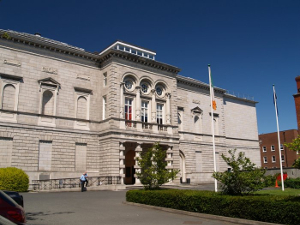
The National Gallery of Ireland, which opens its doors ten years later, houses the national collection of Irish and European art. It is located in the centre of Dublin with one entrance on Merrion Square, beside Leinster House, and another on Clare Street. The Gallery has an extensive, representative collection of Irish painting and is also notable for its Italian Baroque and Dutch masters painting.

The façade of the National Gallery copies the Natural History building of the National Museum of Ireland which is already planned for the facing flank of Leinster House. The building itself is designed by Francis Fowke, based on early plans by Charles Lanyon.

The Gallery is unlucky not to have been founded around an existing collection, but through diligent and skillful purchase, by the time it opens it has 125 paintings. In 1866 an annual purchase grant is established and by 1891 space is already limited. In 1897, the Dowager Countess of Milltown indicates her intention of donating the contents of Russborough House to the Gallery. This gift includes about 223 paintings, 48 pieces of sculpture, 33 engravings, much silver, furniture and a library, and prompts construction from 1899 to 1903 of what is now called the Milltown Wing, designed by Thomas Newenham Deane.

At around this time Henry Vaughan leaves 31 watercolours by J.M.W. Turner with the requirement that they can only be exhibited in January, this to protect them from the ill-effects of sunlight. Though modern lighting technology has made this stipulation unnecessary, the Gallery continues to restrict viewing of the Vaughan bequest to January and the exhibition is treated as something of an occasion.

Another substantial bequest comes with the untimely death in the sinking of the RMS Lusitania of Hugh Lane (1875–1915), since 1914 director of the Gallery. Not only does he leave a large collection of pictures, but he also leaves part of his residual estate, and the Lane Fund has continued to contribute to the purchase of art works to this day. In addition to his involvement in the Gallery, Hugh Lane has also hoped to found a gallery of modern art, something only realised after his death in Dublin City Gallery The Hugh Lane. George Bernard Shaw also makes a substantial bequest, leaving the Gallery a third of royalties of his estate in gratitude for the time he spent there as a youth.

The Gallery is again extended in 1962 with a new wing designed by Frank DuBerry of the Office of Public Works. This opens in 1968 and is now named the Beit Wing. In 1978 the Gallery receives from the government the paintings given to the nation by Alfred Chester Beatty and in 1987 the Sweeney bequest purchases fourteen works of art including paintings by Pablo Picasso and Jack Butler Yeats. The same year the Gallery is once again given some of the contents of Russborough House when Alfred Beit donates 17 masterpieces, including paintings by Diego Velázquez, Bartolomé Esteban Murillo, Jan Steen, Johannes Vermeer and Henry Raeburn.

In the 1990s a lost Caravaggio, The Taking of Christ, known through replicas, is discovered hanging in a Jesuit house of studies in Leeson Street in Dublin by Sergio Benedetti, senior conservator of the gallery. The Jesuits generously allow this painting to be exhibited in the Gallery and the discovery is the cause of national excitement. In 1997 Anne Yeats donates sketchbooks by her uncle Jack Yeats and the Gallery now includes a Yeats Museum. Denis Mahon, a well-known art critic, promises the Gallery part of his rich collection and eight painting from his promised bequest are on permanent display, including Jacob Blessing the Sons of Joseph by Guercino.