seamus dubhghaill

Promoting Irish Culture and History from Little Rock, Arkansas, USA


Leave a comment

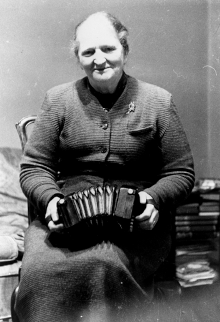
Death of Concertina Player Elizabeth “Lizzie” Crotty

Elizabeth “Lizzie” Crotty (née Markham), concertina player better known as Mrs. Crotty, dies in Kilrush, County Clare, from angina pectoris on December 27, 1960.

Markham is born on January 8, 1886, at Gower, Cooraclare, County Clare, the youngest in the large family of Michael Markham, farmer, and Margaret Markham (née Keane). She attends national school in Cooraclare from 1893 to 1899. Although she does not speak or understand the Irish language, as do her father and likely her mother, the Rosary is recited in Irish at home. She and a sister are the only siblings not to emigrate. Her mother plays the fiddle, while her older sister Margaret (Maggie) plays the concertina and probably influences her to do likewise. She has no single teacher and acquires tunes and her style of playing from neighbours and family friends. She begins to play a two-row German-type concertina at house dances throughout west Clare and becomes very much in demand.

In 1914, Markham marries Michael (Miko) Crotty from Gowerhass, the townland next to Gower. Miko had been in the United States for a couple of years and uses the money earned there to buy a public house on the Market Square in Kilrush, now known as “Crotty’s Pub.” They live in the Square in Kilrush and Miko bottles his own whiskey. The pub is an important venue for Irish traditional music, especially for those who wish to hear Crotty play. She remains relatively unknown outside of Clare until the early 1950s, and there are a relatively small number of recordings of her playing the concertina. The broadcaster Ciarán Mac Mathúna conducts recording sessions in her house in 1955 and she is to be heard on A Job of Journeywork, his programme on Radio Éireann. She possesses a number of concertinas, but the Lachenal that she purchases in the 1950s is her favourite and the one with which she is most closely identified. In 1954, she is a founder member and the first president of the Clare branch of Comhaltas Ceoltóirí Éireann. During her time as president, the All Ireland Fleadh is held in Ennis in 1956.

Crotty often sings the traditional song “An draighneán donn,” which is one of her favourites. Among tunes she enjoys playing are the “Ewe reel,” the “Dublin reel,” and “The maid of Mount Cisco,” along with “The wind that shakes the barley.” Her straight style of playing for dancing and dancers increases her popularity. Seán Ó Riada regards her as one of the finest concertina players he ever heard. Although she does not read or write staff notation, she creates a written code for herself by giving the concertina keys a number and by using a symbol for the press or draw movement on the concertina keys.

Crotty suffers from severe angina which necessitates visits for medical treatment to Dublin, where she becomes friends with fiddle player Kathleen Harrington (née Gardiner). They attend the Pipers’ Club in Thomas Street, play together on Radio Éireann, and travel together to fleadhanna.

Crotty dies on December 27, 1960, of an anginal attack while at her home. She is buried in (old) Shanakyle cemetery. She loses her first three children, and a son drowns in the River Shannon in 1945. Another son, Thomas, becomes a priest. A festival, ‘Éigse Mrs Crotty’, is held in her memory each summer in Kilrush. Her son Paddy gives three perpetual trophies for presentation at the All-Ireland Fleadh Cheoil.

(From: “Crotty, Elizabeth (‘Lizzie’)” by Ríonach uí Ógáin, Dictionary of Irish Biography, http://www.dib.ie, October 2009)


Leave a comment

Death of Philanthropist Thomas John Barnardo

Thomas John Barnardo, philanthropist and founder and director of homes for poor children, dies in London on September 19, 1905. From the foundation of the first Barnardo’s home in 1867 to the date of his death, nearly 60,000 children are taken in.

Barnardo is born in Dublin on July 4, 1845. He is the fourth of five children of John Michaelis Barnardo, a furrier who is of Sephardic Jewish descent, and his second wife, Abigail, an Englishwoman and member of the Plymouth Brethren. In the early 1840s, John emigrates from Hamburg to Dublin, where he establishes a business. Barnardo moves to London in 1866. At that time he is interested in becoming a missionary.

Barnardo establishes “Hope Place” ragged school in the East End of London in 1868, his first attempt at aiding the estimated 30,000 ‘destitute’ children in Victorian London. Many of these children are not only impoverished, but orphaned, as the result of a recent cholera outbreak. For those unable to afford private education, the school offers education which, although Christian-based in nature, is not exclusively religion-focused, and works to provide tutelage on various common trades of that time.

In 1870, Barnardo is prompted to form a boys’ orphanage at 18 Stepney Causeway after inspecting the conditions within which London’s orphaned population sleep. This is the first of 122 such establishments, caring for over 8,500 children, founded before his death in 1905. Significant provisions are available to occupants. Infants and younger children are sent to rural districts in attempt to protect them from industrial pollution. Teenagers are trained in skills such as carpentry and metalworking, to provide them a form of basic financial stability.

In June 1873, Barnardo marries Sara Louise Elmslie, known as Syrie, the daughter of an underwriter for Lloyd’s of London. She shares her husband’s interests in evangelism and social work. The couple settles at Mossford Lodge, Essex, where they have seven children, three of whom die in early childhood.

Barnardo’s homes do not just accommodate boys. In 1876 the “Girls’ Village Home” is established and by 1905 accommodates 1,300 girls, who are trained for “domestic occupation.” Another establishment, the “rescue home for girls in serious danger,” aims to protect girls from the growing tide of child prostitution.

Barnardo’s work is carried on by his many supporters under the name Dr. Barnardo’s Homes. Following societal changes in the mid-20th century, the charity changes its focus from the direct care of children to fostering and adoption, renaming itself Dr. Barnardo’s. Following the closure of its last traditional orphanage in 1989, it takes the still simpler name of Barnardo’s.

Barnardo dies of angina pectoris in London on September 19, 1905, and is buried in front of Cairn’s House, Barkingside, Essex. The house is now the head office of the children’s charity he founded, Barnardo’s. A memorial stands outside Cairn’s House.

After Barnardo’s death, a national memorial is instituted to form a fund of £250,000 to relieve the various institutions of all financial liability and to place the entire work on a permanent basis. At the time of his death, his charity is caring for over 8,500 children in 96 homes.

At the time of the Whitechapel murders, due to the supposed medical expertise of the Ripper, various doctors in the area are suspected. Barnardo is named a possible suspect long after his death. Ripperologist Gary Rowlands theorises that due to Barnardo’s lonely childhood he had anger which may have led him to murder prostitutes. However, there is no evidence whatsoever that he committed the murders. Critics have also pointed out that his age and appearance do not match any of the descriptions of the Ripper.