seamus dubhghaill

Promoting Irish Culture and History from Little Rock, Arkansas, USA


1 Comment

Birth of John Morrissey, Irish American Politician & Boxing Champion

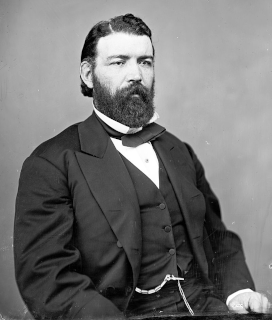
John Morrissey, Irish American politician, bare-knuckle boxing champion and criminal also known as ‘Old Smoke,’ is born on February 12, 1831, at Templemore, County Tipperary.

Morrissey is the only son among eight children of Timothy Morrissey, factory worker, and Julia (or Mary) Morrissey. In 1834 the family emigrates to Canada and then the United States, settling at Troy, New York. From the age of ten he works, first in a mill, and then as an iron worker due to his size and strength. He becomes involved in various street gangs, developing a reputation as a pugilist of great strength and resolve. As leader of the Down-Town gang, he defeats six members of the rival Up-Town gang in a single afternoon in 1848. He takes work on a Hudson River steamer and marries Sarah Smith, daughter of the ship’s captain, around 1849. They have one child who dies before reaching adulthood.

In a New York saloon Morrissey challenges Charley ‘Dutch’ Duane to a prize fight and, when he is not to be found, with typical bravado he extends the challenge to everyone present. This impresses the owner, Isaiah Rynders, the Tammany Hall politician, and he employs Morrissey to help the Democratic Party, which involves intimidating voters at election time. A fistfight with gang rival Tom McCann earns him the nickname ‘Old Smoke.’ Mid-fight he is forced onto a bed of coals, but despite having his flesh burned, refuses to concede defeat. He fights his way back and beats McCann into unconsciousness. Stowing away to California to challenge other fighters, he begins a gambling house to raise money and embarks on a privateering expedition to the Queen Charlotte Islands in a quixotic attempt to make his fortune.

In his first professional prize fight on August 21, 1852, Morrissey defeats George Thompson at Mare Island, California, in dubious circumstances, and begins calling himself the ‘champion of America.’ However, it is only on October 12, 1853, that he officially earns this title, when he wins the heavyweight championship of America in a bout at Boston Corner, New York, against Yankee Sullivan. The fight lasts thirty-seven rounds, and Morrissey has the worst of most of them, but he is awarded the contest after a free-for-all in the ring.

Increasingly involved in New York politics, Morrissey and his supporters fight street battles against the rival gang of William Poole, known as ‘Bill the Butcher,’ a Know Nothing politician later fictionalised in the film Gangs of New York (2002). On July 26, 1854, the two men fight on the docks, but Morrissey is beaten badly and forced to surrender. This marks the beginning of a bitter feud between the two parties, with heavy casualties on both sides, which climaxes on March 8, 1855, when Poole is murdered. Morrissey is indicted as a conspirator in the crime but is soon released because of his political connections.

On October 20, 1858, Morrissey fights John C. Heenan (1835–73) in another heavyweight championship bout. Heenan breaks his hand early in the fight and is always at a disadvantage. After taking much punishment Morrissey finally makes his dominance count. There is a rematch on April 4, 1859, which Morrissey again wins, and after this he retires from the ring. Investing his prize money, he runs two saloons and a gambling house in New York. With the huge profits from his gambling empire, he invests in real estate in Saratoga Springs, New York, opening the Saratoga Race Course there in 1863 which has endured to become America’s oldest major sports venue.

A political career beckons as a reward for Morrissey’s consistent support for the Democratic Party. He is elected to the United States House of Representatives in 1866 representing New York’s fifth district, is re-elected the following year, and serves until March 3, 1871. He supports President Andrew Johnson against demands for his impeachment and is skeptical about the Radicals’ plans for reconstruction in the south. In his final years he serves in the New York State Senate (1875–78).

After contracting pneumonia, Morrissey dies at the Adelphi Hotel, Saratoga Springs, on May 1, 1878, and is buried at Saint Peter’s Cemetery, Troy. On the day of his funeral, flags at New York City Hall are lowered to half-mast, while the National Police Gazette declares on May 4, 1878, that “few men of our day have arisen from beginnings so discouraging to a place so high in the general esteem of the community.” His name is included in the list of ‘pioneer’ inductees in the International Boxing Hall of Fame in Canastota, New York, and each year the John Morrissey Stakes are held at Saratoga Race Course in honour of its founder.

(Pictured: John Morrissey, U.S. Representative from New York, circa 1870s, source Library of Congress)

Leave a comment

Birth of Mike Donovan, Middleweight Boxer

professor-mike-donovan

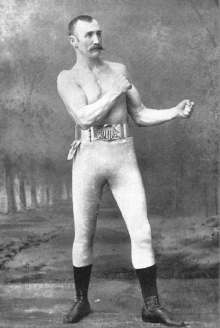
Mike Donovan, middleweight boxer of the bare-knuckle era also known as Professor Mike Donovan and Mike O’Donovan, is born in Chicago, Illinois on September 27, 1847, to Irish-born parents. He later becomes one of the foremost teachers of the sport.

The first of many memorable events in Donovan’s life comes when he fights for the Union Army in the American Civil War, serving in William Tecumseh Sherman‘s army in its march through Georgia. After the war, he begins a boxing career that associates him with some of the best-known people of his age, in and out of the ring.

In 1868, Donovan defeats John Shanssey in a bout in Cheyenne, Wyoming, refereed by famous Western lawman Wyatt Earp. He wins the middleweight title in 1887 in San Francisco. He also fights the most famous Irish boxing champion in history, John L. Sullivan, fighting two four-round fights with him in 1880 and 1881.

After his active boxing career ends, Donovan becomes a boxing instructor at the New York Athletic Club and works with several famous Irish fighters. He is in Jake Kilrain‘s corner when he loses to John L. Sullivan in the last bare-knuckle heavyweight championship fight, and also helps James Corbett when he defeats Sullivan for the title in 1892.

Donovan spars with President Theodore Roosevelt, who loves boxing, on several occasions. He earns the sobriquet “Professor” for his scientific approach to his own career and in his later teaching of the sport. The “Professor” leaves a legacy, as well. His son Arthur is a famous boxing referee in the 1930s and 1940s and is enshrined in the International Boxing Hall of Fame along with the “Professor,” the only father-son combination so honored. His grandson, also Art, plays for the Baltimore Colts in the National Football League and is enshrined in the Pro Football Hall of Fame in Canton, Ohio.

Donovan dies on March 24, 1918, at St. Francis Hospital in the Bronx, New York from complications from a bout with pneumonia he develops while teaching a boxing class. He is survived by his wife, Cecilia, and eight children, all who are at his bedside when he dies. After his death, his will indicates that his last name is actually O’Donovan.

Donovan’s silver championship belt is bequeathed to his son, Arthur, who at the time is serving in the United States Army, in the 105th Field Artillery at Spartanburg, South Carolina, during World War I.

Donovan is elected to the International Boxing Hall of Fame in Canastota, New York in 1998.


Leave a comment

The Last Official Bare-Knuckle Title Fight

sullivan-kilrain-fight

Heavyweight boxer John L. Sullivan defeats fellow Irish American Jake Kilrain in a world championship bout which lasts 75 rounds on July 8, 1889, the last official bare-knuckle title fight ever held.

Bare-knuckle boxing is the original form of boxing, closely related to ancient combat sports. It involves two individuals fighting without boxing gloves or other padding on their hands. The difference between a street fight and a bare-knuckle boxing match is an accepted set of rules, such as not striking a downed opponent.

The Sullivan-Kilrain fight is considered to be a turning point in boxing history because it is the last world title bout fought under the London Prize Ring Rules, and therefore the last bare-knuckle heavyweight title bout. It is one of the first sporting events in the United States to receive national press coverage.

For the first time, newspapers carry extensive pre-fight coverage, reporting on the fighters’ training and speculating on where the bout will take place. The traditional center of bare-knuckle fighting is New Orleans, but the governor of Louisiana has forbidden the fight in that state. Sullivan has trained for months in Belfast, New York under trainer William Muldoon, whose biggest problem has been keeping Sullivan from liquor. A report on Sullivan’s training regimen in Belfast is written by famed reporter Nellie Bly and published in the New York World.

Rochester reporter Arch Merrill comments that occasionally Sullivan would “escape” from his guard. In Belfast village, the cry is heard, “John L. is loose again. Send for Muldoon!” Muldoon would snatch the champ away from the bar and take him back to their training camp.

On July 8, 1889, an estimated 3,000 spectators board special trains for the secret location, which turns out to be Richburg, a town just south of Hattiesburg, Mississippi. The fight begins at 10:30, and it looks as if Sullivan is going to lose, especially after he vomits during the 44th round. But the champion gets his second wind after that, and Kilrain’s manager, Mike Donovan, finally throws in the towel after the 75th round. Kilrain does not want to give up thinking he can outlast Sullivan, but Donovan defends his actions insisting that Kilrain would die if the fight continued. In any case, the Kilrain-Sullivan fight can rightly be listed among the greatest fights of the pre-modern era.