seamus dubhghaill

Promoting Irish Culture and History from Little Rock, Arkansas, USA


Leave a comment

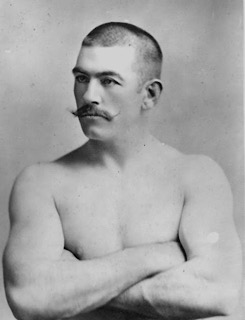
Birth of Heavyweight Boxing Champion John L. Sullivan

John Lawrence Sullivan, heavyweight boxing champion from 1892 to 1892, is born on October 15, 1858, in the Roxbury neighborhood of Boston, Massachusetts. Known as “The Boston Strong Boy,” he becomes one of the most iconic figures in boxing history.

Sullivan is the son of Michael Sullivan from Abbeydorney, County Kerry, and Catherine Kelly from Drum, County Roscommon. He attends public schools in his native Boston, attending the Dwight Grammar School and performing well academically. His parents aspire for their son to enter the priesthood as a Catholic priest. To this end he enrolls at Boston College, but his passion for sports leads him to abandon formal education for professional baseball and later boxing. He quickly gains a reputation for raw power and aggression, earning the nickname “The Boston Strong Boy” during exhibition tours.

On February 7, 1882, Sullivan defeats Paddy Ryan in Mississippi City, Mississippi, winning the bare-knuckle championship of America. On August 29, 1885, he wins the Marquess of Queensberry Rules title from Dominick McCaffrey, becoming the first heavyweight champion under gloved rules. His 1889 knockout of Jake Kilrain under the old rules makes him the last bare-knuckle heavyweight champion.

Sullivan holds the gloved heavyweight title from 1882 to 1892, with a record of 41–1–3 and 33 knockouts.

Sullivan’s fights are widely covered by newspapers, helping to launch modern sports journalism in the United States. He is one of the highest-paid athletes of his era, earning over $75,000 for a single bout. His “I can lick any man in the house” challenge becomes a symbol of Irish American defiance and determination.

After retiring in 1892, Sullivan opens the John L. Sullivan’s Theatre in New York City. He marries Annie Bates Lord in 1883 and has one daughter, Helen. He struggles with alcohol after his defeat to James J. Corbett in 1892 but later lectures against alcoholism. He dies at the age of 59 on February 2, 1918, in Abington, Plymouth County, Massachusetts. He is buried at Mount Calvary Cemetery in Roslindale, Suffolk County, Massachusetts.

Sullivan’s career transforms boxing from an underground, often illegal pastime into a national spectacle. He remains a cultural icon, celebrated in literature, film, and sports history.

Leave a comment

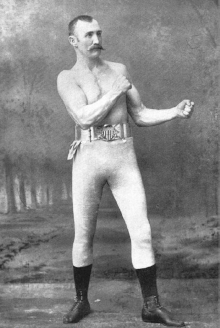
Birth of Mike Donovan, Middleweight Boxer

professor-mike-donovan

Mike Donovan, middleweight boxer of the bare-knuckle era also known as Professor Mike Donovan and Mike O’Donovan, is born in Chicago, Illinois on September 27, 1847, to Irish-born parents. He later becomes one of the foremost teachers of the sport.

The first of many memorable events in Donovan’s life comes when he fights for the Union Army in the American Civil War, serving in William Tecumseh Sherman‘s army in its march through Georgia. After the war, he begins a boxing career that associates him with some of the best-known people of his age, in and out of the ring.

In 1868, Donovan defeats John Shanssey in a bout in Cheyenne, Wyoming, refereed by famous Western lawman Wyatt Earp. He wins the middleweight title in 1887 in San Francisco. He also fights the most famous Irish boxing champion in history, John L. Sullivan, fighting two four-round fights with him in 1880 and 1881.

After his active boxing career ends, Donovan becomes a boxing instructor at the New York Athletic Club and works with several famous Irish fighters. He is in Jake Kilrain‘s corner when he loses to John L. Sullivan in the last bare-knuckle heavyweight championship fight, and also helps James Corbett when he defeats Sullivan for the title in 1892.

Donovan spars with President Theodore Roosevelt, who loves boxing, on several occasions. He earns the sobriquet “Professor” for his scientific approach to his own career and in his later teaching of the sport. The “Professor” leaves a legacy, as well. His son Arthur is a famous boxing referee in the 1930s and 1940s and is enshrined in the International Boxing Hall of Fame along with the “Professor,” the only father-son combination so honored. His grandson, also Art, plays for the Baltimore Colts in the National Football League and is enshrined in the Pro Football Hall of Fame in Canton, Ohio.

Donovan dies on March 24, 1918, at St. Francis Hospital in the Bronx, New York from complications from a bout with pneumonia he develops while teaching a boxing class. He is survived by his wife, Cecilia, and eight children, all who are at his bedside when he dies. After his death, his will indicates that his last name is actually O’Donovan.

Donovan’s silver championship belt is bequeathed to his son, Arthur, who at the time is serving in the United States Army, in the 105th Field Artillery at Spartanburg, South Carolina, during World War I.

Donovan is elected to the International Boxing Hall of Fame in Canastota, New York in 1998.


Leave a comment

The Last Official Bare-Knuckle Title Fight

sullivan-kilrain-fight

Heavyweight boxer John L. Sullivan defeats fellow Irish American Jake Kilrain in a world championship bout which lasts 75 rounds on July 8, 1889, the last official bare-knuckle title fight ever held.

Bare-knuckle boxing is the original form of boxing, closely related to ancient combat sports. It involves two individuals fighting without boxing gloves or other padding on their hands. The difference between a street fight and a bare-knuckle boxing match is an accepted set of rules, such as not striking a downed opponent.

The Sullivan-Kilrain fight is considered to be a turning point in boxing history because it is the last world title bout fought under the London Prize Ring Rules, and therefore the last bare-knuckle heavyweight title bout. It is one of the first sporting events in the United States to receive national press coverage.

For the first time, newspapers carry extensive pre-fight coverage, reporting on the fighters’ training and speculating on where the bout will take place. The traditional center of bare-knuckle fighting is New Orleans, but the governor of Louisiana has forbidden the fight in that state. Sullivan has trained for months in Belfast, New York under trainer William Muldoon, whose biggest problem has been keeping Sullivan from liquor. A report on Sullivan’s training regimen in Belfast is written by famed reporter Nellie Bly and published in the New York World.

Rochester reporter Arch Merrill comments that occasionally Sullivan would “escape” from his guard. In Belfast village, the cry is heard, “John L. is loose again. Send for Muldoon!” Muldoon would snatch the champ away from the bar and take him back to their training camp.

On July 8, 1889, an estimated 3,000 spectators board special trains for the secret location, which turns out to be Richburg, a town just south of Hattiesburg, Mississippi. The fight begins at 10:30, and it looks as if Sullivan is going to lose, especially after he vomits during the 44th round. But the champion gets his second wind after that, and Kilrain’s manager, Mike Donovan, finally throws in the towel after the 75th round. Kilrain does not want to give up thinking he can outlast Sullivan, but Donovan defends his actions insisting that Kilrain would die if the fight continued. In any case, the Kilrain-Sullivan fight can rightly be listed among the greatest fights of the pre-modern era.