

John Kelly, also known as Kelly of Killanne, a leader of the Society of United Irishmen, is hanged along with seven other rebel leaders on Wexford bridge on June 22, 1798.
Kelly lives in the town of Killanne in the parish of Rathnure and is a United Irish leader who fights in the Irish Rebellion of 1798.
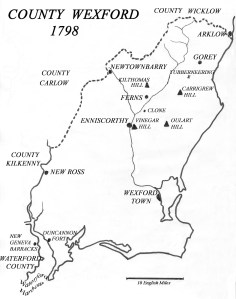
While Kelly is obviously well known to rebel and loyalist alike during the short duration of the Wexford Rebellion, almost nothing is known of him outside this time. He is one of the leaders of the rebel victory at the Battle of Three Rocks which leads to the capture of Wexford town but is later seriously wounded while leading a rebel column at the Battle of New Ross.
Kelly is under orders from the Wexford commander Bagenal Harvey to attack the British outposts around New Ross but on no account to attack the town itself.
The rebels outnumber the British forces, and so Harvey sends a messenger to give them an opportunity to surrender. The messenger is shot while carrying a white flag. This angers the rebels who begin the attack without receiving the official order from Harvey.
Kelly’s column of 800 men attacks and breaks through Ross’s “Three Bullet Gate” and proceeds into the town itself. After initial success, they are eventually beaten back by British troops and Kelly is wounded in the leg. He is moved to Wexford to recuperate but, after the fall of Wexford on June 21, he is dragged from his bed, tried and sentenced to death.
John Kelly is hanged on June 22, 1798, along with seven other rebel leaders on Wexford bridge, after which his body is decapitated, the trunk thrown into the River Slaney and the head kicked through the streets before being set on display on a spike.
Kelly’s exploits are commemorated in the famous Irish ballad Kelly the Boy From Killanne written by Patrick Joseph McCall (1861–1919). Don Partridge records a solo acoustic version of the song in 1964, and later regularly plays the song during street busking, before and after his hit records in the late 1960s.
(Pictured: The grave of John Kelly, Kelly of Killanne, in Saint Anne’s Churchyard, Killanne, County Wexford)
 seamus dubhghaill