seamus dubhghaill

Promoting Irish Culture and History from Little Rock, Arkansas, USA


Leave a comment

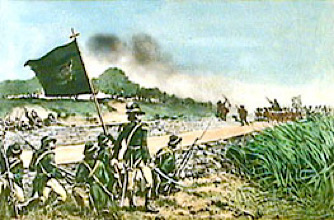
The Battle of Tubberneering

During the Irish Rebellion of 1798, the Battle of Tubberneering (also Tuberneering or Toberanierin) takes place on June 4, 1798, during the Wexford Rebellion fought between Crown forces and United Irishmen insurgents, at Tubberneering (modern townlands of Toberanierin North and Toberanierin South) south of Gorey in the north of County Wexford. The rebels ambush and rout the British.

The United Irish rebels, under Fr. John Murphy’s command, have been encamped on land belonging to a Mr. Donovan at the foot of Carrigrew Hill on June 2 and 3. This small respite from hostilities and marching affords the rebels some rest and time to re-group from previous skirmishes. Some of the rebels take leave to visit their families during these two days before re-joining the camp in advance of their move north toward Gorey.

On the morning of the June 4, Lieutenant-General Loftus and Lieutenant-Colonel Walpole march out of Gorey with 1,200 men with the intention of attacking the rebel encampment at Carrigrew Hill. Loftus leads his 600 men out the Ballycanew road to attack the camp from the east while Walpole heads due south via Clough to attack the camp on its northern side.

Having received advanced warnings of the British plans, the poorly equipped rebel army of 10,000 to 12,000 men sets out from Carrigrew Hill and marches through Ballyoughter on to Tubberneering. Their aim is to defeat the Crown forces in Gorey and release rebel prisoners that have been captured and imprisoned there.

On approaching Tubberneering, a vanguard of rebels is warned by a scouting party returning from Clough that the British forces are heading their way. The vanguard sets up an ambush with musketeers on top of the rock at Tubberneering and pikemen laying in wait inside the ditch along the road south of Cain bridge.

The battle is an ambush of a British force of 400 men under Lieutenant-Colonel Walpole, containing one troop of regular cavalry (the 4th Royal Irish Dragoon Guards) and militia and yeomanry auxiliaries. They are ambushed in a narrow defile by United Irish rebels, led by Fr. John Murphy. Walpole and one hundred men are killed, while the rest throw away their weapons and uniforms and flee. The regular dragoons make an attempt to fight back but are in a bad place for cavalry so they withdraw. This defeat allows three cannon to be captured which are subsequently used against British troops at the Battle of Arklow. The rebels are unable to take Arklow however. The day after the engagement at Tubberneering, the United Irishmen attempt to take New Ross in the south of County Wexford but are repulsed at a heavy cost.


2 Comments

Execution of Father John Murphy

father-john-murphy

John Murphy, Irish Roman Catholic priest and one of the leaders of the Irish Rebellion of 1798 in Wexford, is executed by British soldiers on July 2, 1798.

Murphy is born at Tincurry in the Parish of Ferns, County Wexford in 1753, the youngest son of Thomas and Johanna Murphy. Studying for the priesthood is then illegal in Ireland and so priests are trained abroad. He sails for Spain in early 1772 and studies for the priesthood in Seville, where many of the clergy in Ireland receive their education due to the persecution of Catholics as a result of the Penal Laws.

Fr. Murphy is initially against rebellion and actively encourages his parishioners to give up their arms and sign an oath of allegiance to the British Crown. On May 26, 1798, a company of men armed with pikes and firearms gather under Fr. Murphy to decide what to do for safety against the regular yeomanry patrols at a townland called the Harrow. At about eight o’clock that evening, a patrol of some twenty Camolin cavalry spot the group and approach them, demanding to know their business. They leave after a brief confrontation, having burned the cabin of a missing suspected rebel whom they had been tasked to arrest. As the patrol returns, they pass by Fr. Murphy’s group, who are now angry at the sight of the burning cabin. As the cavalry passes by the men an argument develops, followed by stones being thrown and then an all-out fight between the men and the troops. Most of the cavalry quickly flees, but two of the yeomen are killed. The Wexford Rebellion has begun and Fr. Murphy acts quickly. He sends word around the county that the rebellion has started and organises raids for arms on loyalist strongholds.

Parties of mounted yeomen respond by killing suspects and burning homes, causing a wave of panic. The countryside is soon filled with masses of people fleeing the terror and heading for high ground for safety in numbers. On the morning of May 28, a crowd of some 3,000 gather on Kilthomas Hill but is attacked and put to flight by Crown forces who kill 150. At Oulart Hill, a crowd of over 4,000 combatants gather, plus many women and children. Spotting an approaching North Cork Militia party of 110 rank and file, Fr. Murphy and the other local United Irishmen leaders such as Edward Roche, Morgan Byrne, Thomas Donovan, George Sparks and Fr. Michael Murphy organise their forces and massacre all but five of the heavily outnumbered detachment.

The victory is followed by a successful assault on the weak garrison of Enniscorthy, which swells the Irish rebel forces and their weapon supply. However, defeats at New Ross, Arklow, and Bunclody mean a loss of men and weapons. Fr. Murphy returns to the headquarters of the rebellion at Vinegar Hill before the Battle of Arklow and is attempting to reinforce its defences. Twenty thousand British troops arrive at Wexford with artillery and defeat the rebels, armed only with pikes, at the Battle of Vinegar Hill on June 21. However, due to a lack of coordination among the British columns, the bulk of the rebel army escapes to fight on.

Eluding the crown forces by passing through the Scullogue Gap, Fr. Murphy and other leaders try to spread the rebellion across the country by marching into Kilkenny and towards the midlands. On June 26, 1798, at the Battle of Kilcumney Hill in County Carlow, their forces are tricked and defeated. Fr. Murphy and his bodyguard, James Gallagher, become separated from the main surviving group. Fr. Murphy decides to head for the safety of a friend’s house in Tullow, County Carlow, when the path clears. They are sheltered by friends and strangers. One Protestant woman, asked by searching yeomen if any strangers have passed, answers “No strangers passed here today.” When she is later questioned about why she had not said Murphy and Gallagher had not passed, she explains that they had not passed because they were still in her house when she was questioned.

After a few days, some yeomen capture Murphy and Gallagher in a farmyard on July 2, 1798. They are brought to Tullow later that day where they are brought before a military tribunal, charged with committing treason against the British crown, and sentenced to death. Both men are tortured in an attempt to extract more information from them. Fr. Murphy is stripped, flogged, hanged, decapitated, his corpse burned in a barrel of tar and his head impaled on a spike. This final gesture is meant to be a warning to all others who fight against the British Crown.

Fr. John Murphy’s remains are buried in the old Catholic graveyard with Fr. Ned Redmond in Ferns, County Wexford.


Leave a comment

Death of John Kelly, United Irish Leader

john-kelly-marker

John Kelly, also known as Kelly of Killanne, a leader of the Society of United Irishmen, is hanged along with seven other rebel leaders on Wexford bridge on June 22, 1798.

Kelly lives in the town of Killanne in the parish of Rathnure and is a United Irish leader who fights in the Irish Rebellion of 1798.

While Kelly is obviously well known to rebel and loyalist alike during the short duration of the Wexford Rebellion, almost nothing is known of him outside this time. He is one of the leaders of the rebel victory at the Battle of Three Rocks which leads to the capture of Wexford town but is later seriously wounded while leading a rebel column at the Battle of New Ross.

Kelly is under orders from the Wexford commander Bagenal Harvey to attack the British outposts around New Ross but on no account to attack the town itself.

The rebels outnumber the British forces, and so Harvey sends a messenger to give them an opportunity to surrender. The messenger is shot while carrying a white flag. This angers the rebels who begin the attack without receiving the official order from Harvey.

Kelly’s column of 800 men attacks and breaks through Ross’s “Three Bullet Gate” and proceeds into the town itself. After initial success, they are eventually beaten back by British troops and Kelly is wounded in the leg. He is moved to Wexford to recuperate but, after the fall of Wexford on June 21, he is dragged from his bed, tried and sentenced to death.

John Kelly is hanged on June 22, 1798, along with seven other rebel leaders on Wexford bridge, after which his body is decapitated, the trunk thrown into the River Slaney and the head kicked through the streets before being set on display on a spike.

Kelly’s exploits are commemorated in the famous Irish ballad Kelly the Boy From Killanne written by Patrick Joseph McCall (1861–1919). Don Partridge records a solo acoustic version of the song in 1964, and later regularly plays the song during street busking, before and after his hit records in the late 1960s.

(Pictured: The grave of John Kelly, Kelly of Killanne, in Saint Anne’s Churchyard, Killanne, County Wexford)