seamus dubhghaill

Promoting Irish Culture and History from Little Rock, Arkansas, USA


Leave a comment

Birth of Michael McCarthy, Professional Football Player & Manager

Michael Joseph “Mick” McCarthy, professional football manager, pundit and former player, is born on February 7, 1959, in Barnsley, South Yorkshire, England. He is most recently the head coach of Blackpool.

McCarthy makes his league debut for then-Fourth Division Barnsley on August 20, 1977, in a 4–0 win over Rochdale. He spends two years in the basement league, before the club wins promotion. A strong central defender, he is a virtual ever-present for his hometown club, but departs in December 1983 for fellow Division 2 club Manchester City.

Manchester City wins promotion in McCarthy’s first full season, and he finally has the chance to play at the highest level. His first season in the topflight is steady enough as the club reaches mid-table, but relegation strikes the following year. However, he does not face the drop as he signs for Celtic in May 1987 in a surprise £500,000 move.

McCarthy is brought to Parkhead by David Hay but within days of the signing the Celtic boss is sacked. Fortunately for McCarthy, Hay’s replacement is the returning Parkhead legend Billy McNeill, who quickly recognises that McCarthy’s strength and aggression are qualities desperately required by a notoriously leaky Celtic defence. He picks up his first silverware with Celtic as they win the league and cup double in his first season. The following season he again wins a Scottish Cup winners medal, although the club has to settle for third place in the league.

If ever an example is needed to reflect McCarthy’s values, it cannot be bettered than that on the day of the 1998 Scottish Cup Final. Celtic wins 2-1, but to the disgust of many, the unpopular Conservative Prime Minister Margaret Thatcher is in attendance and to present the trophy to the winners. The players are under pressure from the Scottish Football Association (SFA) to meet her, but a few refuse. According to fellow Celtic player Andy Walker, McCarthy refuses point-blank, as he is from Barnsley and the son of a miner. Shaking hands with her is an impossibility for him.

In the summer of 1988, McCarthy joins fellow Celtic players Packie Bonner and Chris Morris in Germany as part of the Republic of Ireland European Championship squad and gives a fine account of himself particularly in the historic 1-0 win over England. He, like Bonner and Morris, also star in the Republic’s 1990 FIFA World Cup squad which makes it to the quarterfinals in Italy.

In terms of his Celtic career, McCarthy never repeats the achievements or level of performance of his debut season.

McCarthy signs for Lyon in the summer of 1989 for £350,000. Afflicted by injuries and mindful of his spot in Ireland’s World Cup team, he finishes that season on loan to Millwall. After a captain’s showing in Italy for the Ireland national side, Millwall signs him full-time and later he becomes manager at The Den in 1992. In February 1996, he follows Jack Charlton into the Ireland manager’s job and experiences various highs and lows over his nearly seven years in charge. He has since managed Sunderland and Wolverhampton Wanderers.

In later years McCarthy becomes a low-key candidate for the Celtic manager’s job after the departures of Martin O’Neill and Gordon Strachan but is never favoured by the board or the general support for the role. Ironically then in 2018, he takes over from Martin O’Neill following his second stint as the Ireland manager. Notably, Roy Keane is Martin O’Neill’s assistant and has to step down also. On April 4, 2020, amid the global coronavirus pandemic, he stands down as manager and is immediately replaced by Stephen Kenny.

McCarthy joins Cypriot First Division club APOEL as manager on November 2, 2020, signing a contract until 2022. He is sacked by the club on January 5, 2021, following a run of 2 wins, 1 draw and 5 defeats in his eight games in charge.

On January 22, 2021, McCarthy is appointed as manager of Cardiff City, following the sacking of Neil Harris. He signs a contract until the end of the season. After making an unbeaten start to his reign at the club, a run that includes a six-game winning streak, he signs a new two-year deal with the club on March 4, 2021. Cardiff finishes the season in 8th place. Despite losing one of their opening six matches at the start of the following season, a run of results follows which sees Cardiff drop as low as 21st in the table. On October 23, 2021, after suffering a club-record eighth successive loss of the season at the hands of Middlesbrough, McCarthy leaves the club by mutual consent.

On January 19, 2023, McCarthy is appointed head coach of the Championship’s second-bottom placed club Blackpool on a short-term contract until the end of the season. On April 8, 2023, he leaves Blackpool by mutual consent, following a 3–1 home defeat to Cardiff the previous day. He achieves two wins in his 14 games in charge, losing nine of them, which leaves the club in 23rd position. “With results on the pitch not improving in recent weeks, the decision has been agreed by both parties that a change is needed,” the club says in a statement.


Leave a comment

Death of Professional Footballer Johnny Carey

john-joseph-carey

John Joseph “Johnny” Carey, professional footballer, manager and one of Manchester United F.C.’s great captains, dies in Macclesfield, Cheshire, England on August 22, 1995.

Carey is born in Dublin on February 23, 1919. As a schoolboy, he plays football for Home Farm F.C. As a youth, he also plays Gaelic football and is selected to represent Dublin GAA at minor level before he signs for St. James’s Gate F.C. at the start of the 1936–1937 season.

After just two months of League of Ireland football, he is spotted by Billy Behan, a Dublin-based Manchester United scout. In November 1936 United signs him for a then League of Ireland record fee of £250. He makes his debut as an inside left for United on September 23, 1937, against Southampton F.C. During his first season with United, Carey, together with Harry Baird, Jack Rowley, Tommy Bamford, Tommy Breen and Stan Pearson, help United gain promotion to the First Division.

As a player Carey spends most of his career with Manchester United, where he is team captain from 1946 until he retires as a player in 1953. He also plays as a guest for several other clubs including Cardiff City F.C., Manchester City F.C., Everton F.C., Liverpool F.C. and Middlesbrough F.C.

Carey is also a dual internationalist, playing for and captaining both Ireland teams – the FAI XI and the IFA XI. In 1947 he also captains a Europe XI which plays a Great Britain XI at Hampden Park. In 1949 he is voted the Football Writers’ Association Footballer of the Year and in the same year captains the FAI XI that defeats England 2–0 at Goodison Park, becoming the first non-UK team to beat England at home.

Carey is also the first non-UK player and the first Irishman to captain a winning team in both an FA Cup Final and the First Division. Like his contemporary Con Martin, he is an extremely versatile footballer and plays in nine different positions throughout his career. He even plays in goal for United on one occasion.

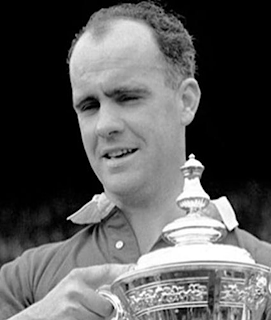
(Pictured: Manchester United captain Johnny Carey is carried on the shoulders of his teammates, after they win the FA Cup final of 1948 against Blackpool. Date: April 24, 1948)