On June 25, 1990, shortly after 8:30 p.m., the Provisional Irish Republican Army detonates a bomb at the Carlton Club, a club in London popular among MPs and supporters of the ruling Conservative Party. The ground floor collapses to the basement and windows are shattered. The blast is felt up to half a mile away. The bombing injures twenty people, including Lord Donald Kaberry, a former Vice-Chairman of the Conservative Party, and a much-loved porter, Charles Henry. Neither ever regains full health. Kaberry dies the following March, though Henry is able to return to his duties after a serious operation, but dies three years later.
In a statement, the IRA says, “Like Brighton in 1984, the IRA has brought the war directly to those who keep the British Army on the streets and in the fields of Ireland. While such occupation continues, and the Nationalist people face daily oppression, the policy makers and their military arm will not be safe.” The attack is part of the IRA’s escalating campaign that started in early 1990 and which has claimed two lives and 27 injuries since May of that year. The conservative MP for FulhamMatthew Carrington calls the attack very “worrying” as it is a non-military target, suggesting a dangerous tactic from the IRA against members of the public.
The bomb contains 15 lbs. (6.8 kg) of Semtex explosives. Prime MinisterMargaret Thatcher arrives at the club shortly after the bombing and speaks with some of the victims.
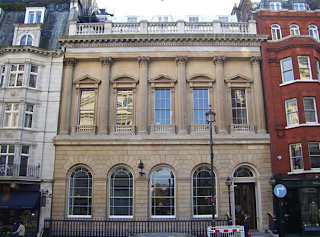
(Pictured: Building of Arthur’s which has hosted the Carlton Club since 1943)
The London Stock Exchange bombing occurs at 8:49 a.m. on the morning of July 20, 1990, with the explosion of a 5 to 10 lb. (2.3 to 4.5 kg) bomb of high explosives inside the London Stock Exchange building on Threadneedle Street in the City of London, England, planted by the Provisional Irish Republican Army (IRA). The building and surrounding area are evacuated after the IRA gives a telephone warning 40 minutes prior to the explosion, and thus nobody is wounded. As many as 300 people are evacuated from the building alone. The bomb’s strength blows a 10-foot hole inside the Stock Exchange Tower and causes massive damage to the visitors’ gallery on the first floor, which is frequently used by foreign tourists and schoolchildren and had been scheduled to open ten minutes after the explosion. The bomb is placed in the men’s toilets behind the gallery. The gallery and public viewing area is forced to close in 1992.
The bombing comes on the eighth anniversary of the July 20, 1982, Hyde Park and Regent’s Park bombings which killed eleven soldiers and wounded 53 people. The IRA launches a renewed campaign in London in 1990. During May, a soldier at an army recruiting centre is killed by a bomb in Wembley, while five are injured in a similar explosion in Eltham. In June 1990, bombs at the Honourable Artillery Company (HAC) and the Carlton Club injure 19 and 20 people respectively.
Scotland Yard‘s anti-terrorist chief George Churchill-Coleman says eight phone calls from the same man with an Irish accent are made between 8:02 a.m. and 8:20 a.m. to the City of London Police, the London Fire Brigade, Reuters, the Financial Times, The Salvation Army and the Stock Exchange itself. The caller telephones Reuters just after 8:00 a.m. and says, “This is the IRA. The bomb is due to go off in half an hour at the stock exchange.” The caller then gives a code word that the police say is known to them and used by the IRA to show that its threats are serious, and says, “Clear the building.”
The Stock Exchange’s chairman, however, says after the attack, “If the purpose of this callous act was to bring the City to a halt, they have failed singularly.” The explosion has little impact on stock trading since that is being carried out by computers elsewhere.
A spokesman for Prime MinisterMargaret Thatcher says she is “appalled when people leave explosive devices in this manner in public areas.” On October 12, 1984, a bomb planted by the IRA at the Grand Brighton Hotel in Brighton, where the Conservative Party is holding its annual conference, kills five people and comes close to killing Thatcher.
In 1992, the IRA bombs the Baltic Exchange building in the city.
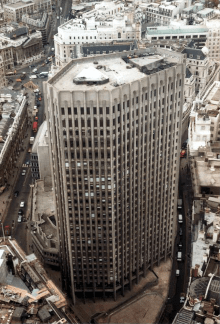
(Pictured: The Stock Exchange Tower in 1983, taken from the top of the National Westminster Tower (now Tower 42), clearly showing the symbolic coffin shape of the building)

 seamus dubhghaill