seamus dubhghaill

Promoting Irish Culture and History from Little Rock, Arkansas, USA


2 Comments

Death of Thomas Mulvany, Roman Catholic Bishop of Meath

Thomas Mulvany, the Roman Catholic Bishop of Meath from 1929 until his death, dies on June 16, 1943, in Mullingar, County Westmeath.

Mulvany is born in MoynaltyCounty Meath, 8 km (5 mi) north of Kells, on March 1, 1864, to James Mulvany and Mary Monaghan. He is ordained a priest of the Diocese of Meath on March 6, 1892.

Following his predecessors death, Pope Pius XI names him Bishop of Meath on April 12, 1929, and he is consecrated on June 30, with Cardinal Joseph MacRory being the principal consecrator. He retains that position until his death.

At the time of his appointment, Mulvaney becomes involved with plans for a new cathedral for Mullingar and the Diocese of Meath to replace the aging Cathedral of the Immaculate Conception (1836–1936). He takes the plans to Pope Pius XI, who is supportive and requests that the new building be dedicated as the Cathedral of Christ the King. Construction begins in 1932 and the building is completed in 1936.

Mulvany opens St. Patrick’s Classical School in Navan, County Meath, in the former study hall of St. Finian’s College, Navan, which moved to Mullingar at the beginning of the twentieth century.

Mulvany dies at the age of 75 as a result of hypertension and cerebral hemorrhage, in the Bishops Palace, Mullingar, on June 16, 1943. His death is registered on June 24, 1943, by Margaret Walsh, a nurse who is present at his death. He is buried in the grounds of the Cathedral of Christ the King, Mullingar.

Leave a comment

Creation of the Diocese of Galway

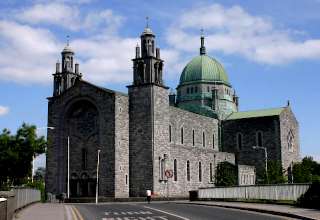
cathedral-of-our-lady-assumed-into-heaven-and-st-nicholas

The Diocese of Galway is created on April 23, 1831. The diocese has its origins in the ancient Kilmacduagh monastery and the Wardenship of Galway (1484–1831). Following the abolition of the Wardenship by the Holy See in 1831, the first Bishop of the new Diocese of Galway is appointed in the same year.

In 1866, Bishop John McEvilly of Galway is made Apostolic Administrator of the diocese of Kilmacduagh and Kilfenora. When he is appointed coadjutor bishop to the Archdiocese of Tuam in 1878, he retains Galway until he succeeds as archbishop in 1881. McEvilly continues to oversee Kilmacduagh and Kilfenora until 1883 when Pope Leo XIII unites the diocese with the neighbouring Diocese of Kilmacduagh. At the same time, the ordinary of the United Diocese of Galway and Kilmacduagh is appointed, in perpetuum, as the Apostolic Administrator of the Diocese of Kilfenora.

The bishopric of Kilmacduagh had been a separate title until 1750 when Pope Benedict XIV decrees that it is to be united with the bishopric of Kilfenora. Since Kilmacduagh is in the Ecclesiastical province of Tuam while Kilfenora is in the Province of Cashel, it is arranged that the ordinary of the united dioceses is to be alternately bishop of one diocese and apostolic administrator of the other. The first holder of this unusual arrangement is Peter Kilkelly, who had been Bishop of Kilmacduagh since 1744. He becomes Apostolic Administrator of Kilfenora in September 1750. Since that date, Kilfenora has been administered by that united diocese as an apostolic vicariate. Since the territory of an apostolic vicariate comes directly under the pope as “universal bishop”, the pope exercises his authority in Kilfenora through a “vicar.”

The geographic remit of the see includes the city of Galway, parts of County Galway and the northern coastal part of County Clare. Large population centres include Ennistymon, Oranmore and Oughterard. The cathedral church of the diocese is the Cathedral of Our Lady Assumed into Heaven and St. Nicholas. It is in the ecclesiastical province of Tuam and is subject to the Metropolitan Archdiocese of Tuam. The deanery of Kilfenora, previously a diocese in its own right, lies in the ecclesiastical province of Cashel. The Ordinary is Bishop Brendan Kelly who is appointed on December 11, 2017.

(Pictured: The Cathedral of Our Lady Assumed into Heaven and St. Nicholas)