
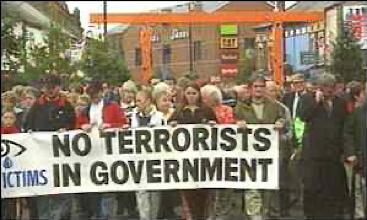
On September 25, 1999, a group of Protestant civil rights marchers in Belfast deliberately defy a ban imposed by the Belfast City Council to participate in an event during the so-called “Long March.” The march is organized as part of a series of demonstrations by Protestant and Unionist groups in Northern Ireland, following the signing of the Good Friday Agreement in 1998.
The march is orchestrated by networks of Ulster Unionist victims’ groups, Protestant clergy, parties, and cultural organizations. The mobilization draws from what scholars term the Unionist Victims Movement, which seeks to highlight perceived mistreatment of Protestant Unionists in the post-agreement political settlement. Groups involved include the Northern Irish Victims of Terrorism Association (NIVTA) and affiliated organizations. They frame the protest in terms of civil rights for Protestants, drawing analogies with global civil rights movements to legitimize their cause.
The September 25 march aims to lay a wreath at the cenotaph in Belfast to commemorate victims of the Troubles. This act is symbolic, emphasizing that Protestant victims of the conflict feel ignored or marginalized in the ongoing peace process. The march is also referred to as “The Long March,” which is structured to traverse central areas of Belfast, culminating in a rally at the grounds of Stormont Parliament. Organizers promote messages such as “pride, not prejudice” and “heritage, not hatred” to frame the march as a civic, rights-based demonstration rather than sectarian agitation.
Belfast City Council issues a ban on the march, restricting access to certain areas. Nevertheless, the Protestant marchers blatantly defy this prohibition. This act of defiance is deliberate, signaling a protest against perceived institutional bias and asserting the visibility of the Protestant community’s grievances.
The march reflects ongoing tensions within Northern Irish society during a period of post-conflict transition, where newly established power sharing mechanisms are perceived by some Unionist factions as disadvantaging Protestant communities. The event is emblematic of a strategy used by the Unionist Victims Movement to mobilize public attention and articulate a collective identity rooted in historical victimhood, despite being part of a locally dominant ethno-national group.
Contemporary news accounts note the boldness of defying official restrictions and the wider sociopolitical implications for the peace process. The Long March serves as both a commemorative act and a political statement, uniting a range of Protestant organizations in a conflictual social movement for civil rights recognition.
In summary, the September 25, 1999 Protestant civil rights march in Belfast is a strategically organized demonstration by Protestant and Unionist groups that deliberately defies a municipal ban to assert the civil rights of their community. The event combines symbolic commemoration of the Troubles’ victims with a broader protest against perceived post-Good Friday Agreement injustices, highlighting the complex dynamics of post-conflict mobilization and identity politics in Northern Ireland.


