seamus dubhghaill

Promoting Irish Culture and History from Little Rock, Arkansas, USA


6 Comments

The Shipwrecks of the Trevor and Nonpareil

Two hundred passengers are lost in the shipwrecks of the brigs Trevor and Nonpareil on October 20, 1775. Among the casualties are The Hononorable Major Francis Caulfield, Member of Parliament (MP) for Charlemont, his wife, and daughters. Also lost is John French, Member for Roscommon County.

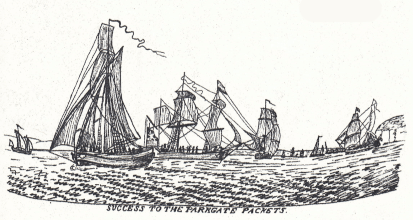
On Thursday, October 19, 1775, the brig Trevor, with Captain William Totty at the helm, and the brig Nonpareil, with Capatin Samuel Davies, sail from Parkgate for Dublin. That evening, as the vessels are near Holyhead, the wind shifts about from the south southwest to the west, and so violent a hurricane arises that they cannot carry any sail, but are obliged to lie to, and drive before the wind. In this situation, the Trevor drives upon the banks near the Lancashire shore and is totally lost.

Everyone on board perishes, except Samuel Fairclough, a mariner, who miraculously saves his life by leaping aboard another vessel named the Charming Molly, under Captain Joseph Holloway, which is transporting coal from Chester to Newry. The Charming Molly accidentally runs afoul of the Trevor and carries away the Trevor‘s foretopmast and, at the instant the two vessels come together, Fairclough makes his leap. He was the only survivor of the 30 to 40 passengers and crew aboard the Trevor.

Captain Holloway states that his vessel and the Trevor came together at some distance from the coast. They parted at the time Fairclough jumped across, and the Trevor subsequently went to pieces. A great many chests, boxes, some of which are broken, and quantities of East India goods are strewn along the shore, all wet with salt water. These items are in the custody of Mrs. Hesketh, Lady of the Manor of this coast, secured by Mr. Standen of Rossall Hall. The East India goods had arrived by land from London. The cargo and coins aboard the Trevor are estimated to be worth £15,000.

The Charming Mary runs ashore at Blackpool with most of her sails carried away, but otherwise with little damage.

The Nonpareil is lost in the storm between Parkgate and Dublin, driven on shore near Hoyle-sands and lost. There are no survivors. The wife of Captain Davies states that her husband sailed from Parkgate with very low spirits as he did not like the appearance of the weather. He is pressured to put to sea, which he does, and is turned back twice, but gets off on the third attempt, and is never seen again.

Between them, the Trevor and the Nonpareil reportedly carry nearly 200 passengers, the majority being on the Nonpareil. They carry cargo valued at £15,000.

On Tuesday evening, October 24, the Collector of the port of Chester receives the melancholy account of the loss of the Trevor by a letter from the Collector of Poulton, in Lancashire. This is immediately communicated to the Merchants, who are concerned in shipping the cargo, and they set out as soon as possible to give assistance and to secure each part of the cargo as might come ashore.

The merchants from Chester reach Poulton late on Wednesday night, October 25. The following morning, they set out along the shore from Blackpool, where the Charming Mary is stranded. The greatest part of the hull of the Trevor lay scattered along the shore at a great distance. On their arrival at Rossall Hall, about six miles from Blackpool, they have the satisfaction to find that Mr. Standen, who is Steward of the Manor of Bold Fleetwood Hesketh, now a minor and son to the deceased Fleetwood Hesketh, on whose estate the wreck is taken up, has taken all possible care of everything that can be saved from plunderers.


Leave a comment

Birth of Irish Politician Henry Grattan

henry-grattan

Henry Grattan, Irish politician and member of the Irish House of Commons, who campaigns for legislative freedom for the Irish Parliament in the late 18th century, is born at Fishamble Street in Dublin on July 3, 1746.

Grattan is baptised at the church of St. John the Evangelist in Dublin. He attends Drogheda Grammar School and then goes on to become a distinguished student at Trinity College, Dublin, where he begins a lifelong study of classical literature, and is especially interested in the great orators of antiquity.

After studying at the King’s Inns, Dublin, and being called to the Irish bar in 1772, he never seriously practises law but is drawn to politics, influenced by his friend Henry Flood. He enters the Irish Parliament for Charlemont in 1775, sponsored by Lord Charlemont, just as Flood has damaged his credibility by accepting office. Grattan quickly supersedes Flood in the leadership of the national party, not least because his oratorical powers are unsurpassed among his contemporaries.

Grattan’s movement gains momentum as more and more Irish people come to sympathize with the North American colonists in their war for independence from Great Britain. By 1779, he is powerful enough to persuade the British government to remove most of its restraints on Irish trade, and in April 1780 he formally demands the repeal of Poynings’ Law, which has made all legislation passed by the Irish Parliament subject to approval by the British Parliament. Two years later the British relinquish their right to legislate for Ireland and frees the Irish Parliament from subservience to the English Privy Council. Despite these successes, Grattan soon faces rivalry from Flood, who bitterly criticizes Grattan for failing to demand that the British Parliament completely renounce all claims to control of Irish legislation. Flood succeeds in undermining Grattan’s popularity, but by 1784 Flood himself has lost much of his following.

From 1782 to 1797 Grattan makes limited progress in his struggle to reform the composition of the Irish Parliament and to win voting rights for Ireland’s Roman Catholics. The outbreak of the French Revolution in 1789 bolsters his cause by infusing democratic ideas into Ireland, but the subsequent growth of a radical Irish movement for Catholic emancipation provokes repressive measures by the British. Grattan is caught between the two sides. Ill and discouraged, he retires from Parliament in May 1797 and is in England when the Irish radicals stage an unsuccessful rebellion in 1798.

Grattan returns to Parliament for five months in 1800 and wages a vigorous but fruitless campaign against Prime Minister William Pitt’s plans for the legislative union of the Irish and British parliaments. In 1805, Grattan is elected to the British House of Commons, where for the last 15 years of his life he fights for Catholic emancipation.

In 1920, after crossing from Ireland to London while in poor health to bring forward the Irish question once more, he becomes seriously ill. On his deathbed he speaks generously of Castlereagh, and with warm eulogy of his former rival, Flood. Henry Grattan dies on June 4, 1820, and is buried in Westminster Abbey. His statue is in the Outer Lobby of the Palace of Westminster.

The building housing the faculty of Law and Government at Dublin City University has been named in his honour. Grattan Bridge crossing the River Liffey between Parliament Street on the south side of Dublin and Capel Street on the north side is also named in his honour.