seamus dubhghaill

Promoting Irish Culture and History from Little Rock, Arkansas, USA


Leave a comment

Birth of Brian Warfield, Founding Member of The Wolfe Tones

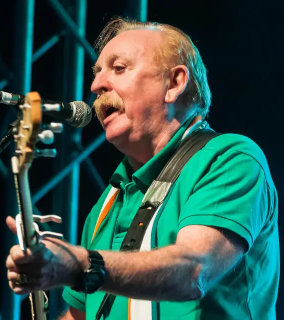
Brian Warfield

Patrick Brian Warfield, vocalist, banjo, harp and bodhrán player and lead songwriter with long-standing Irish band The Wolfe Tones, is born on April 2, 1946, in the National Maternity Hospital, Dublin. He introduces many of the songs at the Wolfe Tones live concerts and is a keen historian.

Warfield is raised in the Dublin suburb Inchicore, the second born in a family of four boys. Today, he and his wife June Warfield (née Radburn) reside in Blessington, County Wicklow.

Warfield is one of the founding members and lead singers of the Irish Folk band, The Wolfe Tones. He has written many songs for the band, notably “Up and Away (The Helicopter Song),” “Irish Eyes” and “My Heart is in Ireland.” “Let the People Sing” is written in dedication to those Irish ballad singers who were banned from singing Irish songs. It has been performed by many Celtic and Irish Rebel bands, including Celtic band Charlie and the Bhoys. The song is popular among fans of Celtic F.C. and a version is performed by The Malleys, omitting the second verse, at Celtic Park on match days.

Warfield’s affiliation with Celtic F.C. leads to him being asked to write a song for the club to celebrate its 100th anniversary. As a result, “Celtic Symphony” is composed. It is a song popular with many Celtic fans, but controversial due to its chorus, which features the words “ooh, ah, up the RA.” This is often seen as being a pro-Irish Republican Army (IRA) stance, but according to Warfield, the words were included in the balladic tradition of writing what is observed at the time.

As a songwriter, Warfield’s writing is typically a social commentary on Ireland and its issues. For the 2012 album, Child of Destiny, Warfield composes “Swing A Banker,” which is a comical ballad referring to Irish bankers as chickens. The music video is recorded outside the Treasury Building in Dublin.

The Wolfe Tones continue to tour but have announced that they are set to retire in 2024, after 60 years of performing together. In addition to gigs in the United States, there will be concerts at Galway Airport, Castlebar, County Mayo, and in the 3Arena in Dublin, with the band’s final gig taking place in Belfast in October 2024.

As of January 2024, Warfield has not communicated with his brother Derek Warfield since he left The Wolfe Tones in 2001.


1 Comment

Birth of Derek Warfield, Founding Member of The Wolfe Tones

Derek Warfield, Irish singer, songwriter, historian, and a former member of the musical group The Wolfe Tones, is born in the Dublin suburb of Inchicore on September 15, 1943.

Warfield is educated at Synge Street CBS. He is apprenticed as a tailor until becoming a folk musician. He is a cousin of Sinn Féin Senator Fintan Warfield.

Warfield is a singer, songwriter, mandolin player and a founding member of The Wolfe Tones, performing with the band for nearly thirty-seven years, writing and recording over 60 songs. As a founding member, he is featured on every album recorded by the band from 1965’s debut album The Foggy Dew through to 1989’s 25th Anniversary.

In 1989, a contract is signed by Warfield, signing rights to an American distributor, Shanachie Records. The contents of this contract are apparently misrepresented to the other members of The Wolfe Tones, resulting in a clause that prevents them from recording any new material. Unable to reverse this agreement, they continue to tour, albeit without any new material. As of July 2017, Warfield has not spoken to his brother and former bandmate Brian Warfield since he left The Wolfe Tones in 2001.

A solo album, Legacy, is released in 1995 as he is still eligible to record under his own name. With Warfield on vocals and mandolin, the music on this album is performed by a new band, although he is still touring with The Wolfe Tones. Legacy is followed by Liberte’ ’98, Sons of Erin, Take Me Home To Mayo and Clear The Way. He also has a video Legacy and two books, The Songs and Ballads of 1798 and The Irish Songster of the American Civil War.

In 2001, after a show played in Limerick, Warfield leaves The Wolfe Tones to concentrate on his own career. Calling themselves “Brian Warfield, Tommy Byrne and Noel Nagle, formerly of The Wolfe Tones,” the remaining three go on to release You’ll Never Beat the Irish (2001) and the subsequent album Child of Destiny (2011).

Warfield has performed his music and songs at American Civil War events and commemorations at such sites as Gettysburg, Sharpsburg and Harrisburg with his band, The Sons of Erin. His 2002 release, Clear the Way, is the second in his Irish Songs in the Civil War series.

The ballad “Take Me Home to Mayo,” written by Belfastman Seamus Robinson as a tribute to Michael Gaughan, is recorded as a duet with Irish American Andy Cooney and is the title track of another 2002 Warfield release.

In 2003, following a complaint by an Ulster Unionist Party (UUP) politician, Roy Beggs, Jr., a radio channel dedicated to the music of Derek Warfield is removed from the in-flight entertainment of Aer Lingus. Beggs complains of the “Blatant promotion of militant, armed republicanism” by the playing of this music, saying it is the same as “the speeches of Osama bin Laden being played on a trans-Atlantic Arabian airline.” Aer Lingus removes the material from their flights stating: “It is something that should not have been on board and we removed it immediately we became aware of it.”

In March 2006, Warfield releases his ninth solo album, a 36-song double CD of Irish songs. On March 1, 2006, his wife Nuala dies, followed by the death of his eldest daughter on September 28, 2007.

Warfield now tours with his new band, Derek Warfield and The Young Wolfe Tones.

A biography of Robert Emmet in two volumes, although not written by Warfield, has been published by him, and a collaboration with Raymond Daly of Tullamore has resulted in the publishing of a critically acclaimed book of lyrics and histories of Irish songs called Celtic and Ireland in Song and Story.