
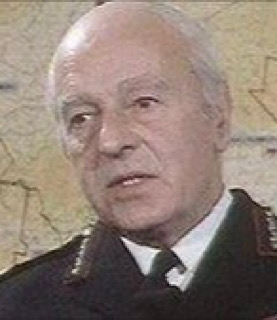
Sir Robert Edward Graham Shillington CBE, a senior Northern Irish police officer, is born on April 2, 1911, in Portadown, County Armagh. He serves as Chief Constable of Royal Ulster Constabulary (RUC) from 1970 to 1973.
Shillington is the youngest of six children born to Major David Graham Shillington, who goes on to become a Member of the Parliament of Northern Ireland, and Sarah Louisa (née Collen). He is educated at Castle Park School, a preparatory school in Dublin, and Sedbergh School, a public boarding school in Sedbergh, Cumbria, North West England. He then attends Clare College, Cambridge, where he studies natural sciences. He graduates Bachelor of Arts (BA) in 1932.
Shillington originally plans to join the Northern Ireland Civil Service, however he wants a more varied career. He joins the Royal Ulster Constabulary on February 8, 1933, as a cadet officer. He completes his training at the Newtownards depot in County Down. He is promoted to district inspector in 1935, and serves as officer in charge of D District in Belfast. In 1944, he is promoted to 1st Class District Inspector and is posted to Derry, County Londonderry.
In 1953, after nine years in Derry, Shillington is promoted to County Inspector and returns to Belfast. There, he joins the Inspector General’s Headquarters and serves in an administrative post. On January 16, 1961, he is appointed Commissioner of Belfast City.
In 1969, Shillington is appointed Deputy Inspector-General of the RUC, as second-in-command to the Inspector-General, Anthony Peacocke, who, like Shillington, had been educated at Sedbergh and Cambridge. When the Battle of the Bogside breaks out in Derry in August 1969, he requests permission to use CS gas for the first time in the United Kingdom. When that does not halt the rioting, he requests that the British Army be brought in. He telephones Peacocke on August 13 in order to persuade him of this. Peacocke, who has long denied the need for army involvement, eventually agrees, but his reputation never recovers and following the publication of the Hunt Report in October he resigns as Inspector-General.
Shortly thereafter, Sir Arthur Young is seconded from the City of London Police to be the last Inspector-General and the first Chief Constable of the RUC. James Callaghan, then Home Secretary, sends him to implement the Hunt Report. Young’s measures introduce the standard British rank system for police officers in Northern Ireland and disbands the Ulster Special Constabulary (USC). Shillington remains as Young’s deputy, and when the latter returns to the mainland in 1970 he succeeds him to become the RUC’s second Chief Constable.
In the 1952 New Year Honours, Shillington is appointed Member of the Order of the British Empire (MBE). He is promoted to Officer of the Order of the British Empire (OBE) in the 1959 Queen’s Birthday Honours. He is knighted in the 1972 Queen’s Birthday Honours List.
Shillington marries Mary (Peggy) Bulloch in 1935. They have two sons and a daughter. He dies on August 14, 2001, at the age of 90, in a County Armagh nursing home.

 seamus dubhghaill