seamus dubhghaill

Promoting Irish Culture and History from Little Rock, Arkansas, USA


Leave a comment

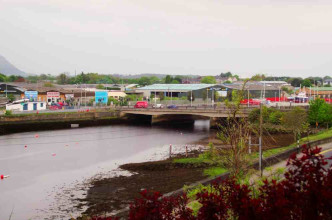
Opening of the Michael Hughes Bridge in Sligo

The Michael Hughes Bridge, the first major infrastructural project to be started in Sligo in decades, is officially opened to the motoring public on December 9, 1988.

Often referred to locally as “The New Bridge,” construction of the £2.55 million four lane bridge over the River Garavogue estuary is started in July 1987, with the aim of relieving Sligo of the chaotic traffic congestion which has been crippling the town’s streets for several decades. The project starts taking shape after a study of the traffic in Sligo is carried out in 1969 and updated in 1975 by consultants DeLaw, Chadwick & O’h Eocha.

The location of the Michael Hughes Bridge is from the embankment at Markievicz Road, adjacent to the location of the old Municipal Swimming Pool, which has itself been demolished in recent years to make way for a small recreation area, to the old Harbour Office on Custom House Quay.

The Queens Store, an old warehouse, is demolished to make way for a new section of road leading from the bridge up as far as Union Street, beside where TD Howley’s public house stands. Major resurfacing works are carried out by Sligo Borough Council, then known as Sligo Corporation, on Adelaide Street and on Union Street prior to the opening of the bridge.

The contractors for the construction of the Michael Hughes Bridge are Ascon Ltd., Ireland‘s largest civil engineering contractor based in Kill, County Kildare.

The Michael Hughes Bridge is named after the late Councillor Michael Hughes who spearheaded the campaign to have a new road bridge built across the River Garavogue in the 1940s. It is opened by Mayor Matt Lyons, which he describes as being “the most historic civic occasion in Sligo for decades.”

Two thousand people turn out to see the opening of the long-awaited piece of infrastructure, which includes many schoolchildren, as all of the schools in Sligo are closed for the day. Mayor Lyons unveils a plaque to mark the opening of the bridge, which is followed by a multi-denominational blessing ceremony and a parade across the bridge.

A ship anchored nearby blasts its siren as the bridge, the first new bridge in Sligo since 1852, is officially declared open.

(From: The Michael Hughes Bridge, The Sligo Town Website, http://www.sligotown.net)


Leave a comment

Death of Luke Dolan, Ireland’s Oldest Man

luke-dolanIreland’s oldest man, Luke Dolan, dies at the age of 108 at Cloverhill nursing home on November 9, 2014.

Dolan, from Cloonfree, Strokestown, County Roscommon, lives at home on the family farm until he is over 100 years old. A keen Gaelic Athletic Association (GAA) man, he attributes his longevity to a boiled egg every day, plenty of sugar in his tea and a devoted wife. He has also not had a cigarette for almost 50 years, having kicked the habit at age 60.

Dolan is one of seven children including one sister, Mary-Kate, who lived to the age of 106. A father of seven himself, his wife Peggy passed away in 2005 at the age of 85.

In 1932, Dolan plays for Strokestown GAA when the club wins the county championship and he is proud of the fact that his grandson, also named Luke Dolan, has lined out for the Roscommon GAA senior team for a number of years.

Dolan’s funeral takes place at Strokestown parish church on November 12. Local councillor Eugene Murphy pays tribute to Dolan and notes how “He was a very learned man.” He is survived by his sons John Joe, Tom, Pat, Michael, Gerard and daughters Madeline and Bernadette, as well as his grandchildren and great-grandchildren.

With the passing of Dolan, County Roscommon retains the distinction of being home to Ireland’s oldest man. Michael Lambert, from Ballintubber, turned 107 in October 2014 (Lambert dies less than three months later on January 25, 2015). The two men, who were born a year and less than 20 miles apart, met for the first time during the summer of 2014, when Lambert dropped into Cloverhill to chat about the old days.

(From: “Ireland’s oldest man Luke Dolan dies at 108” by Marese McDonagh, The Irish Times, November 10, 2014)


Leave a comment

The Islandmagee Witch Trial

islandmagee-witch-trial

Eight women from Islandmagee, County Antrim, in what is today Northern Ireland, are imprisoned and pilloried on March 31, 1711 for “bewitching” a woman named Mary Dunbar, who has experienced strange fits and visions. The Islandmagee witch trial takes place in 1710–1711 on Islandmagee and is believed to be the last witch trial to take place in Ireland.

In March 1711, in Carrickfergus, County Antrim, eight women are put on trial and found guilty of witchcraft. The women are put in stocks and then jailed for one year. The trial is the result of a claim by Mrs. James Haltridge that 18-year-old Mary Dunbar exhibited signs of demonic possession such as “shouting, swearing, blaspheming, throwing Bibles, going into fits every time a clergyman came near her and vomiting household items such as pins, buttons, nails, glass and wool.” Assisted by local authorities, Dunbar picks out eight women she claims are witches that have attacked her in spectral form.

During the trial, Mary Dunbar is dumb and unable to give evidence. Evidence is given by twenty individuals, of whom four are clergymen of the Presbyterian church. The trial lasts from 6:00 AM until 2:00 PM. For the accused, it is said they are industrious, attend public worship, some having latterly received the sacrament. Judge Upton says, “real witches could not assume or retain the form of religion by frequenting worship. The jury should not find them guilty on the sole testimony of the visionary images of the afflicted person.” Judge Macartney believes they might, from the evidence, bring them in guilty and they do.

According to Andrew Sneddon, history lecturer at University of Ulster, “Mary Dunbar was making up the whole thing.” Sneddon writes that “Mary Dunbar learned the part of a demoniac from accounts about Salem or Scotland, or someone told her about it. Remember, this was a time when people were pouring in from Scotland.”

Records of what happened to Mary Dunbar or those convicted of witchcraft are apparently lost when the Public Records Office in question is burned down in June 1922 during the Battle of Dublin in the Irish Civil War.

A memorial to the eight women convicted is proposed by the author Martina Devlin. However the memorial is objected to by Traditional Unionist Voice (TUV) councillor Jack McKee who believes the plaque could become a “shrine to paganism” and furthermore states that he is not convinced the women were not guilty and that he believes the proposal to be “anti-god.”


Leave a comment

UCC Students Protest Henry Kissinger Visit

kissingers-arrival-in-dublinFormer United States Secretary of State Henry Kissinger visits University College Cork (UCC) on February 27, 2002 where he is confronted by more than 400 angry students protesting his presence.

The protesters chant and wave banners bearing the slogan “The Milosevic of Manhattan” prior to the arrival of the 56th U.S. Secretary of State, who was in office during the controversial administration of Richard Nixon. Kissinger says he is pleased to discover that even in Ireland people are not indifferent to him. However, he denies being a war criminal claiming it is an insult to human intelligence for protesters in Cork to compare him with Slobodan Milošević.

“These people are throwing around allegedly criminal charges without a shred of real evidence. I don’t know who they represent but I wish their knowledge equalled their passion.”

Kissinger, who is visiting the university to deliver a speech at an MBA Association of Ireland business conference, says he has never replied to derogatory remarks in the media. He adds, “I consider them (the accusations) fundamentally beneath contempt. They are based on distortions and misrepresentations.”

The focus of Kissinger’s address is on United States foreign policy particularly in aftermath of the September 11, 2001 terrorist attacks.

Kissinger says the international scene is experiencing an extraordinary period of change for which there is no historical precedent. One of the biggest challenges facing the U.S. administration, he says, is to bring countries together to prevent the spread of biological and chemical weapons.

Kissinger’s visit is condemned by human rights organisations who claim he flouted international law in his dealings with Bangladesh, Chile and East Timor. Cork Sinn Féin councillor Jonathan O’Brien tells an earlier council meeting that Kissinger is not welcome in the city, and calls on UCC to cancel his invitation.