seamus dubhghaill

Promoting Irish Culture and History from Little Rock, Arkansas, USA


6 Comments

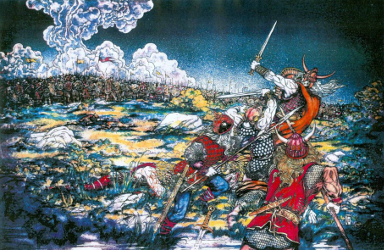
The Battle of Moira

battle-of-moira

The Battle of Moira, known archaically as the Battle of Magh Rath, is fought on June 24, 637, near the Woods of Killultagh, just outside the village of Moira in what becomes County Down. The battle pits the Gaelic High King of Ireland Domnall II against his foster son King Congal of Ulster, supported by his ally Domnall the Freckled (Domnall Brecc) of Dál Riata.

The battle is allegedly the largest battle ever fought on the island of Ireland, and results in the death of Congal and the retreat of Domnall Brecc. The battle is caused as a result of the invading Gaels spreading out from Galway Bay. The Gaels have fled France and Spain to escape the Roman invasion of those areas. The Gaels are later to be known as Irish but are not native to the island. The native people of Ulster have been pushed into an area the size of two counties in what is now Antrim and Down.

Congal first establishes his power base in Dál nAraidi, where he becomes King before being recognised as King of Ulster in 627. His ambitions soon come into conflict with Domnall II, who becomes High King of Ireland in 628. Ironically, Domnall II rises to such a position because Congal has defeated and killed the previous High King, Suibne Menn, in a previous battle.

Domnall continues to press the rivalry with Congal very quickly. In 629 the two kings engage each other at the Battle of Dún Ceithirn in what is now County Londonderry. On that occasion Congal is defeated and Domnall is left unchallenged as the High King.

Throughout the 630s, Domnall continues to wage war on his rivals in the Uí Néill clan. In 637, however, Congal once again rises to challenge the Ard Rí, and enlists the help of Dál Riata to do so. The two forces meet just east of Lough Neagh.

Little is known about the actual battle itself. The armies of both Domnall II and Congal are primarily made up of warriors native to Ireland. However, Domnall I of Dál Riata brings a more varied force to the fight. His army included Scots, Picts, Anglo-Saxons, and Britons (Welshmen). At least one side has a substantial cavalry force.

There is reason to believe that the battle might have lasted a week, at the end of which the defeated force flees towards the woods of Killultagh. The forces of Ulster and Dál Riata are defeated, with Domnall of Dál Riata forced to flee north to his kingdom’s holdings. Congall is killed in the course of the battle.

The scale of the battle is confirmed in the 19th century when the railway line in Moira is being constructed. Thousands of bodies of men and horses are excavated. When one considers that the survivors probably numbered quite considerably more, then the reputation of the scale of the battle becomes obvious.


Leave a comment

Formation of the Independent Orange Order

independent-orange-orderThe Independent Orange Order, a Protestant fraternal organisation, is formed in Belfast on June 11, 1903 by Thomas Sloan and others associated with the Belfast Protestant Association, who have been expelled from the Orange Order because they voice opposition to it being used for party political ends by Ulster Unionists. Originally it is associated with the labour movement, but it soon realigns itself with traditional unionist politics.

It takes its name in memory of King William of Orange of the house of Orange who fights at the Battle of the Boyne, brings about the Glorious Revolution and the Bill of Rights giving the Westminster parliament ultimate power of the country rather than the Monarch. The Independent Order is small compared to the main organisation with 1,500 to 2,000 members. It is largely based around north County Antrim in Northern Ireland but has lodges around the world, including England, Scotland, and Australia. Its annual main Twelfth of July demonstration is held in a north Antrim town or village.

The first notable effect after the formation of the Independent Order is a more liberal interpretation of the rules of the “Old Order.” In the early years of the Institution, many suffer the full wrath of the “powers that be,” who are opposed to any splitting of the Orange Order. Jobs are lost, homes are burned, and their headquarters in Belfast is bombed.

Independent Orangeism today maintains that it is essential for the Orange Institution to be kept free from politics and to guard the principles of Reformation Protestantism. They often express alarm when they believe these principles are endangered by conciliatory politicians. They are opposed to ecumenism and, while being opposed to Orangeism being linked to the Ulster Unionist Party, they are not apolitical and tend to work alongside unionist politicians and parties.

The Institution also promotes Ulster Protestant history and proclaims the principle of “Liberty of Conscience.” They declare their right to think and act independently without direction from political or clerical masters, they seek to strengthen the position of Orangeism, and they often warn of the danger of the development of a social and cultural Orangeism devoid of Protestant principle.


Leave a comment

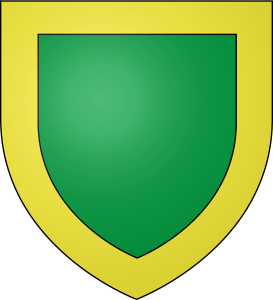
Hugh de Lacy Appointed 1st Earl of Ulster

1st-earl-of-ulster-coat-of-arms

King John of England appoints Hugh de Lacy, a leading figure in the Norman invasion of Ireland in the 12th century, as the 1st Earl of Ulster on May 29, 1205.

Circa 1189 de Lacy is appointed Viceroy of Ireland, a position previously held by his father, Hugh de Lacy, Lord of Meath. He is replaced in 1190 by Guillaume le Petil. He is later reappointed to serve as viceroy from 1205 to 1210.

In 1199, King John authorises de Lacy to wage war on John de Courcy, who has conquered much of Ulster without help or permission from the King. Hugh captures de Courcy in 1204. An account of the capture appears in the Book of Howth.

After King John creates him Earl of Ulster in 1205, he makes what was de Courcy’s territory in Ulster the Earldom of Ulster. He grants Drogheda its charter and continues the conquest of the northeastern over-kingdom of Ulaid, building on de Courcy’s success, with the earldom spanning across the modern counties of Antrim and Down and parts of Londonderry.

In 1207, war breaks out between the Earl of Ulster and the justiciar. This brings King John to Ireland, where he expels the earl’s brother, Walter de Lacy, from Meath, and compels the earl himself to flee to Scotland.

For several years Ulster takes part in the wars in France, and de Lacy does not return to Ireland until 1221, when he allies himself with the O’Neills against the English. In 1226, his lands in Ulster are handed over to his brother Walter, but they are restored to him in the following year, after which date, he appears to loyally serve the king, being more than once summoned to England to give advice about Irish affairs.

De Lacy purportedly separates from his first wife and lives in adultery. He has legitimate and natural children. In 1226, his daughter by his first wife marries Alan, Lord of Galloway. He marries his second wife, Emmeline de Riddlesford, the daughter of Walter de Riddlesford around 1242. Hugh de Lacy dies shortly thereafter in 1242 or 1243. Emmeline’s second marriage takes place around 1243 with Stephen Longespee, grandson of Henry II of England, by whom she has two daughters, Ela Longespee, Lady of Ashby, and Emmeline Longespee, Lady of Offaly.

Left with no surviving legitimate children, the earldom of Ulster reverts to the crown upon de Lacy’s death.