seamus dubhghaill

Promoting Irish Culture and History from Little Rock, Arkansas, USA


Leave a comment

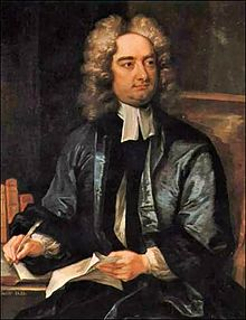
Birth of Jonathan Swift, Essayist, Pamphleteer, Poet & Cleric

Jonathan Swift, satirist, essayist, political pamphleteer, poet and cleric who becomes Dean of St. Patrick’s Cathedral, Dublin, is born in Dublin on November 30, 1667.

Swift’s father, an attorney, also named Jonathan Swift, dies just two months before he is born. Without steady income, his mother struggles to provide for her newborn. Moreover, he is a sickly child. It is later discovered that he suffers from Ménière’s disease, a condition of the inner ear that leaves the afflicted nauseous and hard of hearing. In an effort to give her son the best upbringing possible, Swift’s mother gives him over to Godwin Swift, her late husband’s brother and a member of the respected professional attorney and judges group Gray’s Inn. Godwin Swift enrolls his nephew with one of his cousins in Kilkenny College, which is perhaps the best school in Ireland at the time. He arrives there at the age of six, where he is expected to have already learned the basic declensions in Latin. He has not and thus begins his schooling in a lower form. He graduates in 1682, when he is 15. His transition from a life of poverty to a rigorous private school setting proves challenging. He does, however, make a fast friend in William Congreve, the future poet and playwright.

In 1682, Swift commences his undergraduate studies at Trinity College, Dublin. In 1686, he receives a Bachelor of Arts degree and goes on to pursue a master’s degree. Not long into his research, huge unrest breaks out in Ireland. The king of Ireland, England and Scotland is soon to be overthrown. What becomes known as the Glorious Revolution of 1688 spurs him to move to England and start anew. For 10 years, Swift works in Surrey‘s Moor Park and acts as an assistant to Sir William Temple, 1st Baronet.

During his Moor Park years, Swift meets the daughter of Temple’s housekeeper, an 8-year-old named Esther Johnson, known as “Stella.” They become lovers for the rest of their lives until Johnson’s death in 1728. It is rumored that they marry in 1716, and that Swift keeps of lock of Johnson’s hair in his possession at all times.

During his decade of work for Temple, Swift returns to Ireland twice. On a trip in 1695, he takes all necessary requirements to become an ordained priest in the Anglican tradition. Under Temple’s influence, he also begins to write, first short essays and then a manuscript for a later book. Temple dies in 1699. Swift completes the task of editing and publishing Temple’s memoirs. He then leans on his priestly qualifications and finds work ministering to a pea-sized congregation just 20 miles outside of Dublin. For the next ten years, he gardens, preaches and works on the house provided to him by the church. He also returns to writing. His first political pamphlet is titled A Discourse on the Contests and Dissentions in Athens and Rome.

In 1704, Swift anonymously releases A Tale of a Tub and The Battle of the Books. Tub, although widely popular with the masses, is harshly disapproved of by the Church of England. Ostensibly, it criticizes religion, but Swift means it as a parody of pride. Nonetheless, his writings earn him a reputation in London and when the Tories come into power in 1710, they ask him to become editor of The Examiner, their official paper. After a time, he becomes fully immersed in the political landscape and begins writing some of the most cutting and well-known political pamphlets of the day, including The Conduct of the Allies, an attack on the Whigs. Privy to the inner circle of Tory government, he lays out his private thoughts and feelings in a stream of letters to his beloved Stella. They are later published as The Journal to Stella.

When he sees that the Tories will soon fall from power, Swift returns to Ireland. In 1713, he takes the post of Dean at St. Patrick’s Cathedral, Dublin. While leading his congregation at St. Patrick’s, he begins to write what would become his best-known work. In 1726, at last finished with the manuscript, he travels to London and benefits from the help of several friends, who anonymously publish it as Travels into Several Remote Nations of the World, in Four Parts. By Lemuel Gulliver, First a Surgeon, and then a Captain of Several Ships, more simply known as Gulliver’s Travels. The book is an immediate success and has not been out of print since its first run.

Not long after the celebration of this work, Esther Johnson, falls ill. She dies in January 1728. Her death moves Swift to write The Death of Mrs. Johnson.

In 1742, Swift suffers a stroke and loses the ability to speak. He dies on October 19, 1745. He is laid to rest next to Esther Johnson inside Dublin’s St. Patrick’s Cathedral.

Leave a comment

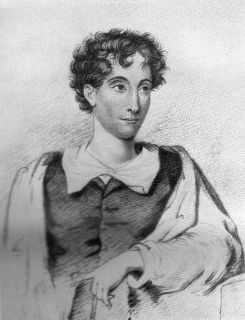
Birth of Charles Maturin, Clergyman, Playwright & Novelist

Charles Robert Maturin, also known as C. R. Maturin, an Irish Protestant clergyman ordained in the Church of Ireland and a writer of Gothic plays and novels, is born in Dublin on September 25, 1780. His best-known work is the novel Melmoth the Wanderer.

Maturin is descended from Huguenots who found shelter in Ireland, one of whom is Gabriel Jacques Maturin who becomes Dean of St. Patrick’s Cathedral, Dublin, after Jonathan Swift in 1745. He attends Trinity College Dublin. Shortly after being ordained as curate of Loughrea, County Galway, in 1803, he moves back to Dublin as curate of St. Peter’s Church. He lives in York Street with his father William, a Post Office official, and his mother, Fedelia Watson. He marries the acclaimed singer Henrietta Kingsbury on October 7, 1804.

Maturin’s first three works are Gothic novels published under the pseudonym Dennis Jasper Murphy and are critical and commercial failures. They do, however, catch the attention of Sir Walter Scott, who recommends Maturin’s work to Lord Byron. With their help, his play Bertram is staged in 1816 at the Theatre Royal, Drury Lane for 22 nights, with Edmund Kean starring in the lead role as Bertram. Financial success, however, eludes Maturin, as the play’s run coincides with his father’s unemployment and another relative’s bankruptcy, both of them assisted by the fledgling writer. To make matters worse, Samuel Taylor Coleridge publicly denounces the play as dull and loathsome, and “melancholy proof of the depravation of the public mind,” going nearly so far as to decry it as atheistic.

The Church of Ireland takes note of these and earlier criticisms and, having discovered the identity of Bertram‘s author after Maturin had shed his nom de plume to collect the profits from the play, subsequently bar his further clerical advancement. Forced to support his wife and four children by writing on his curate salary of £80-90 per annum, compared to the £1000 he made for Bertram, he switches back from playwright to novelist after a string of his plays meet with failure. He produces several novels in addition to Melmoth the Wanderer, including some on Irish subjects and The Albigenses, a historical novel which features werewolves. Various poems have also been ascribed to Maturin on dubious grounds and appear to be the work of others. The prize-winning “Lines on the Battle of Waterloo” is published in 1816 under the name of the university graduate John Shee. “The Universe” appears with Maturin’s name on the title page in 1821 but is now thought to be almost completely the work of James Wills.

The exaggerated effectiveness of Maturin’s preaching can be gauged from the two series of sermons that he publishes. On the occasion of the death of Princess Charlotte, he declares, “Life is full of death; the steps of the living cannot press the earth without disturbing the ashes of the dead – we walk upon our ancestors – the globe itself is one vast churchyard.” A contemporary account records that there had seldom been seen such crowds at St Peter’s. “Despite the severe weather, people of all persuasions flocked to the church and listened spellbound to this prince of preachers. In his obituary it is said that ‘did he leave no other monument whereon to rest his fame, these sermons alone would be sufficient.'”

Maturin dies in Dublin on October 30, 1824. A writer in the University Magazine later sums up his character as “eccentric almost to insanity and compounded of opposites – an insatiable reader of novels; an elegant preacher; an incessant dancer; a coxcomb in dress and manners.”

A sister of Maturin’s wife marries Charles Elgee, whose daughter, Jane Francesca, becomes the mother of Oscar Wilde. Thus, Charles Maturin is Oscar Wilde’s great-uncle by marriage. Wilde discards his own name and adopts the name of Maturin’s novel, Melmoth, during his exile in France.

Maturin’s eldest son, William Basil Kingsbury Maturin, follows him into the ministry, as do several of his grandsons. One of these, Basil W. Maturin, dies in the sinking of RMS Lusitania on May 7, 1915. The second son is Edward Maturin, who emigrates to the United States and becomes a novelist and poet there.


Leave a comment

St. Patrick’s Cathedral Designated National Cathedral

st-patricks-cathedral-dublin

St. Patrick’s Cathedral, Dublin, is designated the National Cathedral of the Church of Ireland on May 2, 1872. Chapter members at St. Patrick’s are drawn from each of the twelve dioceses of the Church of Ireland.

St. Patrick’s Cathedral is dedicated on March 17, 1191. With its 141-foot spire, it is the tallest church (not cathedral) in Ireland and the largest.

St. Patrick’s Cathedral is founded on the spot where St. Patrick himself is believed to have baptized the first Irish believers into the Christian faith. The sacred well which St. Patrick used has been lost, but the Cathedral is built in the area where the conversions are believed to have taken place.

The first church is constructed here in the 5th century but St. Patrick’s as it stands now is built between 1191 and 1270. In 1311, the Medieval University of Dublin is founded here, and the church begins a place of higher education as well as a place of worship.

By the 16th century, however, St. Patrick’s falls into disrepair following the English Reformation, a time when the Church of England breaks away from the Roman Catholic Church. In 1537, St. Patrick’s becomes designated as an Anglican Church of Ireland, and it remains a part of the Church of Ireland to this day.

Repairs to the cathedral begin in the 1660s and continued in phases over the following decades to save it from falling into complete ruin.

As its status grows, St. Patrick’s begins to rival Christ Church Cathedral in importance. This is where the history of St. Patrick’s Cathedral takes a bit of a complicated turn in term of church definitions. The current cathedral building is often hailed as one of the best examples of medieval architecture in Dublin, however, it is only fair to point out that the structure went through a massive rebuild in the 1860s, mainly financed by money from Benjamin Guinness.

As one of Dublin’s two Church of Ireland cathedrals, St. Patrick’s is actually designated as the “National Cathedral of Ireland.” However, it lacks the one thing that usually makes a church a cathedral – a bishop. The Archbishop of Dublin actually has his seat at Christ Church Cathedral, which is designated as the local cathedral of the Diocese of Dublin and Glendalough. St. Patrick’s is instead headed by a dean who is the ordinary for the cathedral. This office has existed since 1219 with its most famous office holder being Jonathan Swift.

Today St. Patrick’s Cathedral plays host to a number of public national ceremonies. Ireland’s Remembrance Day ceremonies, hosted by the Royal British Legion and attended by the President of Ireland, take place there every November. Its carol service (the Service of Nine Lessons and Carols), celebrated twice in December, including every December 24, is a colourful feature of Dublin life. On Saturdays in autumn the cathedral hosts the graduation ceremonies of Technological University Dublin.

The funerals of two Irish presidents, Douglas Hyde and Erskine Childers, take place in St. Patrick’s Cathedral in 1949 and 1974 respectively. In 2006, the cathedral’s national prominence is used by a group of 18 Afghan migrants seeking asylum, who occupied it for several days before being persuaded to leave without trouble.