seamus dubhghaill

Promoting Irish Culture and History from Little Rock, Arkansas, USA


Leave a comment

Free State Government Purchases Copyright to “The Soldiers Song”

amhran-na-bhfiann

The Irish Free State government purchases the copyright of Peadar Kearney‘s The Soldiers Song on October 20, 1933, which becomes the Irish national anthem Amhrán na bhFiann. The song has three verses, but only the choral refrain is officially designated the national anthem.

A Soldiers’ Song is composed in 1907, with words by Peadar Kearney and music by Kearney and Patrick Heeney. The text is first published in Irish Freedom by Bulmer Hobson in 1912. It is used as a marching song by the Irish Volunteers and is sung by rebels in the General Post Office (GPO) during the Easter Rising of 1916. Its popularity increases among rebels held in Frongoch internment camp after the Rising, and the Irish Republican Army (IRA) in the Irish War of Independence (1919–21). After the establishment of the Irish Free State in 1922, a large proportion of the IRA’s men and apparatus become the National Army. The Soldiers’ Song remains popular as an Army tune and is played at many military functions.

The Free State does not initially adopt any official anthem. The delicate political state in the aftermath of the Irish Civil War provokes a desire to avoid controversy. Ex-Unionists continue to regard God Save the King as the national anthem, as it has been for the rest of the British Empire. W. T. Cosgrave, President of the Executive Council of the Irish Free State expresses opposition to replacing The Soldiers’ Song, which is provisionally used within the State.

There is concern that the lack of an official anthem is giving Unionists an opportunity to persist with God Save the King. The Soldiers’ Song is widely if unofficially sung by nationalists. On July 12, 1926, the Executive Council of the Irish Free State decides to adopt it as the National Anthem, with Cosgrave the driving force in the decision. However, this decision is not publicised.

In 1928, the Army band establishes the practice of playing only the chorus of the song as the Anthem, because the longer version is discouraging audiences from singing along.

The anthem is played by Radio Éireann at close down from its inception in 1926. Cinemas and theatres do so from 1932 until 1972. Peadar Kearney, who has received royalties from publishers of the text and music, issues legal proceedings for royalties from those now performing the anthem. He is joined by Michael Heeney, brother of Patrick Heeney, who had died in 1911. In 1934, the Department of Finance acquires the copyright of the song for the sum of £1,200. Copyright law changes in 1959, such that the government has to reacquire copyright in 1965, for £2,500. As per copyright law, the copyright expires in December 2012, following the 70th anniversary of Kearney’s death. In 2016, three Fianna Fáil senators introduce a private member’s bill intended to restore the state’s copyright in the anthem.


Leave a comment

First Prisoners Arrive at Kilmainham Gaol

kilmainham-gaol

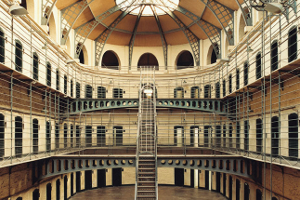
Kilmainham Gaol in Dublin receives its first prisoners on August 12, 1796. When it is first built in 1796, Kilmainham Gaol is called the “New Gaol” to distinguish it from the old prison it is intended to replace. It is officially called the County of Dublin Gaol, and is originally run by the Grand Jury for County Dublin.

Originally, public hangings take place at the front of the prison. However, from the 1820s onward very few hangings, public or private, take place at Kilmainham. A small hanging cell, located on the first floor between the west wing and the east wing, is built in the prison in 1891.

There is no segregation of prisoners as men, women, and children are incarcerated up to five in each cell, with light and heat provided by a single candle which has to last for two weeks. The cells are roughly 28 square metres in area.

At Kilmainham the poor conditions in which women prisoners are kept provide the spur for the next stage of development. Remarkably, for an age that prides itself on a protective attitude for the “weaker sex,” the conditions for women prisoners are persistently worse than for men. Male prisoners are supplied with iron bedsteads while females lay on straw on the floor. Half a century later, however, there is little improvement.

Many Irish revolutionaries, including the leaders of the 1916 Easter Rising, are imprisoned and executed in the prison by the British.

Kilmainham Gaol is decommissioned as a prison by the Irish Free State government in 1924. Seen principally as a site of oppression and suffering at the time, there is no declared interest in its preservation as a monument to the struggle for national independence. The jail’s potential function as a location of national memory is also undercut and complicated by the fact that the first four republican prisoners executed by the Free State government during the Irish Civil War are shot in the prison yard.

The Irish Prison Board contemplates reopening it as a prison during the 1920s but the plans are abandoned in 1929. In 1936 the government considers the demolition of the prison, but the price of this undertaking is seen as prohibitive.

In February 1960 detailed plans submitted by the Kilmainham Gaol Restoration Society for the restoration of Kilmainham, which notably also envisions the site’s development as a tourist attraction, receive the approval of the notoriously parsimonious Department of Finance. Restoration work begins in May of the same year. The final restoration of the site is completed in 1971 when Kilmainham Gaol chapel is re-opened to the public.

Kilmainham Gaol now houses a museum on the history of Irish nationalism and offers guided tours of the building. An art gallery on the top floor exhibits paintings, sculptures, and jewelry of prisoners incarcerated in prisons all over contemporary Ireland.  It is run by the Office of Public Works, an agency of the Government of Ireland.