seamus dubhghaill

Promoting Irish Culture and History from Little Rock, Arkansas, USA


Leave a comment

Death of Cathal Crobhdearg Ua Conchobair, the King of Connacht

Cathal Crobhdearg Ua Conchobair, the King of Connacht and youngest son of the Irish High King Tairrdelbach mac Ruaidri Ua Conchobair, dies on May 27, 1224. This finally opens the way for the Norman occupation of Connacht.

Ua Conchobair is born in 1153 and serves as King of Connacht from 1189 to 1199, and is re-inaugurated on the stone at Clonalis about 1201, reigning until 1224. He first succeeds his elder half brother Ruaidri‘s son Conchobar Máenmaige Ua Conchobair as ruler of Connacht. Conchobar Máenmaige’s son Cathal Carrach Ua Conchobair then rules from 1199 to 1202, with Cathal Crobhdearg back in power from then.

From his base west of the River Shannon he is forced to deal with the Norman invaders. He is a competent leader despite problems, avoiding major conflicts and winning minor skirmishes. Ua Conchobair attempts to make the best of the new situation with Ireland divided between Norman and Gaelic rulers. His long reign is perhaps a sign of relative success. He is the subject, as Cáhal Mór of the Wine Red Hand, of the poem A Vision of Connaught in the Thirteenth Century by the 19th-century Irish nationalist James Clarence Mangan.

Ua Conchobair founds Ballintubber Abbey in 1216, and is succeeded by his son, Aedh Ua Conchobair. His wife, Mor Ní Briain, is a daughter of King Domnall Mór Ua Briain of Thomond, dies in 1218.

In 1224 Ua Conchobair writes to Henry III as Lord of Ireland, asking that his son and heir Od (Aedh) be granted all of Connacht, in particular those parts, Kingdom of Breifne, owned by William Gorm de Lacy.

An account of Ua Conchobair’s inauguration has been preserved, written down by Donogh Bacach Ó Maolconaire, the son of O’Connor’s very inaugurator Tanaide Ó Maolconaire, who is also his historian.

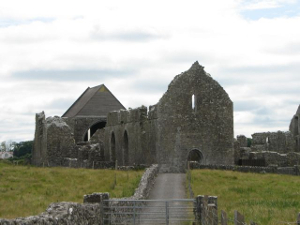
(Pictured: Ruins of the 12th century Cistercian Knockmoy Abbey which contains the burial site of King Cathal Crobhdearg Ua Conchobair)


Leave a comment

Henry II Lands at Waterford

henry-ii-at-waterford

Henry II, fearful that Richard de Clare, 2nd Earl of Pembroke, also known as Strongbow, will grow too powerful in Ireland, lands with an army at Waterford on October 17, 1171. The Normans, Norse, and Irish all submit to him, except for the most remote Irish kings.

Henry is worried about the growing power of the Cambro-Norman knights, in particular Strongbow, who has in the previous two years carved out what is a substantial new territory, as well as a delicately located new territory with regard to Henry’s own holdings in what is termed the Angevin Empire.

Henry’s presence changes the game for the Norman lords. Either they agree to do as he asks, submit to his sovereignty and accept the land they have grasp through force of arms as his gift, or branded as rebels they face their King with an army of 1,000 knights.

The Lords see the way of things and agree to the demand. Many of the Gaelic Irish, seeing Henry as a potential ally against the power of the Norman Lords, swear allegiance as well.

Henry receives recognition and hostages from the Ostmen of Wexford, who have captured Robert FitzStephen, as well as from many other kings in Ireland including Diarmait MacCarthaigh, king of Cork, Domnall Mór Ua Briain, king of Limerick, Murchadh O Cearbhaill, king of Airgialla, Tighearnán Mór Ua Ruairc, king of Breifne, and Donn Sléibe mac Con Ulad Mac Duinn Sléibe, king of Ulaid.

Henry formally grants Leinster to Strongbow in return for homage, fealty, and the service of 100 knights, reserving to himself the city and kingdom of Dublin and all seaports and fortresses. He also grants the kingdom of Meath, from the River Shannon to the sea, to his own follower Hugh de Lacy.

Henry II’s arrival at Waterford puts to rest the idea of an independent Irish kingdom that any Norman lord might imagine and determines a course for Ireland for some 750 years.