seamus dubhghaill

Promoting Irish Culture and History from Little Rock, Arkansas, USA


Leave a comment

Birth of Marmaduke Coghill, Member of Parliament

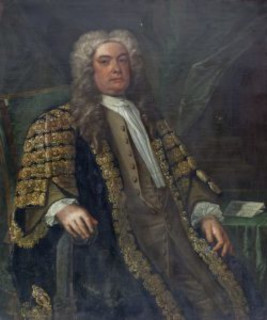
Marmaduke Coghill, member of Parliament for University of Dublin, judge of the prerogative court and Chancellor of the Exchequer of Ireland, is born in Dublin on December 28, 1673.

Coghill is the son of John Coghill of Knaresborough, North Yorkshire, judge of the prerogative court and one of the masters in chancery. His mother is the daughter of Tobias Cramer, of Ballyfoyle, County Kilkenny. Two elder sisters and a younger brother, James, survive infancy. He spends his childhood in Dublin.

Coghill occupies a prominent place in the life of Dublin, and is remarkable for his early display of ability. At the age of fourteen he enters the University of Dublin, graduating at the age of eighteen as a Bachelor of Laws. At the age of nineteen he is returned to Parliament and at the age of 26 he becomes judge of the prerogative court.

In Parliament, from 1692 to 1713 Coghill is a representative of the borough of Armagh, and from 1713 until his death in 1739, a representative of the University of Dublin. He is politically close to William Conolly, speaker of the Irish House of Commons, who dies in 1729. Upon Conolly’s death he succeeds him as a commissioner of the revenue. Over the following years he plays a prominent role in parliament, particularly on financial matters. He also builds up a close relationship with John Perceval, the British Prime Minister‘s chief advisor on Irish affairs.

Coghill becomes Chancellor of the Exchequer in 1735 and is regarded as an honest and able supporter of Irish interests. Outside parliament he is very active on boards, commissions and trusts, takes a hand in the building of Dr. Steevens’ Hospital and is pro-vice-chancellor of Trinity College Dublin. He lives in Belvedere House, now in the grounds of St. Patrick’s College, Dublin. He suffers from gout for a large part of his life.

From his father, Coghill, who never married, had inherited a lease from the Corporation of lands in Clonturk, where he erects a house which is afterwards known as Drumcondra House. He moves into Drumcondra House and lives there with his unmarried sister Mary until his death in 1738. He is buried in the family vault in St. Andrew’s Church, Dublin.

Upon Coghill’s death Mary is left, for her lifetime, his lands in the barony of Coolock, rents from his properties in Clonturk, all his household goods, and his coach, chariot and horses. In 1743, she erects the parish church of Clonturk, now Drumcondra Church, and places in it a statue of her brother by the Dutch sculptor Peter Scheemakers.


Leave a comment

Birth of James Gandon, Influential Irish Architect

james-gandon

James Gandon, possibly the most influential architect in Irish history, is born in New Bond Street, London, on February 20, 1743. His better known works include The Custom House, the Four Courts, King’s Inns in Dublin, and Emo Court in County Laois.

Gandon is the only son of Peter Gandon, a gunmaker, and Jane Burchall. He is educated at Shipley’s Drawing Academy where he studies the classics, mathematics, arts, and architecture. Upon leaving the drawing academy he is articled to study architecture in the office of Sir William Chambers. Chambers’s palladian and neoclassical concepts greatly influence the young Gandon.

In 1765, Gandon leaves William Chambers to begin practice on his own. His practice always remains small but is successful. His first commission is on Sir Samuel Hellier’s estate at The Wodehouse, near Wombourne. Around 1769 he enters an architectural competition to design the new Royal Exchange in Dublin. The plan submitted by Thomas Cooley is eventually chosen but Gandon’s design comes in second and brings him to the attention of the politicians who are overseeing the large-scale redevelopment of Dublin.

During the following years in England, Gandon is responsible for the design of the County Hall in Nottingham. Between 1769 and 1771, he collaborates with John Woolfe on two additional volumes of Vitruvius Britannicus, a book of plans and drawings of Palladian revival buildings by such architects as Inigo Jones and Colen Campbell. During his English career he is awarded the Gold medal for architecture by the Royal Academy, London in 1768.

In 1781, at the age of 38, Gandon accepts an invitation to Ireland from Lord Carlow and John Beresford, the Revenue Commissioner for Ireland, to supervise the construction of the new Custom House in Dublin. The original architect on that project, Thomas Cooley, had died and Gandon is chosen to assume complete control. The Irish people are so opposed to the Custom House and its associated taxes that Beresford has to smuggle Gandon into the country and keeps him hidden in his own home for the first three months. The project is eventually completed at a cost of £200,000, an enormous sum at the time.

This commission proves to be the turning point in Gandon’s career and Dublin is to become Gandon’s home for the remainder of his life. The newly formed Wide Streets Commission employs Gandon to design a new aristocratic enclave in the vicinity of Mountjoy Square and Gardiner Street. Gandon also designs Carlisle Bridge, now O’Connell Bridge, over the River Liffey to join the north and south areas of the city. In 1786, he is charged with completing the Four Courts in 1786, which is also originally a Thomas Cooley project.

The success of Gandon’s designs and commissions are not reflected in personal popularity as he attracts huge criticism from his enemies. The taxation symbolised by the Custom House is to taint the appreciation of his work throughout his lifetime. It is even claimed that Gandon designs buildings to boost his self-esteem.

In 1798, revolution breaks out on the streets of Ireland and Gandon, an unpopular figure, hurriedly flees to London. Upon returning to Dublin he finds a much changed city. James Gandon dies in 1823 at his home in Lucan, County Dublin, having spent forty-two years in the city. He is buried in the church-yard of Drumcondra Church.