seamus dubhghaill

Promoting Irish Culture and History from Little Rock, Arkansas, USA


Leave a comment

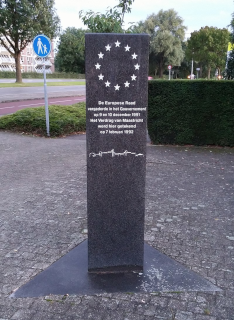
The Maastricht Treaty Comes into Effect

The Treaty on European Union, commonly known as the Maastricht Treaty, comes into effect on November 1, 1993, formally establishing the European Union (EU).

The international agreement is approved by the heads of government of the states of the European Community (EC) in Maastricht, Netherlands, in December 1991. Ratified by all EC member states (voters in Denmark reject the original treaty but later approve a slightly modified version), the treaty is signed on February 7, 1992. The treaty is signed on Ireland’s behalf by Minister for Foreign Affairs Gerry Collins and Minister for Finance Bertie Ahern.

Concluded in 1992 between the then-twelve member states of the European Communities, the treaty announces “a new stage in the process of European integration.” The treaty establishes a European Union (EU), with EU citizenship granted to every person who is a citizen of a member state. EU citizenship enables people to vote and run for office in local and European Parliament elections in the EU country in which they live, regardless of their nationality. The treaty also provides for the introduction of a central banking system and a common currency (the euro), commits members to implement common foreign and security policies, and calls for greater cooperation on various other issues, including the environment, policing, and social policy.

Although these provisions are widely seen to presage a “federal Europe,” the focus of constitutional debate shifts to the later 2007 Treaty of Lisbon. In the wake of the European debt crisis unfolding from 2009, the most enduring reference to the Maastricht Treaty has been to the rules of compliance – the “Maastricht criteria” – for the currency union.

Against the background of the end of the Cold War and the reunification of Germany, and in anticipation of accelerated globalisation, the treaty negotiates tensions between member states seeking deeper integration and those wishing to retain greater national control. The resulting compromise faces what is to be the first in a series of EU treaty ratification crises.

The twelve members of the European Communities signing the Treaty are represented by:

(Pictured: Stone memorial in front of the entry to the Limburg Province government building in Maastricht, Netherlands, commemorating the signing of the Maastricht Treaty)


Leave a comment

Birth of David Byrne, Former AG of Ireland and EU Commissioner

David Byrne, Fianna Fáil politician, Irish senior counsel, former Attorney General of Ireland and former European Commissioner for Health and Food Safety, is born in Monasterevin, County Kildare, on April 6, 1947.

Byrne is educated at Newbridge College, County Kildare, University College Dublin (UCD) and King’s Inns, Dublin. He is called to the Bar in 1970 and practises law in the Irish and European Courts. During his student days in Dublin, he founds the Free Legal Advice Centre, a student-run organisation providing legal aid to citizens in association with the legal profession. He campaigns in favour of Irish entry into the European Community (EC) in the 1970s and has been a keen supporter of European integration ever since.

Byrne becomes a Senior Counsel in 1985. He practises in both the Irish courts and the European Court of Justice and also serves as a member of the International Court of Commercial Arbitration from 1990–97.

In 1997 Byrne becomes Attorney General of Ireland in the Fianna Fáil-Progressive Democrats coalition government. As one of the negotiators of the Good Friday Agreement in April 1998, he drafts and oversees the major constitutional amendments required by that agreement, which are approved by Referendum in May 1998. He also advises on the constitutional amendments necessary for Ireland’s ratification of the Treaty of Amsterdam. During his tenure, he establishes the first independent Food Safety Agency in Europe responsible to the Minister for Health.

Byrne is nominated to the European Commission by Taoiseach Bertie Ahern in September 1999, serving as Ireland’s EU Commissioner and has responsibility for Health & Consumer Protection in the Prodi Commission. He continues in that role until replaced as Ireland’s Commissioner by Charlie McCreevy in 2004.

During his time in office, Byrne is a major driving force behind European tobacco control legislation, such as directives banning tobacco advertising and regulating tobacco products, in keeping with the World Health Organization Framework Convention on Tobacco Control (WHO FCTC). Under his leadership, the European Union also creates the European Centre for Disease Prevention and Control (ECDC) in 2004.

When he concludes his Brussels assignment, Byrne acts as World Health Organization (WHO) Special Envoy on the revision of the International Health Regulations (IHR) for a six-month period following a series of outbreaks of SARS and avian influenza.

Byrne is mooted as a potential candidate for the position of Director General of the World Health Organization following the death of the incumbent, Dr Lee Jong-wook in 2006. However, he is eventually not included in the list of thirteen candidates to head the agency.

In December 2006 Byrne is appointed as Chancellor of Dublin City University (DCU). He holds this position until 2011.

After leaving the European Commission, Byrne holds a variety of paid and unpaid positions, including Co-Chair of European Alliance for Personalised Medicine, member of the International Advisory Board of FleishmanHillard, Chairman of the Ethics Committee of the International Prevention Research Institute (IPRI), Chairman of the Advisory Committee of the National Treasury Management Agency (NTMA), of counsel of Wilmer Cutler Pickering Hale and Dorr, Honorary Co-Chair of the World Justice Project (WJP) and a member of the World Prevention Alliamce.


Leave a comment

Jack Lynch Resigns as Taoiseach of Ireland

Jack Lynch, Irish politician and Taoiseach of Ireland from 1966 to 1973 and from 1977 to 1979, resigns as Taoiseach and leader of Fianna Fáil on December 5, 1979.

In 1946, Lynch has his first involvement in politics when he is asked by his local Fianna Fáil cumann to stand for Dáil Éireann in a by-election. Over the next 35 years he serves as Parliamentary Secretary to the Taoiseach (1951-54), Parliamentary Secretary to the Minister for Lands (1951-54), Minister for the Gaeltacht (March 1957-June 1957), Minister for Education (1957-59), Minister for Industry and Commerce (1959-65), Minister for Finance (1965-66), Leader of Fianna Fáil (1966-79), Leader of the Opposition (1973-77), and 5th Taoiseach of Ireland (1977-79).

The year 1979 proves to be the year in which Lynch finally realises that his grip on power has slipped. The first direct elections to the European Parliament take place in June and see the electorate severely punishing the ruling Fianna Fáil party. A five-month postal strike also led to deep anger amongst people all over the country. On 27 August 1979, the Provisional Irish Republican Army assassinates Earl Mountbatten of Burma in County Sligo. On the same day the IRA kills 18 British soldiers at Warrenpoint in County Down.

A radical security review and greater cross-border co-operation are discussed with the new British Prime Minister, Margaret Thatcher. These discussions lead Síle de Valera, a backbench TD, to directly challenge the leadership in a speech at the Liam Lynch commemoration at Fermoy, County Cork, on September 9. Although Lynch quickly tries to impose party discipline, attempting to discipline her for opposing party policy at a parliamentary party meeting held on September 28, de Valera correctly points out that she had not opposed the party policy regarding the North which called for the declaration of the British intent to withdraw from the north. The result is embarrassing for Lynch.

The visit of Pope John Paul II to Ireland in September proves to be a welcome break for Lynch from the day-to-day running of the country. In November, just before he departs on a visit to the United States, he decides that he will resign at the end of the year. This would allow him to complete his term as President of the European Community. The defining event which makes up his mind is the news that Fianna Fáil had lost two by-elections on November 7 in his native Cork (Cork City and Cork North-East).

In addition, during the trip Lynch claims in an interview with The Washington Post that a five-kilometre air corridor between the border had been agreed upon during the meeting with Thatcher to enhance security co-operation. This is something highly unsavory to many in Fianna Fáil. When Lynch returns, he is confronted openly by Síle de Valera, Dr. Bill Loughnane, a noted hardline Republican backbencher, along with Tom McEllistrim, a member of Charles Haughey‘s gang of five, at a parliamentary party meeting. Lynch stated that the British do not have permission to overfly the border. Afterwards Loughnane goes public with the details of the meeting and accuses Lynch of deliberately misleading the party. An attempt to remove the whip from Loughnane fails.

At this stage Lynch’s position has become untenable, with supporters of Haughey caucusing opinion within the party. George Colley, the man whom Lynch sees as his successor, comes to him and encourages him to resign sooner. Colley is convinced that he has enough support to defeat the other likely candidate, Charles Haughey, and that Lynch should resign early to catch his opponents on the hop. Lynch agrees to this and resigns as leader of Fianna Fáil on December 5, 1979, assured that Colley has the votes necessary to win. However, Haughey and his supporters have been preparing for months to take over the leadership and Lynch’s resignation comes as no surprise. He narrowly defeats Colley in the leadership contest and succeeds Lynch as Taoiseach.

Lynch remained on in Dáil Éireann as a TD until his retirement from politics at the 1981 Irish general election.