seamus dubhghaill

Promoting Irish Culture and History from Little Rock, Arkansas, USA


Leave a comment

First Mass at St. Mary’s Church, Belfast

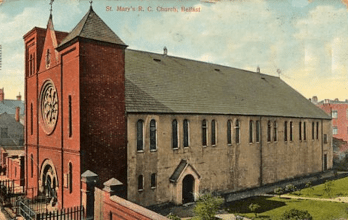
St. Mary’s Church, Belfast, a Roman Catholic church located in Chapel Lane/Smithfield area of Belfast, Northern Ireland, opens for public worship on May 30, 1784. It is mother church for the city. At the time, it is the only Roman Catholic church in the then town of Belfast after the relaxation of some of the Penal Laws. The church grounds contain an undistinguished grotto dedicated to Our Lady of Lourdes.

In the census of 1782, there are only 365 Catholics recorded living in Belfast. Following a collection from the local Church of Ireland and Presbyterian congregations, funds are donated to the building of St. Mary’s Church.

The first Mass is celebrated on Sunday, May 30, 1784, by Father Hugh O’Donnell, the first Parish Priest of Belfast. In the opening ceremony, a company of the Irish Volunteers line the chapel yard and escort Father O’Donnell into the building.

In 1813, the church’s pulpit is donated by the Anglican Vicar of Belfast, Canon Turner, continuing the positive relationship between the Roman Catholic church and the local Protestant congregations. Later, in 1815, St. Patrick’s Church is built to accommodate the growing Catholic population of the city.

As Belfast’s Catholic population grows after the famine, the church is deemed too small and thus architect John O’Neill is contracted to design a church big enough for the burgeoning congregation. Although none of the original church can be seen, in 1868 the church is enlarged and renovated into a new Romanesque style building.

In the Marian Year of 1954 a Grotto to Our Lady of Lourdes is established under the auspices of the then Administrator, Fr. Bernard MacLaverty, an uncle of the Belfast novelist of the same name. The grotto is created in the gardens surrounding the church by the Belfast architect Padraic Gregory.

To mark the bicentenary the sanctuary is renovated in 1983 with work by artist Roy Carroll, a favourite of Cahal Daly. Much of this timber furniture is later removed after Daly’s departure from the Diocese of Down and Connor.

In May–August 2017, the church undergoes substantial renovation work to repair the roof and walls, and to repave the grotto area.

For almost forty years the church is served by clergy from the Mill Hill Fathers, the last of whom leave in 2019. The current Administrator is Fr. Timothy Bartlett assisted by a range of retired clergy. The church holds two masses a day on Sunday and Monday, and three a day on Friday and Saturday. The 6:00 p.m. Mass on both Friday and Saturday are held in the Irish language.

Leave a comment

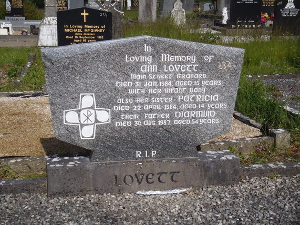
Death of Ann Lovett & Her Newborn Son

OLYMPUS DIGITAL CAMERA

Ann Lovett, a 15-year-old schoolgirl from Granard, County Longford, dies on January 31, 1984, while giving birth beside a grotto. Her baby son dies at the same time and the story of her death plays a huge part in a seminal national debate in Ireland at the time on women giving birth outside marriage.

Tuesday, January 31, 1984, is a cold, wet, winter’s day in Granard. That afternoon, the fifteen-year-old schoolgirl leaves her Cnoc Mhuire Secondary School and makes her way to a Grotto dedicated to the Virgin Mary at the top of her small hometown in the Irish midlands. It is here beneath the statue of Our Lady, that she gives birth, alone, to her infant son.

At around 4:00 PM some children on their way home from school see Ann’s schoolbag on the ground and discover her lying in the Grotto. They alert a passing farmer who rushes to the nearby priest’s house to inform him of the chilling discovery of Ann and her already deceased baby in the adjacent grotto. The priest’s response to his request for help is “It’s a doctor you need.”

Ann, still alive but hemorrhaging heavily, is carried to the house of the Parish Priest from where a doctor is phoned. She is then driven in the doctor’s car to her parents’ house in the centre of the town. By the time an ambulance arrives it is already too late.

Ann Lovett and her child are quietly buried three days later in Granardkill cemetery.

An inquest is held in Mullingar, County Westmeath, a few weeks later and finds that Ann’s death is due to irreversible shock caused by hemorrhage and exposure during childbirth. The inquest also confirms that, contrary to claims emanating from the local community, some people did indeed know about Ann’s condition before her death. Subsequent inquiries by the Gardaí, the Department of Education and the Midlands Health Board have yet to be published leaving the tragic events of that day and the circumstances that forced a young girl to leave her classroom on a cold, wet winters day to give birth alone in a grotto, still shrouded in uncertainty.

Ann Lovett’s death comes just four months after the outcome of a divisive abortion referendum in which a two-thirds majority vote to enshrine the right to life of the unborn in the constitution, creating confusion over where that leaves the rights of the mother. In the ensuing public debate, the tragic events at Granard become symbolic of the emerging clash between church and state.