seamus dubhghaill

Promoting Irish Culture and History from Little Rock, Arkansas, USA


Leave a comment

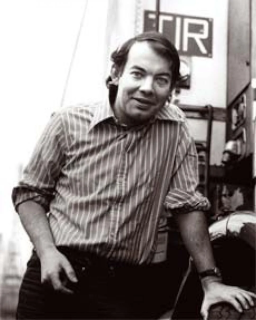
Birth of Bill Graham, Rock Journalist & Author

Bill Graham, Irish rock journalist and author, is born in Belfast, Northern Ireland, on August 29, 1951. He attends Blackrock College and Trinity College, Dublin. In addition to authoring several books, he writes for Hot Press magazine from its founding.

Graham’s long time colleague and Hot Press editor Niall Stokes describes him, “In many ways, he was a founding father of modern Irish music. He inspired a whole generation of Irish fans and musicians to look at the world in a different and broader light. And he was good on more than music too. He felt a kinship with Northern Ireland and the people on both sides of the sectarian and political divide there that was unusual in those who were brought up within the narrow confines of the culture of Ireland in the ‘60s and ‘70s – and his political writing reflected this. And he was also ahead of the game in terms of his appreciation of the importance of the politics of food and the position of the developing world in the new era.”

Graham is instrumental in the formation of Irish rock band U2, having brought them to the attention of their manager Paul McGuinness. At an exhibition of early group photos, McGuinness remembers the role Graham played by introducing him to the band. Despite being widely known as the man who “discovered” U2, it is a title he disavowed. He writes enthusiastically about the band, giving them their first exposure. Both guitarist The Edge and Bono have explained Graham’s role in the band’s development.

John Waters observes that “It is often said that Bill ‘discovered’ U2. This is untrue. Bill created U2, through his enthusiasm for them. He gave them a reflection of their own possibilities and they only looked back that once.” Graham has a deep knowledge of virtually every form of popular and roots music. Waters goes on to credit him as “the first Irish writer to write about the connection between Irish political culture and Irish rock ‘n’ roll.”

A number of music critics/journalists have cited Graham as a primary influence, in some cases suggesting they got into the field as a direct result of his writing.

Graham dies of a heart attack at the age of 44 at his home in Howth, County Dublin, on May 11, 1996. His funeral draws many of the biggest bands from the world of Irish music including Clannad, Altan, U2, and Hothouse Flowers, along with singers Simon Carmody and Gavin Friday.
Leave a comment

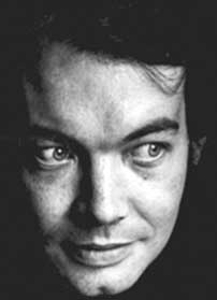
Death of Rock Journalist Bill Graham

Bill Graham, Irish rock journalist and author, dies of a heart attack at the age of 44 at his home in HowthCounty Dublin, on May 11, 1996. He attends Trinity College, Dublin. In addition to authoring several books, Graham writes for Hot Pressmagazine from its founding.

Graham’s long time colleague and Hot Press editor Niall Stokes describes him, “In many ways, he was a founding father of modern Irish music. He inspired a whole generation of Irish fans and musicians to look at the world in a different and broader light. And he was good on more than music too. He felt a kinship with Northern Ireland and the people on both sides of the sectarian and political divide there that was unusual in those who were brought up within the narrow confines of the culture of Ireland in the ‘60s and ‘70s – and his political writing reflected this. And he was also ahead of the game in terms of his appreciation of the importance of the politics of food and the position of the developing world in the new era.”

Graham is instrumental in the formation of Irish rock band U2, having brought them to the attention of their manager Paul McGuinness. At an exhibition of early group photos, McGuinness remembers the role Bill Graham played by introducing him to the band. Despite being widely known as the man who “discovered” U2, it is a title he disavowed. He writes enthusiastically about the band, giving them their first exposure. Both guitarist The Edge and Bono have explained Graham’s role in the band’s development.

John Waters observes that “It is often said that Bill ‘discovered’ U2. This is untrue. Bill created U2, through his enthusiasm for them. He gave them a reflection of their own possibilities and they only looked back that once.” Graham has a deep knowledge of virtually every form of popular and roots music. Waters goes on to credit him as “the first Irish writer to write about the connection between Irish political culture and Irish rock’n’roll.”

A number of music critics/journalists have cited Graham as a primary influence, in some cases suggesting they got into the field as a direct result of his writing.

Bill Graham’s funeral draws many of biggest bands from the world of Irish music including ClannadAltan, U2, and Hothouse Flowers, along with singers Simon Carmody and Gavin Friday.


Leave a comment

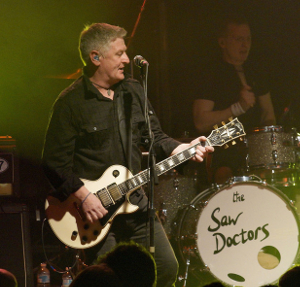
Birth of Davy Carton, Co-Founder of The Saw Doctors

Davy Carton, singer, songwriter, and rhythm guitarist, is born in IslingtonLondon, on April 10, 1959. He is best known as a core member of The Saw Doctors, the folk-rock band he co-founds with Leo Moran and others in 1987.

Carton moves permanently to TuamCounty Galway, with his family in 1966. As a teenager he attends Tuam’s Christian Brothers school, where he forms the punk band Blaze X with fellow students Paul Cunniffe, Paul Ralph, and Ja Keating. He works in a local textile factory after leaving school but continues to play with Blaze X until the band dissolves in 1981, the year Carton marries his girlfriend, Trisha.

Working full-time in the textile factory throughout Ireland’s economically bleak 1980s, Carton largely puts his musical career on hold to support his wife and three young sons.

In the late 1980s, Carton gets together for a pint with Leo Moran, formerly of Irish reggae band Too Much for the White Man. Carton and Moran begin gigging around Galway with a handful of their own rootsy-rock compositions.

The duo adopts the name Saw Doctors — travelers who earn money by sharpening saws in old Ireland — until they can think of something better. As the band grows, the opportunity to find a better name never arises.

Carton finally gives up his day job in 1989, when the Saw Doctors rise to prominence and begin touring with bands including The WaterboysHothouse Flowers, and The Stunning.

Carton’s achievements with the Saw Doctors include six studio albums, two live albums, a concert DVD, several compilation albums, and extensive tours throughout Europe and the United States. Noted for his witty, rapacious lyrics, Carton has co-written almost all of the band’s songs, including “I Useta Lover,” one of the all-time best-selling singles in Ireland.

The Saw Doctors’ lyrics tend to stay out of political issues. “I’m not a politician, and I never will be a politician,” Carton tells the website PopMatters in 2003. “What I like to do is go into a room of people and make them sing along and whatever. I’m not going to tell them how to vote – there’s enough people doing that already. I’d rather talk about girlfriends and football. We don’t like to write about things we don’t really know about. We know about rejection from girls and all that, so we can write about that.”


Leave a comment

Birth of Maria Josephine Doyle Kennedy, Singer & Actress

maria-doyle-kennedy

Maria Josephine Doyle Kennedy, singer, songwriter, and television/film actress, is born in Clontarf, Dublin, on September 25, 1964. With a singing career that has spanned nearly thirty years and an acting career that has spanned twenty-five, she has established herself as one of Ireland’s most prolific artists and entertainers.

Although Doyle Kennedy exhibits a love for singing at an early age, she never considers a formal career in singing until after she graduates from Trinity College, Dublin with a joint honours degree in political science and business. She never considers becoming an actress until after she establishes herself as a singer.

Doyle Kennedy joins a band while still in college in the mid-80s, performing with Hothouse Flowers during the band’s early years. She leaves the band in order to join The Black Velvet Band with her future husband, Kieran Kennedy. The band releases their first album, When Justice Came, in 1989 which reaches number 4 on the Irish charts and is ranked among the best Irish albums of the late 1980s. Doyle Kennedy leaves the group to pursue a career in solo music and, in 2001, releases music on Mermaid Records, a label she founds herself in 2000.

After the release of her alternative folk album Mütter in 2007, Hot Press states that Doyle Kennedy “is one of the finest voices this country has ever produced.” She is subsequently nominated in the Best Irish Female category at the 2008 Meteor Awards.

Doyle Kennedy’s first experience with acting comes in 1991 when she plays Natalie Murphy in The Commitments. She continues to expand her acting platform with roles in John Boorman‘s 1998 film, The General, Alan Bleasdale‘s 1999 miniseries Oliver Twist, and the 1999 British television series Queer as Folk.

In 2007 and 2008, Doyle Kennedy receives widespread recognition for her role as Catherine of Aragon on the British historical fiction television series The Tudors. In 2011 she joins the cast of ITV‘s period drama Downton Abbey, appearing as Vera Bates, estranged wife of the Earl of Grantham’s valet, one of her most recognizable roles within the United Kingdom. In the same year, she also plays a small role as a maid in the film Albert Nobbs, alongside American actress Glenn Close.

In 2012, she plays a leading role in the ITV mini-series Titanic and also appears beside fellow Irish actress Saoirse Ronan in Neil Jordan‘s horror fantasy film Byzantium, which premieres at the 2012 Toronto International Film Festival. She appears in The Conjuring 2, the 2016 sequel to the supernatural horror film The Conjuring.