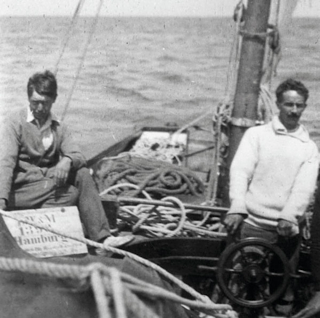
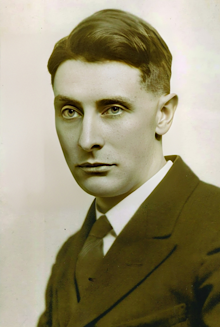
On May 28, 1914, Childers and Figgis travel to Hamburg, Germany, to buy 1,500 Mauser rifles and 49,000 rounds from arms dealer Moritz Magnus, Jr. The rifles, though obsolete, are still serviceable and fire a high-caliber round. To transport them, Childers offers his yacht Asgard to carry 900 rifles, while Conor O’Brien takes the rest on the Kelpie.
The Asgard, a 50-foot gaff ketch built by Colin Archer, leaves Conwy, North Wales, on July 3. The outward journey is uneventful, but the return is stormy, with the rifles filling the cabin and crew sleeping on them. On July 12, the yacht meets the German tug Gladiator at the mouth of the Scheldt, loading the arms.
On July 26, the Asgard reaches Howth. The unloading in daylight draws a crowd, prompting police and military intervention. A riot erupts, and the King’s Own Scottish Borderers are ambushed at Bachelor’s Walk, resulting in the Bachelor’s Walk massacre — four civilians killed and at least 38 wounded. Despite the violence, the guns are secured.
The Howth gun-running is the first major military operation in Ireland’s 20th-century independence movement. The rifles are later used in the Easter Rising of 1916, including at the General Post Office. The event underscores the role of Anglo-Irish republicans in arming the Volunteers and foreshadows the armed struggle that follows.
In short, July 26, 1914, marks the arrival of a critical arms shipment in Howth, a bold act of defiance against British control and a direct response to Ulster’s gun-running, with lasting consequences for Irish history.
(Pictured: Erskine Childers at Asgard’s wheel on her 1914 gun-running voyage)
Born at Hillside Terrace in Howth, County Dublin, on May 5, 1898, Gilmore is the second son of Philip Gilmore, an accountant originally from County Antrim, and Fanny Angus. Despite his father primarily working for Unionist landlords, and being educated at home, George and his brothers Harry and Charlie all turn toward Irish republicanism. By 1916, Gilmore has become a member of Fianna Éireann, the Republican boy scouts, and later a member of the South County Dublin battalion of the Irish Volunteers.
Gilmore fights in the Irish Republican Army in the Irish War of Independence and in the Irish Civil War on the Anti-Treaty IRA side. During the civil war he is captured and imprisoned, but manages to escape custody in August 1923, the aftermath of which causes riots as the remaining prisoners are placed in solitary confinement.
Following the end of the civil war, Gilmore serves as the secretary of future TaoiseachSeán Lemass, as well alongside Frank Aiken. During the early 1920s, he, Lemass and Aiken regularly meet with the IRA army council to represent the emerging political leadership of Irish republicanism that coalesces as Fianna Fáil in 1926. The trio regularly sits opposite IRA leaders Frank Ryan, Peadar O’Donnell, and Seán Russell.
In October 1925, Gilmore and Lemass organise the escape of nineteen IRA prisoners from Mountjoy Prison in Dublin. As part of the jailbreak, Gilmore impersonates a member of Garda Síochána. None of the nineteen escapees are subsequently recaptured, and their escape serves as a major propaganda coup. However, the following month, Gilmore is involved in a riot that takes place on Armistice Day and he is subsequently arrested and sentenced to eighteen months in prison. He resists the entire duration; first resisting the arrest and then, once imprisoned, refusing to wear a prison uniform and going on hunger strike. Early in 1928, members of the IRA attack Mountjoy Prison where he is being held and shoot the warden after a story emerges that Gilmore had previously been the victim of a vicious beating by the guards. He is released in 1929 but re-arrested and re-imprisoned almost immediately, resulting in a retaliatory beating by the guards that leaves him unconscious.
Sometime between 1929 and 1930, Gilmore is sent by the IRA to Russia to receive military training and to seek aid.
Gilmore is arrested yet again upon his return to Ireland in April 1931, charged with having resisted arrest ten months previously. In October he tries to escape with the help of his brother Charlie and almost succeeds, using a plot involving mock pistols wrapped in silver to intimidate the guards. In the aftermath of the failed escape, his treatment in Arbour Hill Prison from 1931-32 is abysmal. He once again refuses to wear prison clothing because of his political status and remains naked in a windowless cell from October 1931 until February 1932. In June 1931, of a cache of weapons are discovered near his home at Killakee in the Dublin Mountains, which results in him and his brother Charlie being placed before a military tribunal which sentences him to five years in prison and Charlie to three (in 1932 Fianna Fail comes to power and the brothers are released). Neither recognises the authority of the court, with George stating, “I do not want anybody to think I excuse myself for such a charge as having arms, I am admittedly hostile to British imperialism and international capitalism.”
Gilmore’s fortunes are dramatically altered when Fianna Fáil emerges victorious in the 1932 Irish general election. In the aftermath, Frank Aiken, former Chief of Staff of the IRA and new Minister for Defence goes to see Gilmore on March 9 and on the next day all republican prisoners are released as part of a general amnesty. Thirty thousand supporters greet the prisoners at College Green, Dublin.
Finally out of long-term imprisonment, Gilmore is eager to resume working toward a socialist Ireland. He has supported Peadar O’Donnell’s shortlived socialist republican group Saor Éire from prison, but in the aftermath of its demise, he concludes that the group has spent too much time imagining what it might do if in government, and not enough time considering what the immediate aims of the IRA should be. With his close personal ties to their leadership, Gilmore has a positive view of Fianna Fáil, and at this point in time believes their goals differ little from his own and those of the IRA. Nevertheless, He encourages the IRA to not become too closely associated with Fianna Fáil, fearing the IRA will become a subservient body. He himself has ascended to the IRA’s army council upon his release, and in March 1932 is among representatives of the Army Council that liaises with Éamon de Valera about a possible partnership between the IRA and Fianna Fáil.
On August 14, 1932, Gilmore and fellow Irish republican T. J. Ryan are beaten badly, shot and wounded by plain-clothes members the Garda Síochána (Criminal Investigation Department) in Kilrush, County Clare. This incident is blamed on the police by an official Tribunal of Inquiry report one month later.
In March 1934, Gilmore, alongside Frank Ryan and Peadar O’Donnell, refuse to continue on as members of the IRA executive as part of a deepening rift over the direction of the IRA. Left-wing members of the IRA such as Gilmore, Ryan and O’Donnell insist that the IRA needs to tie their activity to social agitation in addition to their military aims, but this is a minority viewpoint, with the majority believing the IRA should have a “strictly military” outlook. The rift ultimately spirals into Gilmore, Ryan and O’Donnell being court-martialed and expelled in April.
In the aftermath, Gilmore works with Roddy Connolly, Nora Connolly O’Brien and Peadar O’Donnell to found the Republican Congress, a left-wing socialist Irish republican group. The group breaks up in 1935 over internal differences. Gilmore, Ryan and O’Donnell believe that the Republican Congress should be a united front, an alliance of all republican groups in Ireland. Roddy Connolly and other members of the Communist Party of Ireland believe that the Congress should be a vanguard party. A conference is held by the Republican Congress in Rathmines, Dublin, in September 1934 to vote on the issue. Before the vote is taken, Gilmore gives a speech in which he accuses Fianna Fáil of using republicanism as a means to promote Irish capitalism. When the votes are taken on whether the Republican Congress should be a united front or a vanguard party, Gilmore’s united front faction wins. However, supporters of the vanguard party concept such as Roddy Connolly immediately resign from the Congress in protest and walk out on the group. It proves to be a blow that the Congress never recovers from and the group is defunct by 1936. Gilmore makes a last-ditch effort to save the Congress by traveling to the United States to seek funds from Irish American groups but is not successful.
Upon the outbreak of the Spanish Civil War in July 1936, Gilmore and O’Donnell become supporters of the International Brigades. Both men travel to Spain personally, during which they are involved in a plane crash and Gilmore’s leg is broken.
Following the outbreak of World War II in September 1939, Gilmore writes an appeal pleading with the IRA to dump arms until the war in Europe is over and denounces them for flirting with fascism by seeking aid from Germany.
During the 1960s, when the republican movement once again moves to the left, Gilmore and O’Donnell are once again in demand as speakers and as writers in republican publications. In 1966, for the 50th anniversary of the Easter Rising, Gilmore releases a pamphlet entitled “Labour and the republican movement” in which he espouses the principles of James Connolly. Additionally, he appeals to young republicans not to repeat the mistake older republicans had made in being too rigid in their views and too short on policy.
Gilmore dies on June 29, 1985, at the age of 87, in a nursing home in Howth, County Dublin.
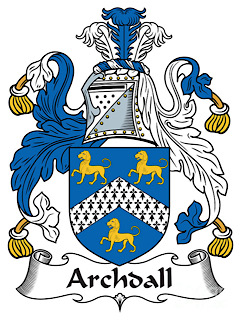
Archdall is educated by Dr. Keenane, and enters Trinity College Dublin (TCD) in 1739. He graduates with a Bachelor of Arts (BA) in 1744 and a Master of Arts (MA) in 1747, and is ordained in the Church of Ireland. He is curate of Howth from 1750 to 1753, and of Kilgobbin and Taney, also in Dublin, from 1753 to 1758, rector of Nathlash in the diocese of Cloyne from 1749 to 1758, and from 1756 domestic chaplain to Richard Pococke, Bishop of Ossory. In 1761 Pococke gives Archdall the livings of Agharney and Attanagh in Ossory which he holds until 1786, when he becomes rector of Slane in the Diocese of Meath. He is also prebendary of Cloneamary from 1762 to 1764 and of Mayne from 1764 to 1772, both in Ossory.
Archdall is interested, almost from his student days, in ancient history and antiquities, and for forty years he gathers material for a work similar to an earlier compilation, William Dugdale‘s Monasticon Anglicanum. He intends to publish two or more large folio volumes, but after Pococke’s death has no sponsor and has to pay for its publication himself causing him to cut back the scale of the project. Monasticon Hibernicum appears in 1786 as a quarto volume, though still of over 800 pages. Archdall attempts encyclopaedic coverage of the history of Ireland’s pre-reformation monasteries and abbeys. The work is ground-breaking and ambitious, though marred by mistakes and inadequacies. He receives help from friends, including scholars such as Pococke and Edward Ledwich, and with them and others is a founder member of the Royal Irish Academy (RIA) in 1786.
In 1789, Archdall publishes his second important work, a new edition of ThePeerageof Ireland by John Lodge. Lodge’s original work in four volumes is expanded by Archdall into seven octavos, adding a good deal of material from his own research to update the genealogies, as well as incorporating manuscript additions unpublished by the original author. These had been left in a cipher or in a private form of shorthand which could not be decoded by any contemporary expert in Dublin, and Archdall is just about to abandon the attempt to read them when his second wife works on it and discovers the key.
Archdall’s first wife, Sarah Colles or Collis, whom he marries in Dublin on July 30, 1747, is said to have been a relative of Thomas Prior, though she may also – or instead – have been connected in some way to Pococke. The bishop is known to have educated Christopher Colles (1739–1816), who becomes an important engineer and entrepreneur in the United States. They have two sons and a daughter, the elder son dying young. Sarah dies on May 28, 1782. Archdall marries his second wife, Abigail Young, on November 25, 1782.
Archdall’s works are still of interest to historians and genealogists, and surviving copies are valuable collectors’ items. In an apologia in his preface to the Peerage he notes, “I have left that inaccurate which could not be exact, and that imperfect which cannot be completed.” He dies suddenly on August 6, 1791, and is buried in Slane churchyard.
(From: “Archdall, Mervyn” by Linde Lunney, Dictionary of Irish Biography, http://www.dib.ie, October 2009)
Cruise O’Brien follows his cousin Owen into Sandford Park School, which has a predominantly Protestant ethos despite objections from Catholic clergy. He subsequently attends Trinity College Dublin (TCD) before joining the Irish diplomatic corps.
Although he is a fierce advocate of his homeland, Cruise O’Brien is a strong critic of Irish Republican Army (IRA) violence and of what he considers the romanticized desire for reunification with Northern Ireland. His collection of essays Maria Cross: Imaginative Patterns in a Group of Modern Catholic Writers (1952; written under the pseudonym Donat O’Donnell) impresses UN Secretary-GeneralDag Hammarskjöld, who in 1961 appoints him UN special representative in the Congo, later the Democratic Republic of the Congo. He orders UN peacekeeping forces into the breakaway Katanga province, and the resulting scandal forces him out of office. Despite UN objections, he writes To Katanga and Back (1963) to explain his actions.
After serving as vice-chancellor of the University of Ghana (1962–65) and Albert Schweitzer Professor of Humanities at New York University (1965–69), Cruise O’Brien enters Irish politics. He holds a Labour Party seat in Dáil Éireann from 1969 to 1977 and then in the Senate from 1977 to 1979, representing Trinity College, of which he is pro-chancellor (1973–2008).
In 1979, Cruise O’Brien is named editor in chief of the British Sunday newspaper The Observer, but he leaves after three tumultuous years. He remains an active newspaper columnist, especially for the Irish Independent until 2007. His books include States of Ireland (1972) and On the Eve of the Millennium (1995), as well as perceptive studies of Charles Stewart Parnell, Edmund Burke, and Thomas Jefferson.
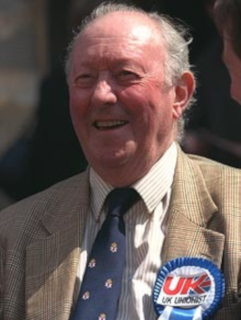
In early July 1996, in the period of Cruise O’Brien’s involvement as a UK Unionist Party (UKUP) representative in talks at Stormont, he suffers a mild stroke. He recovers well, but is left with anxiety about his recall of names. His last public appearance is on September 7, 2006, to deliver an address on the ninetieth anniversary of the death of Tom Kettle, in the old House of Lords chamber of the Bank of Ireland on College Green.
Banville is born to Agnes (née Doran) and Martin Banville, a garage clerk, in Wexford. He is the youngest of three siblings. He is educated at CBS Primary, Wexford, a Christian Brothers school, and at St. Peter’s College, Wexford. Despite having intentions of being a painter and an architect, he does not attend university. After school, he works as a clerk at Aer Lingus, which allows him to travel at deeply discounted rates. He takes advantage of these rates to travel to Greece and Italy. He begins working as a sub-editor at The Irish Press in 1969.
Banville publishes his first book, a collection of short stories titled Long Lankin, in 1970. His first novel, Nightspawn, appears in 1971, followed by his second, Birchwood, two years later. His The Revolutions Trilogy, published between 1976 and 1982, comprises works named after renowned scientists: Doctor Copernicus, Kepler and The Newton Letter. His next work, Mefisto, has a mathematical theme, and, in combination with the three books from The Revolutions Trilogy, is the fourth book from the “Scientific Tetralogy.” His 1989 novel, The Book of Evidence, begins The Frames Trilogy, dealing with the work of art. It is completed by Ghosts and Athena. His thirteenth novel, The Sea, wins the Booker Prize in 2005. In addition, he publishes crime novels as Benjamin Black, most of which feature the character of Quirke, an Irish pathologist based in 1950s Dublin. His alternative history novel, The Secret Guests (2020), is published under the name B. W. Black.
In 1969, Banville marries the American textile artist Janet Dunham, whom he met in San Francisco the previous year while she is a student at the University of California, Berkeley. The couple has two sons together. The marriage breaks down after Banville has an affair with a neighbour, Patricia Quinn, who subsequently becomes director of the Arts Council of Ireland. Banville has two daughters with Quinn, born around 1990 and 1997. Despite separating, Banville and Dunham never divorce and he describes them as remaining “on good terms.” Dunham dies at Blackrock Clinic on November 22, 2021, after which Banville states that he experienced “brain fog” due to grief and is unable to write for six months. In a 2024 interview, he expresses regret over his relationship history, saying, “I caused Janet such anguish. I have caused Patricia Quinn such anguish. I wasn’t good with my children. I was not a good parent. I am not a good person. I am selfish. But I have to have responsibility.”
Babington is called to the Irish Bar in 1900. He briefly lectures in Equity at King’s Inns, and it is during this time, in 1910, that he re-arranges and re-writes R.E. Osborne’s Jurisdiction and Practice of County Courts in Ireland in Equity and Probate Matters. He takes silk in 1917.
In 1947, Babington chairs the Babington Agricultural Enquiry Committee, named in his honour, which is established in 1943 to examine agriculture in Northern Ireland. The committee’s first recommendation under Babington’s leadership is that Northern Ireland should direct all its energies to the production of livestock and livestock products and to their efficient processing and marketing.
Babington retires from the judiciary in 1949, taking up the chairmanship of the Northern Ireland Transport Tribunal, which exists until 1967, established under the Ulster Transport Act – promoting a car-centred transport policy – and which is largely responsible for the closure of the Belfast and County Down Railway. He endorses the closure on financial grounds and is at cross purposes with his co-chair, Dr. James Beddy, who advises against the closure, citing the disruption of life in the border region between the north and the south as his primary reason in addition to financial grounds.
Babington also chairs a government inquiry into the licensing of clubs, the proceeds of which results in new regulatory legislation at Stormont. While Attorney General, he is a proponent of renaming Northern Ireland as “Ulster.”
Babington is critical of the newly proposed Irish constitution, in which the name of the Irish state is changed to “Ireland,” laying claim to jurisdiction over Northern Ireland.
Michael McDunphy, Secretary to the President of Ireland, then Douglas Hyde, recalls Ernest Alton‘s correspondence with Babington on the question of Irish unity, in which Alton and Babington are revealed to be at cross purposes. The discussion is used as an example by Brian Murphy, in Forgotten Patriot: Douglas Hyde and the Foundation of the Irish Presidency, as an example of the office of the Irish President becoming embroiled in an initiative involving Trinity College Dublin and a senior Northern Ireland legal figure, namely Babington.
Babington writes to Alton, then Provost of Trinity College, Dublin, expressing his view that, as Murphy summarises, “… Severance between the two parts of Ireland could not continue, that it was the duty of all Irishmen to work for early unification and that in his opinion Trinity College was a very appropriate place in which the first move should be made.” When Alton arrives to meet with Hyde, it emerges, after conversing with Hyde’s secretary McDunphy, that he and Babington are at cross purposes. “It soon became clear that the united Ireland contemplated by Mr. [sic] Justice Babington of the Northern Ireland Judiciary was one within the framework of the British Commonwealth of Nations, involving recognition of the King of England as the Supreme Head, or as Dr. Alton put it, the symbol of unity of the whole system,” writes McDunphy.
Babington is a keen golfer. He is an international golfer from 1903 to 1913, during which he is runner-up in the Irish Amateur Golf Championships in 1909 and one of the Irish representatives at an international match in 1913. The Babington Room in the Royal Portrush Golf Club is named after him, as is the 18th hole on the course as a result of the key role he plays in shaping its history.
Babington dies at the age of 94 on April 10, 1972 at his home, Creevagh, Portrush, County Antrim.
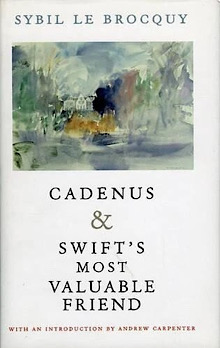
She is born Helen Mary Sybil Staunton on December 21, 1892, in Herbert Street, Dublin, to Dorothy Eleanor Redington and Peter Maurice Staunton. Her father is a barrister who later becomes a solicitor. Though he moves to Aram Lodge, Castlerea, County Roscommon where he practises law, she grows up in Dublin and Howth, going to secondary school in Loreto Abbey, Rathfarnham, and later at Loreto Convent, St. Stephen’s Green. She goes on to study German and singing in Koblenz. She marries Albert le Brocquy on December 30, 1915, and settles in Dublin. They have three children, Louis, Noel and Melanie.
Le Brocquy becomes involved in various women’s movements, helping to organise the Women’s International League for Peace and Freedom in July 1926. She is involved with the League of Nations Association as well as helps to establish Irish Civil Rights, PEN International, and Amnesty International in Ireland. She is an active member of Old Dublin Society and for a time president of the Irish Women Writers’ Society. She acts with the Drama League appearing as Helen Staunton. She writes plays and dramatic pieces which are staged by the Drama League at the Abbey Theatre and broadcast by Radio Éireann.
Her writings and work are often historically investigative, finding W. B. Yeats’s birthplace and arguing that Jonathan Swift had a child by Vanessa. She is involved in the Swift Tercentenary celebrations with Cearbhall Ó Dálaigh. As a result of her work, including with Trinity College Dublin Library and representing the Library on the Royal Irish Academy’s National Committee for Anglo-Irish Literature, she is co-opted to the Cultural Committee of the Department of External Affairs and appointed a Trustee of the National Library of Ireland. She is an excellent organiser and fundraiser and is heavily responsible for securing money for the Gate Theatre, Dublin, in 1970. She also initiates the literary prize, the Book of the Year award.
Le Brocquy becomes ill with an undiagnosed illness and dies on September 4, 1973, at the Meath Hospital, Dublin.
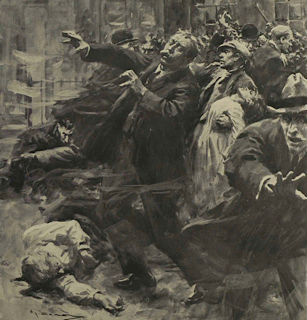
The Bachelor’s Walk massacre occurs in Dublin on July 26, 1914, when a column of troops of the King’s Own Scottish Borderers is accosted by a crowd on Bachelor’s Walk following the Howth gun-running operation. After some verbal baiting, the troops attack “hostile but unarmed” protesters with rifle fire and bayonets, resulting in the deaths of four civilians and injuries to in excess of 30 more. The four killed are Mary Duffy (50), Patrick Quinn (50), James Brennan (18) and Sylvester Pidgeon (40) who succumbs to his wounds on September 24. One of those shot is Luke Kelly, the father of folk singer Luke Kelly.
The events follow the landing of 1,500 rifles and ammunition, purchased for the Irish Volunteers in Hamburg, Germany, in May 1914. In a counter operation to the Unionistsrunning guns into Ulster, Erskine Childers lands the cargo in Howth, County Dublin, and a thousand rifle-carrying Irish Volunteers marched into Dublin. The quantity is negligible when compared to the far greater numbers of weapons landed and distributed by the Ulster Volunteers, completely without hindrance, but the reaction this time is severe from the British ruling authorities.
The incident proves a moment of political opportunity for Irish nationalists as it sharply brings out the different treatment for the Unionists and for unarmed Dublin civilians. Patrick Pearse declares, “The army is an object of odium, and the Volunteers are the heroes of the hour. The whole movement, the whole country, has been re-baptised by bloodshed for Ireland.”
Mary Jennifer Guinness, English-born Irish socialite, member of the Guinness family and victim of a notorious 1986 kidnapping that lasts eight days, passes away peacefully at home on January 23, 2016, after a long battle with cancer. She is surrounded by her family, son Ian and daughters Gillian and Tania and long-term partner Alex Booth.
Guinness is born in England on August 22, 1937. On April 9, 1959, she marries merchant bankerJohn Henry Guinness, a member of the Guinness brewing dynasty and chairman of Guinness Mahon. She is predeceased by her husband, who dies two years after the kidnapping in 1988.
“She had been sick for a long time. We will remember her as a most loving mother,” her son Ian says.
Guinness had been an enthusiastic sailor and member of Howth Yacht Club. “It is with great sadness that the Commodore and Officers of Howth Yacht Club have to inform members of the passing of esteemed member Jennifer Guinness,” a posting on the club website says.
Guinness, at the age of 48, makes headlines around the world after she is abducted from her luxury home in Howth, Dublin on April 8, 1986, by three masked gunmen armed with an Uzisubmachine gun. They pistol-whip her husband and demand a £2.m ransom from him.
She is held for eight days in five various locations and is forced into the boot of a car and a cardboard box during her ordeal. She is also chained to a tree and a bed and at one point, even handcuffed to one of her captors. She is eventually rescued by Garda Síochána from a house on Waterloo Road in Ballsbridge following an all-night standoff with the kidnappers.
It does not take long for her kidnappers to be brought to justice. The following June, John “The Colonel” Cunningham is sentenced to seventeen years in prison, alongside his brother Michael Cunningham, who gets fourteen years. The notorious brothers, who have strong links with the gang led by Martin “The General” Cahill, are behind a string of armed robberies in the 1970s.
Michael Cunningham, who is released from prison in 1995, dies of a heart attack in January 2016. His brother escapes from the Shelton Abbey Prison in 1995 but is tracked down in Holland in 2000 where he serves four years in prison on drug charges before being extradited to Ireland in 2004 to serve out the rest of his sentence. He is released in 2007 and moves to Spain.
After her kidnap ordeal, Guinness says that she never gave in to despair during her eight-day ordeal. “I had no doubt at all, most of the time, that my life was in danger,” she says during a news conference, “but I couldn’t afford to allow myself to lose hope.”
When asked what kept her going during her captivity, Guinness says, “A certain amount of anger, a lot of determination and just a conviction that they weren’t going to get to me.” She draws laughter from reporters when she says, “I kept saying, ‘You’ve got the wrong branch of the family. John’s a banker, but two million is not our style of life.'”
Investigating Gardai praise her courage. Superintendent Frank Hanlon says she was “a considerable asset toward the ending of this incident through her advice to all parties.”
(From: “Jennifer Guinness – victim of a notorious 1986 kidnapping that lasted eight days – has died” by Jerome Reilly, Irish Independent, http://www.independent.ie, January 23, 2016)
O’Brien is a ship builder and designer, and his notable boats include the Kelpie (used for gun running in 1914), the Saoirse (in which he circumnavigates the globe) and the Ilen (a Falkland Islands service ship).
O’Brien is credited with two buildings in his lifetime: the Co-operative Hall in County Donegal and the People’s Hall in County Limerick. He is also known as a naval architect, having designed two ships, the Saoirse and the llen. He later captains both of these ships himself.
In Saoirse, a 20-ton, 42-foot ketch designed and built in 1922 in Baltimore, County Cork, he and three crew members circumnavigate the globe between 1923 and 1925 – the first recorded by an amateur skipper from west to east, the first yacht circumnavigation by way of the three great capes: Cape Horn, Cape of Good Hope and Cape Leeuwin, and the first boat flying the Irish tri-colour to enter many of the world’s ports and harbours. His voyage begins and ends at the Port of Foynes, County Limerick, where he lives. His account of the voyage, Across Three Oceans, (1927) becomes one of the classics of maritime literature.
Up until O’Brien’s circumnavigation, this route is the preserve of square-rigged grain ships taking part in the grain race from Australia to England via Cape Horn (also known as the clipper route).
O’Brien’s seagoing experiences are put to use in his design of the Ilen, which is built for the Falkland Islands as a service boat and launched in the spring of 1926. In 1998, Ilen returns to the site where she was first built, on the River Ilen near Baltimore, County Cork, where she undergoes a full restoration and is re-launched in May 2018. This task provides work-based learning for the students of the Ilen School.
O’Brien has some involvement with gun running in 1914 on behalf of the Irish Volunteers, for political reasons and because he has experience in sailing. On July 26, 1914, nine hundred guns are brought to Howth harbour aboard Erskine Childers‘ yacht Asgard. As part of the same operation, O’Brien transports arms on his yacht, Kelpie. The guns on Kelpie are transshipped to another yacht, Chotah, owned by Sir Thomas Myles, before being landed at Kilcoole in County Wicklow on August 1, 1914. After the gun running incidents, he serves in the Royal Naval Volunteer Reserve.
In 1928, O’Brien marries a well-known artist, Kathleen Francis, the youngest daughter of Sir George Clausen, RA. The couple thereafter moves to Ibiza, where they live on the Saoirse until Kathleen’s death in 1936. They have no children. Relocating to Cornwall, where he lives with his sister, he writes books on sailing and works of fiction for children. Although too old for active service when war with Germany breaks out in 1939, he assists the British war effort by serving in the Small Ships Pool, which delivers support vessels across the Atlantic and brings food supplies from the United States in private yachts.
In 1940 O’Brien sells Saoirse to the Royal Cornwall Yacht Club. The boat remains in use until 1980, when it is lost off the Jamaican coast. After the war he retires to another sister’s home in Foynes, County Limerick, where he lives and continues to write books for children until his death on April 18, 1952.